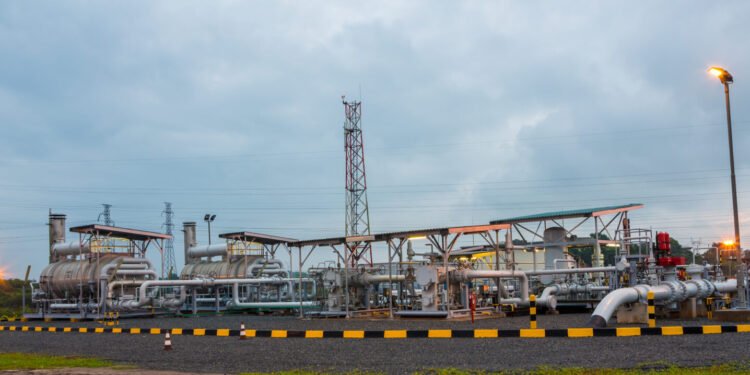
Nigeria’s gas production recorded a marginal decline in May 2025, according to the latest Monthly Report Summary released by the Nigerian National Petroleum Company Limited (NNPC).
The report shows that daily gas output dropped to 7.352 billion standard cubic feet per day (bscfd), slightly down from 7.354 billion bscfd in April.
Despite the minor dip in production, the NNPC reported improved earnings for the month, with total revenue rising to N6.008 trillion, compared to N5.972 trillion in April. This gain was supported by modest improvements in crude oil and condensate output, indicating continued efforts to stabilize upstream operations.
“On strategic efforts, we progressed technical interventions for the AKK pipeline to resolve challenges around the River Niger crossing and are conducting detailed evaluations on the OB3 River Niger Crossing to determine the best project execution path.”
Nigerian National Petroleum Company Limited (NNPC)
Gas sales also reflected a downward shift, dipping from 4.240 billion bscfd in April to 4.185 billion bscfd in May.

Industry observers have pointed to intermittent infrastructure constraints and pipeline integrity issues as contributing factors, though upstream pipeline availability remained high at 98%.


The NNPC emphasized ongoing progress on two major gas infrastructure projects—the Obiafu-Obrikom-Oben (OB3) pipeline and the Ajaokuta-Kaduna-Kano (AKK) pipeline.
The OB3 pipeline is reportedly 96% complete, an important milestone for enhancing domestic gas delivery and linking eastern and western supply networks.
The AKK project, a flagship national energy corridor, is now 81% complete, with technical interventions underway to address engineering challenges at the River Niger crossing.
NNPC said, “These projects are central to unlocking gas-based industrialisation and improving power supply,” adding that the company remains committed to delivering them despite logistical and environmental hurdles.
Downstream Setbacks: Retail Fuel Supply Declines

While upstream indicators remained steady, downstream performance weakened notably in May. Fuel availability at NNPC Retail Limited stations fell to 62%, down from 70% in April, based on internal tracking data.
The is attribute to the decline to logistics challenges, reduced inventory in some regions, and the effects of subsidy-free pricing adjustments introduced earlier in the year. The reduction may also signal bottlenecks in product distribution, raising concerns about sustained supply reliability.
The report outlined a series of turnaround maintenance activities conducted in May, targeting vital midstream and upstream infrastructure.
Notable projects completed during this period include work on the Trans Escravos Pipeline, the Opuama Flow Station (OML 40), and the Obigbo and Agbada Flow Stations (OML 17).
These interventions are part of the company’s strategic plan to reduce downtime, improve operational efficiency, and enhance crude and gas delivery across its network.
Regarding Nigeria’s long-stalled refinery rehabilitation agenda, the NNPC disclosed that works on the Port Harcourt and Warri refineries are “currently under review.”
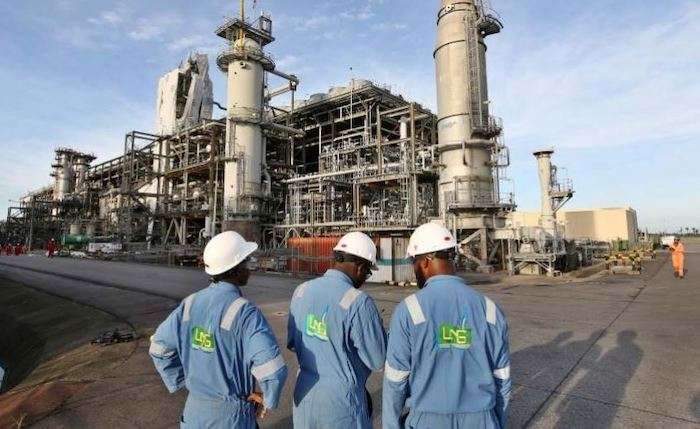
The lack of a definitive update raises questions about progress timelines and cost efficiency amid broader national fuel security goals.
While revenue growth and infrastructure milestones offer positive signs, the May 2025 performance snapshot underscores Nigeria’s delicate energy balancing act. Minor production and sales fluctuations could compound into larger economic or supply chain issues if not managed proactively.
The ongoing execution of strategic projects such as the OB3 and AKK pipelines is expected to enhance gas evacuation, stimulate industrial development, and boost power reliability.
However, logistics inefficiencies in fuel distribution and continued refinery delays threaten to erode gains in other parts of the value chain.
In the coming months, attention will remain focused on how NNPC and its partners address these dual imperatives delivering infrastructure on time while stabilizing downstream supply under a market-driven pricing regime.
READ ALSO: Mastercard and Access Bank Unveil Innovative Age-Segmented Card to Empower Ghana’s Youth