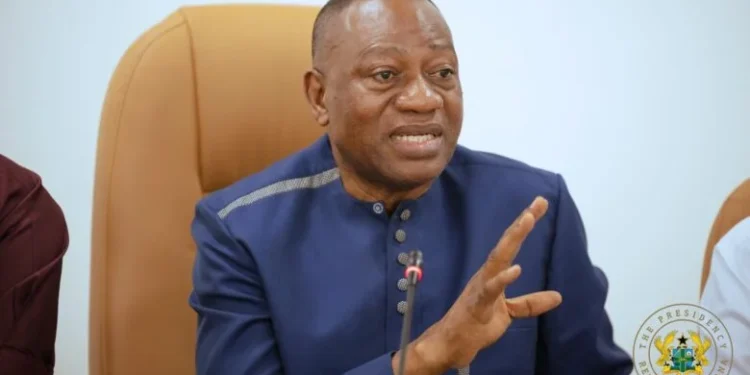
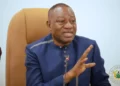
Samuel Atta Akyea, lead counsel in the trial of former Director General of the National Signals Bureau, Kwabena Adu Boahen, has expressed outrage at the conduct of proceedings, accusing the judiciary and the Attorney General’s office of operating in what he called an “ambulance mode” aimed at swiftly jailing the accused.
He refused to withdraw this characterisation despite the court’s disapproval, insisting that it accurately reflected the pace and attitude of the prosecution and the court.
“I will never withdraw that. I believe that because it is as if we are in an ambulance mode to get these people jailed so I will never withdraw it”
Samuel Atta Akyea, Lawyer
Speaking to journalists, Atta Akyea said he had observed a pattern that suggested undue haste in the trial. According to him, this urgency appeared orchestrated by the Attorney General and endorsed by the judge, leaving his clients at a disadvantage.
He claimed that the trial proceedings have ignored essential procedural fairness, arguing that judicial deference to the Attorney General undermines the constitutional rights of the accused, and warned that justice may be sacrificed in the rush to secure a conviction.

“That’s my sense of things, because even where we should wait for a motion to be heard, the Attorney General is in no mood to even respect the rules and the judge will just respect what he’s saying and obey it”
Samuel Atta Akyea, Lawyer
Adu Boahene’s lawyer maintained that the Attorney General’s office had effectively assumed control of the courtroom, with little to no pushback from the presiding judge, who often yielded to the prosecution’s preferences at the expense of the defence.
He stressed that this was not simply about minor procedural disagreements, but about the erosion of constitutional protections. He warned that if the trend continued, the end result would be unjust convictions based on an imbalanced process.


“I’ve seen several things in the court which are telling me that the Attorney General is having his own way,” Atta Akyea said.
Dismissal of Counterarguments
Atta Akyea dismissed claims that the court had made allowances for the defence, such as upholding objections or granting adjournments. He contended that these concessions were trivial and did not reflect the broader issues of fairness and equality.
He explained that motions had been scheduled for hearing on July 29 and 30, but the Attorney General requested that they be bypassed so that the main case could resume the following week. According to him, the Attorney General was obliged and this request was granted without proper consideration for the defence’s rights.
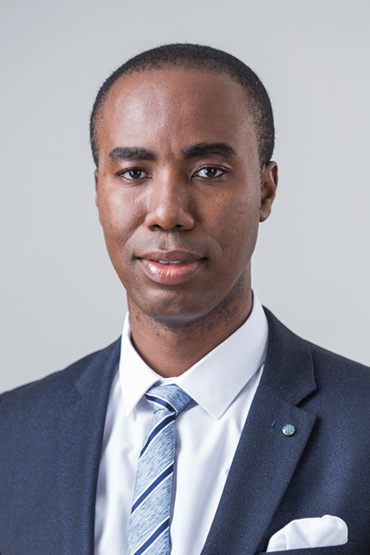
The defence is currently pursuing two key applications before the court – one seeking additional disclosures and another calling for a stay of proceedings.
Atta Akyea argued that full access to evidence is necessary for the defence to mount an effective challenge, especially regarding allegations of property acquisition abroad.
“I want them to see the necessity to look at whether or not somebody acquired a property in London at what time and with what money.
“So if you can’t show the nexus between the property acquisition and the so-called account from which these monies were fretted out, then you have a very poor case”
Samuel Atta Akyea, Lawyer
He questioned why the Attorney General was able to submit documents from the National Security Coordinator while denying access to other materials relevant to the defence. “Where did he get it from?”
He argued that evidence held by national security or investigative bodies should not be treated as inaccessible, especially if it can assist the accused.
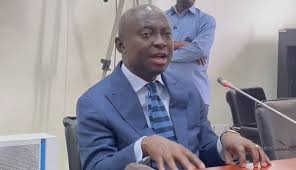
“So we shouldn’t confuse facts and say that if it’s in your possession, it means it’s in your armpit, because we can commandeer it.
“These are constitutional provisions. These are not matters of anybody’s invention. Why are we subverting the constitution with such impunity?”
Samuel Atta Akyea, Lawyer
Trial Fairness
Atta Akyea invoked constitutional principles, arguing that justice cannot be achieved if evidence critical to the defence is withheld. He accused the prosecution of breaching these principles and warned of the long-term consequences for judicial integrity.
“As if we are in an indecent haste to get somebody in prison. That’s my sense of what is going on,” he lamented, reiterating his belief that the trial was being conducted in a manner designed to secure a conviction without fair opportunity for the defence to respond.
He cautioned the court not to prioritise speed over substance, especially when critical materials are still being contested in the Court of Appeal.
“At the end of the day, if you hurry this trial and what the accused persons need for cross-examination and defence is not available, you’ve shortchanged them in an irreparable way”
“That somebody is going to go to jail because concealing evidence is comfortable with the Attorney General – that is unfair”
Samuel Atta Akyea, Lawyer
READ MORE: Trade Surplus Hits $5.6 Billion as Ghana’s External Sector Flexes Muscle Ahead of July MPC Decision