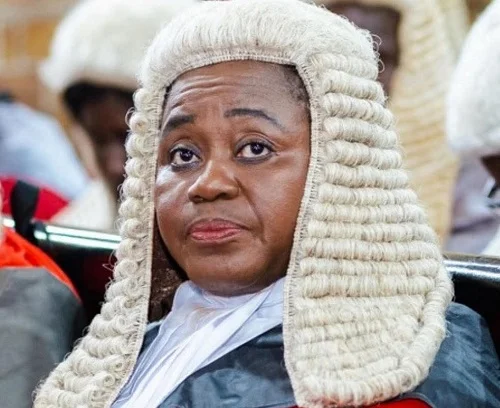
The Ghana Bar Association (GBA) is facing mounting criticism over its recent condemnation of the removal of former Chief Justice Gertrude Torkonoo, with legal expert Prof. Stephen Kwaku Asare calling out what he describes as the association’s double standards on Article 146.
Speaking as a Democracy and Development Fellow at CDD-Ghana, Prof. Asare highlighted that the GBA’s current position sharply contrasts with its own actions in the past.
He recalled events from 1995, when the GBA itself attempted to oust then-Chief Justice I.K. Abban. At the time, rather than invoking Article 146—which the Constitution specifies as the only legal process for the removal of a Chief Justice—the GBA filed its case under Article 2.
Prof. Asare explained that the association argued that Justice Abban did not meet the constitutional requirement of “high moral character and proven integrity” as stipulated in Article 128(4).
“The Supreme Court immediately saw through that maneuver. It held that the GBA’s action was nothing more than an attempted removal through the back door. The Court threw the case out, pointing to Article 146 as the exclusive process for removal.”
Prof. Stephen Kwaku Asare
He argued that this history undermines the GBA’s current rhetoric, in which it portrays the use of Article 146 to remove Chief Justice Torkonoo as an attack on judicial independence.
According to him, it is ironic that the very association now defending Article 146 as sacred once tried to bypass it for its own agenda.


Prof. Asare made it clear that Article 146 is not a threat to the judiciary but rather a safeguard that protects the institution and upholds the rule of law.

For this reason, he called on the GBA to stop making exaggerated statements about Article 146, emphasizing that the association’s past actions reveal a lack of credibility on the issue.
He stressed that the GBA must not portray Article 146 as a threat to judicial independence. “It once tried to dodge that very article, and the Court reminded us all that Article 146 is the proper safeguard, not an assault,” Prof. Asare added.
Growing Criticism of the GBA’s Stance
Prof. Asare’s remarks come at a time when the GBA is being criticized by various legal and political figures for its perceived partisanship.
The association’s strong condemnation of Chief Justice Torkonoo’s removal sparked backlash, with critics arguing that its advocacy appears inconsistent and politically motivated.
Attorney General Dr. Dominic Ayine has also publicly questioned the GBA’s impartiality.
He noted that the association remained silent during past constitutional controversies, such as the removal of former Electoral Commission Chairperson Charlotte Osei and her deputies, but has now taken a vocal stance in Torkonoo’s case.
Dr. Ayine pointed out that this selective advocacy raises legitimate concerns about whether the GBA’s positions are driven by principles or by political alliances.
This inconsistency, both Prof. Asare and Dr. Ayine argue, undermines public trust in the association and damages its reputation as a neutral guardian of Ghana’s legal system.
The 1995 episode involving Chief Justice I.K. Abban remains a pivotal moment in Ghana’s judicial history.
By attempting to use Article 2 instead of Article 146, the GBA not only overstepped its professional boundaries but also risked destabilizing the constitutional balance of power.
The Supreme Court’s firm rejection of that case established a precedent that continues to shape debates today.
Prof. Asare reminded the public that it was the Court, not the GBA, that safeguarded judicial independence by reaffirming Article 146 as the sole legitimate mechanism for removing a Chief Justice.
With this context in mind, Prof. Asare argued that current criticisms of Article 146 are misplaced.
Rather than viewing the process as a political weapon, he believes Ghanaians should see it as a constitutional tool designed to protect the judiciary while holding its highest officers accountable.
“A Chief Justice who has done no wrong cannot be removed; and one who has, can only be removed through the strict hurdles of Article 146. That is not an attack on the judiciary — it is the Constitution defending itself.”
Prof. Stephen Kwaku Asare
Article 146 and The Way Forward
As tensions surrounding the judiciary and the legal profession intensify, calls are growing for the GBA to reassess its role. Prof. Asare urged the association to prioritize consistency, transparency, and fidelity to the Constitution above all else.
He stressed that for Ghana’s democracy to thrive, professional bodies like the GBA must avoid partisanship and uphold their duty to the republic rather than to transient political interests.
The debate over Article 146, and the controversy surrounding Chief Justice Torkonoo’s removal have become a litmus test for the association’s credibility.
Whether the GBA chooses to confront its past missteps or continue down a partisan path could have lasting implications for Ghana’s judicial independence and constitutional integrity.
READ ALSO: Emergency Arab-Islamic Summit Adopts Final Statement