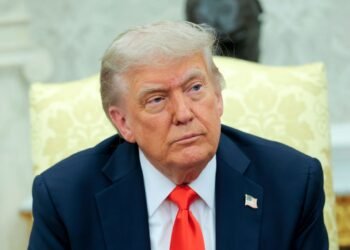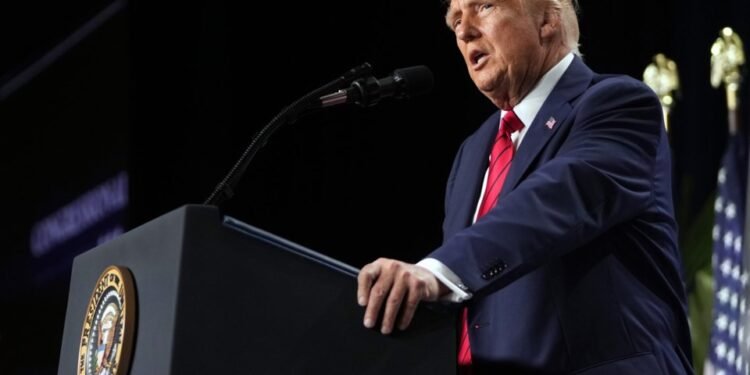

President Donald Trump has reaffirmed his intention to impose a long-term, potentially indefinite ban on migration from what he repeatedly described as “Third World countries,” insisting that such a policy is necessary to protect the United States from what he views as dangerous foreign influences.
Speaking in a media interaction on the US Air Force One, the President offered one of his most direct explanations yet of his stance, maintaining that the United States “doesn’t want those people” and suggesting that many migrants from poorer nations pose a threat to national stability.
During the interaction, Trump rejected the idea that the ban might eventually be lifted. “…No time limit, but it could be a long time,” he remarked.
He pressed his point in characteristic repetition, declaring, “We don’t want those people. Do you understand that?”, framing the issue in terms of nations he said were hostile or dysfunctional. “People from different countries that are not friendly to us and countries that are out of control themselves,” he said.
Trump singled out Somalia as an example of a country he considers unfit to provide migrants to the United States.
“Countries like Somalia that have virtually no government, no military, no police. All they do is go around killing each other. Then they come into our country and tell us how to run our country. We don’t want them”.
President Donald Trump
He further implied that Somali communities in the U.S., and particularly an unnamed lawmaker, were examples of what he characterized as unwelcome influences.



Affecting Countries
Pressed to identify how many nations might be subject to the migration pause, Trump suggested the list was larger than previously reported. “We don’t have that list. Well, I guess we gave you 19, right? There’s probably more than that.”
While he did not explicitly categorize all the nations in question as “third world,” he claimed that many of them were defined by crime, poor governance, and economic underperformance.
“They’re not good countries. They’re very crime-ridden countries. They’re countries that don’t do a good job. They’re countries that don’t register from the standpoint of success. And we, frankly, don’t need their people coming into our country telling us what to do”.
President Donald Trump
The President’s remarks reflect—and amplify—comments he made earlier when he announced plans to “permanently pause migration” from poorer nations. Trump posted on Truth Social, “Only REVERSE MIGRATION can fully cure this situation.”
Trump used the platform to argue that foreign-born residents are a major factor in rising crime, claiming without evidence that “most” are “on welfare, from failed nations, or from prisons, mental institutions, gangs, or drug cartels.”
These assertions build on a narrative he has advanced throughout his presidency, one that portrays immigration from certain regions as a direct threat to law and order in the United States.

The President also vowed to “terminate” millions of admissions he says were made under President Joe Biden, although he did not specify the mechanism by which such actions would occur.
He added that he intends to end federal benefits and subsidies for noncitizens and to pursue denaturalization of individuals he believes “undermine domestic tranquility.” According to Trump, those who are “non-compatible with Western Civilization” should be deported to preserve national cohesion.
His rhetoric arrives at a moment already fraught with tension following a shooting involving two National Guard members deployed to Washington, D.C. under his orders.
One of the guardsmen died shortly before Trump spoke by video to U.S. troops, an incident that the President has cited in recent days to underscore his hardened immigration posture and broader “law and order” message.
Trump’s latest statements are likely to intensify ongoing national debates about immigration, race, national identity, and executive power. Critics have long argued that his framing of migration from Africa, Latin America, and parts of Asia is rooted in xenophobia and inaccurate generalizations.
However, President Trump has always insisted he is acting to protect America’s security and preserve its values from what he views as demographic and cultural threats.

As the administration continues to outline and defend its restrictive immigration plans, the President’s sweeping language — notably his assertion that the nation does not “need their people” — is expected to remain a centerpiece of his political message.
Whether such policies will withstand legal and political challenges remains uncertain, but Trump’s position is unmistakably firm: the ban on what he calls “Third World migration,” in his view, is not simply a temporary measure, but a permanent direction for the country.
READ ALSO: WASSCE 2025 Records Sharp Decline in Core Subject Performance