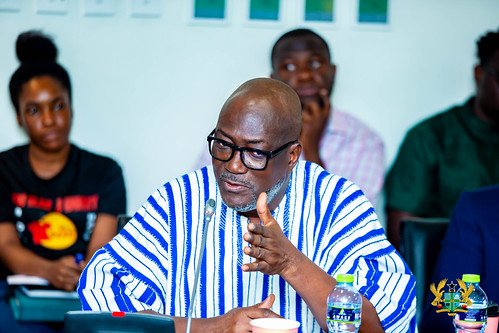
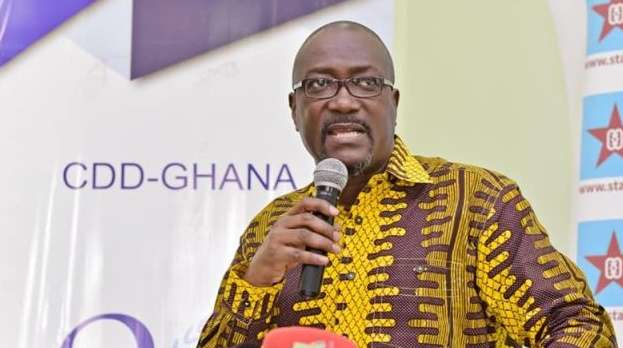
Professor H. Kwesi Prempeh, Executive Director of the Ghana Centre for Democratic Development (CDD-Ghana) and Chairman of Ghana’s ongoing Constitutional Review Committee, has argued that the intense controversies engulfing the Office of the Special Prosecutor (OSP) are symptoms of a deeper structural flaw in Ghana’s constitutional design, not merely institutional mismanagement or political interference.
Speaking against the backdrop of renewed calls from senior national figures for the abolition of the OSP, Professor Prempeh insisted that the problem must be confronted at its constitutional roots if Ghana is to have a credible and sustainable anti-corruption architecture.
He explained that the structural challenge begins with the unique concentration of prosecutorial authority in the hands of one politically appointed individual—the Attorney-General.
“We have an Attorney General who has a constitutional monopoly of prosecution, but that Attorney General under our current dispensation…in the fourth Republic, and I think before that, that Attorney General is a politician, or a political appointee of the President, and a member of the President’s cabinet, and sometimes actually has been an elected member of parliament.
“So this is somebody who actually contests on a party ticket, can get elected to parliament, and then he becomes Attorney General, he or she, and then is possessed of this power solely to prosecute any crimes.”
Professor H. Kwesi Prempeh, Executive Director of the Ghana Centre for Democratic Development
According to him, this arrangement has historically made it difficult for Ghana to credibly fight political corruption, particularly corruption involving “politically exposed persons.”
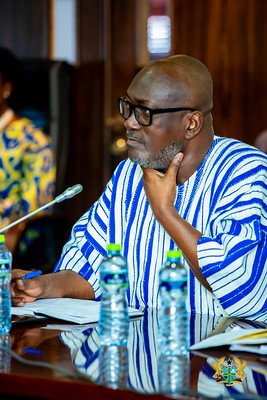
He argued that Attorneys-General have often been more willing to prosecute opposition figures than members of the ruling party, a pattern seen across Ghana’s political history.
This reality, he noted, is not unique to Ghana but has driven reforms in jurisdictions like the United States, where similar tensions led to the creation of the Special Counsel system during the Watergate era.


Lessons from the Watergate Scandal
Professor Prempeh referenced the dramatic events of the 1970s involving President Richard Nixon and Special Prosecutor Archibald Cox, whose attempt to subpoena presidential tapes led to the so-called “Saturday Night Massacre.”
That episode, he explained, demonstrated that even in advanced democracies, prosecutorial power held by a political appointee requires safeguards to maintain public trust.
“So the thought was that, look, we need to create some form of insulation between that person who exercises prosecutorial discretion, at least on a small set of cases involving publicly exposed persons, so that prosecution of those cases can at least be pursued with some credibility.”
Professor H. Kwesi Prempeh, Executive Director of the Ghana Centre for Democratic Development
Without such insulation, he warned, no investigation into high-level corruption can command legitimacy. However, he acknowledged that the OSP, as created by Parliament in 2017, emerged from a difficult constitutional compromise.
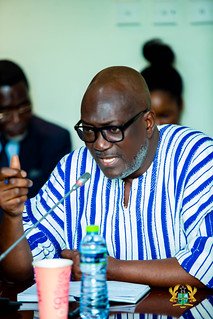
He recalled detailed engagements with Parliament’s Constitutional and Legal Affairs Committee, describing them as “tough conversations” because Ghana’s legal system is highly conservative.
“Trying to carve off a portion of a power that belongs by constitutional fiat exclusively to an Attorney General,” he admitted, “was not neat.” He conceded that the law was not able to fully detach the OSP from the Attorney-General due to Article 88, which entrenches the AG’s exclusive control over prosecution.
He explained that although the OSP was designed to operate independently in practice, its legal foundation created ambiguities that were always bound to produce friction.
“There is no way to take the attorney general’s nominal supervision out without infringing Article 88,” he stated. The AG remains the only cabinet minister whose authority derives directly from the Constitution.
According to him, although the President can dismiss the AG, “the President cannot instruct the attorney general as to what they should do.” That paradox, he said, makes it difficult to craft an autonomous prosecutorial entity within the existing constitutional framework.
The conflict, he suggested, is not just about independence but also about the radical nature of the OSP’s mandate. Ghana’s criminal justice system remains “old, almost archaic,” with many foundational laws dating back to the 1960s.
Injecting new tools such as non-conviction-based asset recovery, lifestyle audits, and unexplained wealth laws into such a system was always going to provoke resistance. “If you’re going to bring in this radically new idea of a special prosecutor,” he argued, it is inevitable that the system “is going to fight it off because it is quite new.”
Professor Prempeh’s remarks follow sharp criticism from high-ranking figures across Ghana’s political divide, including former Speaker of Parliament Professor Aaron Mike Oquaye, Majority Leader and Bawku Central MP Mahama Ayariga, and current Speaker Alban Bagbin.
All have, in different ways, questioned the effectiveness of the OSP since its establishment, despite what they describe as substantial provision of state resources.
The Constitutional Solution
Rather than viewing the controversy as evidence that the OSP experiment has failed, Professor Prempeh argued that Ghana must confront the core constitutional dilemma that has plagued the institution from inception.
“The problem we’re facing now calls for a constitutional solution. We can renew the institution’s legal foundation to offer a more permanent fix than trying to renovate around the problem.”
Professor H. Kwesi Prempeh, Executive Director of the Ghana Centre for Democratic Development
He noted that other countries have successfully restructured their anti-corruption systems by directly addressing conflicts between constitutional roles and operational mandates. Ghana, he insisted, could innovate a model suited to its needs instead of relying on makeshift legislative adjustments.
“If we’re serious about solving the problem,” he argued, “there’s no shortage of innovative ideas. There are comparative models around; we can innovate our own.”
For him, the path forward is not to abolish the OSP but to refine the constitutional and legal framework that governs prosecutorial authority and anti-corruption institutions. This, he believes, is the only durable way to prevent future clashes, restore public trust, and strengthen the integrity of Ghana’s fight against corruption.
READ ALSO: Japan Cautions of Possible Aftershocks After 7.5 Magnitude Earthquake