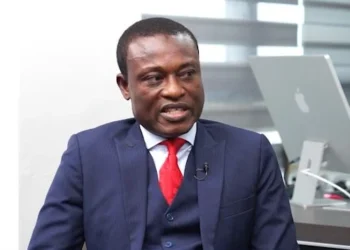

Pollster and Executive Director of Global InfoAnalytics, Mussa Dankwa, has issued a stark warning to the leadership of the opposition New Patriotic Party (NPP), revealing that the party has lost a significant portion of its core supporters nearly a year after its defeat in the 2024 general elections.
Presenting fresh data on political party affiliation trends in Ghana, Mussa Dankwa urged the NPP to confront what he described as a deepening decline in its public support and brand credibility.
Speaking during the release of the organisation’s latest political tracking data, Mussa Dankwa stressed that the figures should alarm anyone within the NPP’s leadership structure. He described the findings as a call for sober reflection and decisive action, not only for the sake of the party but also for the health of Ghana’s democracy.
According to the data, the NPP’s share of openly declared supporters has dropped sharply from 36 percent in October 2024 to 27 percent in October 2025. The nine-percentage-point decline is particularly significant given that these are voters who voluntarily and openly identify as sympathizers of the party.

Mussa Dankwa emphasized that such a shift cannot be dismissed as normal political fluctuation but reflects a deeper dissatisfaction within the party’s traditional base.
“No true democracy thrives with weak and dysfunctional opposition. NPP should not ignore what is happening to their core base, people who openly say they are sympathizers of the party.
“I have spent enough time on social media to fully understand what is going on with the NPP brand. The truth is bitter, but the party is in decline, and the decline is very steep.”
Executive Director of Global InfoAnalytics, Mussa Dankwa
NDC’s Supporting Base Rising
The data also reveals an equally striking countertrend in favour of the National Democratic Congress (NDC), which won the December 2024 general elections decisively.


Over the same period, openly declared NDC affiliation rose from 33 percent to 42 percent—also a nine-percent increase. Mussa Dankwa described this as “very troubling for the leadership of the NPP,” noting that the 9 percent who left the NPP did not merely drift into apathy or indecision but crossed over to identify with the NDC.
“This means that 9% of NPP voters who left the party did not go to floating voters or not disclosed, but actually now self-identify as NDC. This should be very troubling for the leadership of the NPP.”
Executive Director of Global InfoAnalytics, Mussa Dankwa
The poll further shows relatively minor changes in the distribution of other voter groups. Floating voters increased marginally from 15 percent to 17 percent, while those who chose not to disclose their political affiliation declined from 12 percent to 10 percent.

Support for smaller political parties remained unchanged at 4 percent. This stability among other groups strengthens the conclusion that the NPP’s losses have directly fed into gains for the NDC, not into general voter uncertainty.
Mussa Dankwa’s remarks come against the backdrop of the NPP’s historic defeat in the 2024 elections. The party’s presidential candidate, then Vice President Mahamudu Bawumia, conceded to President John Dramani Mahama, who returned to power with 56.55 percent of the votes. Dr Bawumia secured 41.61 percent.
The parliamentary results were similarly decisive, with the NDC winning 185 out of 276 seats, leaving the NPP with 88. Four independents, all now aligned with the NDC Majority, completed the configuration of the new Parliament.
But Mussa Dankwa argued that electoral defeat alone cannot explain the ongoing loss of confidence among the NPP’s base. Instead, he suggesteds that the party’s response—or lack of response—since the election has contributed to continued disaffection.
“They need to understand why this decline is continuing, nearly one year after they lost the election. What actions or inactions of theirs are driving away their voters to NDC?”
Executive Director of Global InfoAnalytics, Mussa Dankwa
He added that the dynamics playing out on social media offer further insight into the NPP’s image challenges. By his assessment, online discourse reflects growing frustration among long-time supporters who feel disconnected from the party’s direction and leadership posture.
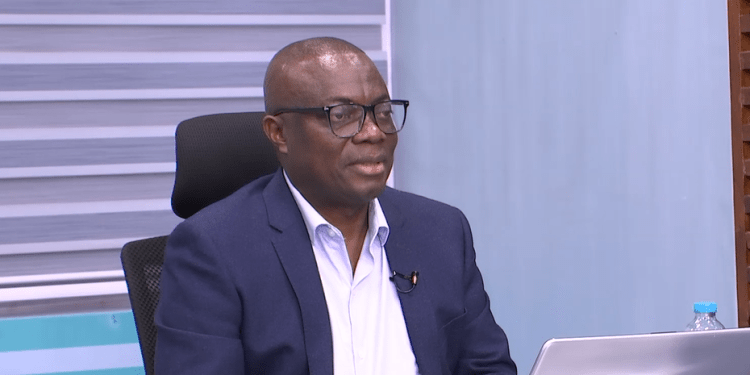
Mussa Dankwa’s warning places renewed pressure on the NPP as it navigates its post-election recovery and attempts to redefine its relevance in a political landscape now dominated by the governing NDC.
The question confronting the party’s leaders is whether they will treat the findings as a critical opportunity for introspection or allow the decline to deepen further ahead of future electoral cycles
READ ALSO: GIPC Boss Holds High-Level Talks with U.S. Embassy on Game-Changing Investment Bill