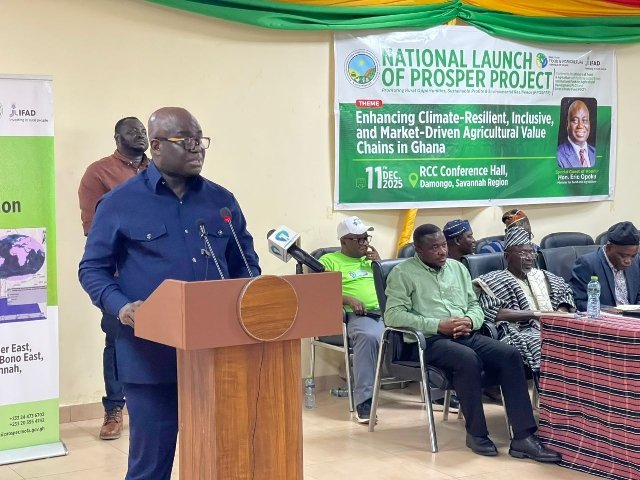
Ghana’s agricultural sector has received a historic boost with the official launch of the Promoting Rural Opportunities, Sustainable Profits and Environmental Resilience (PROSPER) Project.
The national event, held in Damongo in the Savannah Region, marks a bold step by the government to modernise agriculture, strengthen climate resilience, and uplift rural livelihoods. The initiative, launched by the Minister for Food and Agriculture, Mr Eric Opoku, is widely regarded as one of the country’s most strategic efforts to transform farming communities through inclusive, sustainable, and climate smart interventions.
During the launch, Mr Opoku described PROSPER as “one of Ghana’s most strategic and transformative agricultural initiatives,” signalling the government’s commitment to reshaping rural economies. The project brings hope to thousands of smallholder farmers who have long struggled with limited infrastructure, climate variability, weak value chains, and inadequate financing.
At the core of the PROSPER Project is a significant investment valued at $147.3 million. Out of this amount, the Government of Ghana is injecting $22.5 million, with the remaining funds coming from the International Fund for Agricultural Development (IFAD) and the Green Climate Fund (GCF). The massive financing demonstrates a multi stakeholder commitment to strengthening Ghana’s agricultural foundation.
The project targets nine regions across the country. These include Eastern, Bono East, Oti, Bono, Northern, Savannah, North East, Upper East, and Upper West. Seven districts in each region will benefit from the initial rollout, bringing the programme closer to communities with high agricultural potential yet high exposure to climate risks.
According to the Minister, the project will directly support 100,000 rural households while indirectly benefiting an additional 320,000 people. This brings the total number of beneficiaries to 420,000 nationwide. Mr Opoku emphasised that these regions were carefully selected due to their unique vulnerabilities and opportunities for agricultural expansion.


Strengthening Institutions and Rural Infrastructure
One of the strongest pillars of the PROSPER Project is its focus on building institutions and community infrastructure. The initiative aims to improve the rural environment by providing feeder roads, boreholes, markets, post harvest storage facilities, and toilets. All these facilities are designed to improve accessibility, reduce post harvest losses, and ensure that communities have the resources needed to enhance productivity.
Additionally, the project will provide start up kits for economically active persons with disabilities. This component strengthens social inclusion by ensuring that vulnerable groups are not left out of economic opportunities. Capacity building for cooperatives and rural enterprises will also be prioritised, ensuring that local institutions are strengthened for long term sustainability.
The second pillar of PROSPER focuses on economic empowerment. It includes the establishment of climate smart demonstration sites that provide farmers with practical training on sustainable agriculture. Farmers will receive support to improve market linkages and participate in Village Savings and Loans Associations (VSLAs), which promote financial inclusion.
Financial literacy training and a matching grants fund will help agribusinesses and rural enterprises expand their operations. A Blended Finance Facility will also make affordable loans available at below 10 percent interest, reducing the financial barriers that often limit the growth of rural businesses.
Partnerships with institutions such as GIRSAL, ARB Apex Bank, and the Bank of Ghana will ensure that farmers and rural enterprises have a reliable pathway to secure financing. As the Minister stated, “For many who have long been excluded from formal financing, PROSPER brings renewed hope and economic dignity.”
Coordinated Implementation for Maximum Impact
The third component of the project focuses on coordination and operational efficiency. This ensures that every investment produces maximum results. With the government aligning the initiative with the Feed Ghana Programme, PROSPER is expected to boost key value chains including maize, rice, soybeans, cashew, vegetables, poultry, and shea.
Inclusivity remains central to the project. Women, youth, vulnerable smallholders, and persons with disabilities are set to receive targeted support to empower them within the agricultural value chain. The Minister emphasised that the farmers themselves are the heart of the initiative, referring to them as “partners in building a stronger, more resilient agricultural economy.”
PROSPER also places strong emphasis on climate resilience and nutrition. The project will support watershed restoration, erosion control, agroforestry, tree planting, and sustainable land management. Investments in feeder roads, culverts, boreholes, solar powered systems, and small irrigation facilities will protect communities from climate shocks.
Nutrition sensitive agriculture will be promoted through household and school gardens, demonstration of nutritious foods, and distribution of biofortified seeds. The integration of nutrition into Farmer Field Schools will ensure that households adopt healthier dietary practices.
With the launch of the PROSPER Project, Ghana is taking a monumental step toward building a climate resilient, modern, and inclusive agricultural economy. The initiative promises lasting change for rural communities by improving infrastructure, expanding economic opportunities, strengthening institutions, and promoting sustainability.
READ ALSO:Sudanese Militia Leader Sentenced To 20 Years Imprisonment For War Crimes In Darfur