
President John Dramani Mahama has announced that the long-awaited final report of the Constitutional Review Committee (CRC) will be submitted on December 22, marking a decisive step toward one of Ghana’s most anticipated governance reforms in recent years.
The President disclosed this during an engagement with the National Peace Council, reaffirming his administration’s commitment to a constitutional review process that has gained renewed national attention.
Reflecting on the origins of the exercise, President Mahama noted that constitutional reform featured prominently in the 2024 election campaign, with both major political parties acknowledging the need to revisit the 1992 Constitution.
“Both parties agreed that the 1992 Constitution has served us well but the time has come for us to take a look at it again,” he said, emphasizing that the shared political consensus made it possible for the review process to move forward with broad legitimacy.
President Mahama recounted that shortly after assuming office, he fulfilled his campaign pledge by establishing a new eight-member Constitutional Review Committee in January 2025.

The team, chaired by Prof. H. Kwasi Prempeh, was tasked with identifying gaps in earlier review exercises—particularly those undertaken in 2010 and 2023—and proposing actionable amendments that strengthen democratic governance.


Nationwide Consultations
Their work has spanned nearly a year, involving nationwide consultations, solicitation of memoranda from citizens and civil society organizations, and engagements with former presidents, political leaders, and institutional stakeholders.
According to the President, the committee met with him two weeks earlier to provide a preview of some of the recommendations they intend to present in their final report.
While he described the proposals as “quite interesting,” he declined to reveal details, stating that he had been “sworn to silence” until the committee submits its work formally.
In a humorous aside, President Mahama compared the situation to a light-hearted episode involving his daughter, who once struggled to keep a secret from her mother.
“I don’t want to be like my daughter whom I reached an agreement with her not to let her mother something and then her mother came and we were sitting, and she said, Daddy I want tell mommy, and I said Oh but we agreed that you won’t tell mommy but she said Daddy, it’s not me, it’s my mouth. My mouth is saying that I should tell her…”
President John Dramani Mahama
He emphasized, however, that he would “hold his peace” until December 22. Despite withholding specifics, the President affirmed that the committee had “done a fairly good job.”
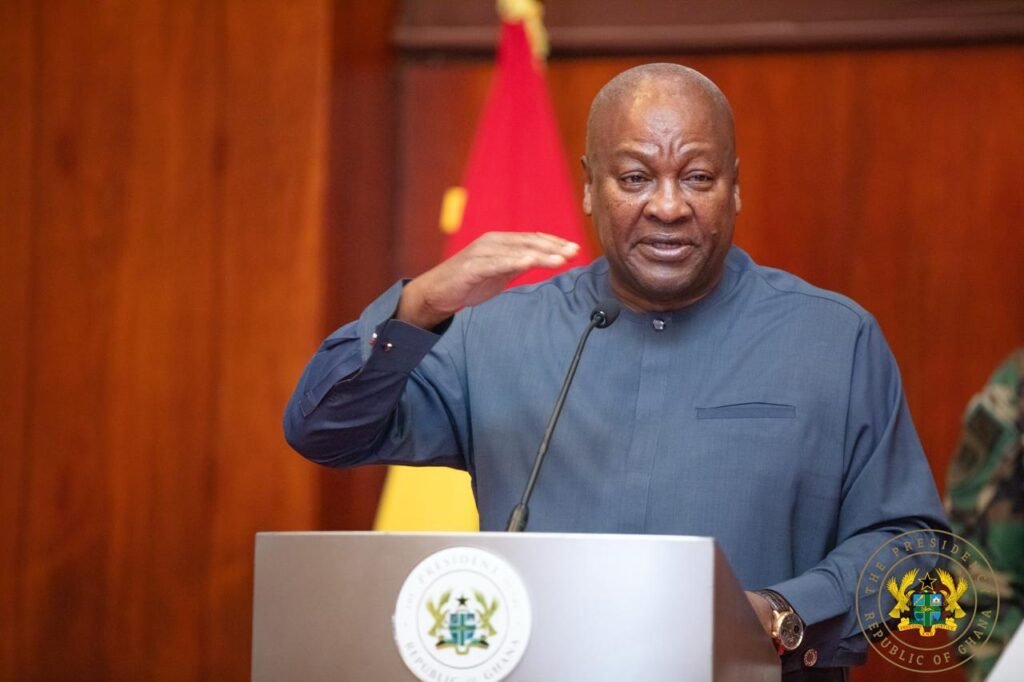
“Some of the amendments seem quite radical, but I do think that the justification behind them would make Ghanaians understand the need for us to do what we have to do.”
President John Dramani Mahama
Sensitive and Far-Reaching Nature of the Areas under Review
His remarks have heightened public interest in the impending release, especially given the sensitive and far-reaching nature of the areas under review. Among the most significant issues the committee has been examining is the longstanding debate over whether Metropolitan, Municipal, and District Chief Executives (MMDCEs) should be elected rather than appointed.
The review has also revisited the contentious emoluments system for Article 71 officeholders, which has sparked public debate for years due to perceptions of inequity.
Additionally, the committee has considered proposals to revise the constitutional requirement that the majority of ministers must be appointed from Parliament—a provision critics argue undermines both parliamentary oversight and the separation of powers.
Another central theme of the review has been the need to address what many governance experts have termed Ghana’s “imperial presidency.” This includes examining the President’s extensive appointment powers, which extend across independent constitutional bodies, public institutions, and oversight agencies. Strengthening judicial independence and enhancing checks and balances have also been key priorities throughout the committee’s work.
The CRC’s membership reflects a blend of legal, governance, and public service expertise. Led by Prof. Prempeh, a respected constitutional scholar, the committee includes Justice Sophia Adinyirah, Prof. Kwame Karikari, Mrs. Charlotte Osei, Dr. Godwin Djokoto, Ibrahim Tanko Amidu, Dr. Esi Ansah, and Dr. Rainer Akumperigeya, who serves as secretary. Their collective experience has anchored the rigorous consultations and analysis that have shaped the forthcoming report.
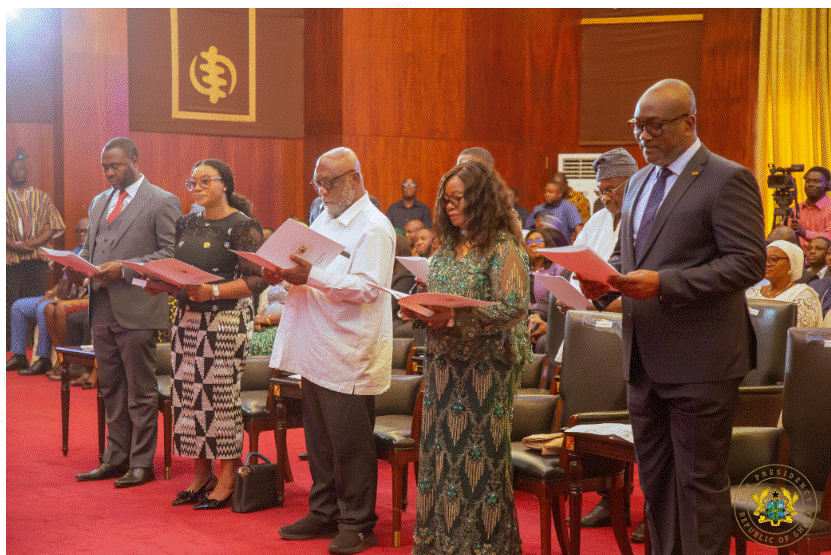
With the December 22 deadline approaching, attention has now shifted to what comes next. Upon receiving the document, the President is expected to release it to the public and issue a White Paper outlining which recommendations the government intends to adopt. Any constitutional amendments, particularly those affecting entrenched clauses, will require parliamentary approval and, in some cases, a national referendum.
President Mahama expressed confidence that the upcoming report will form a solid foundation for Ghana’s next phase of constitutional evolution. He reiterated that although some proposals may be bold, they are grounded in the desire to deepen democracy and enhance accountability. “The justification behind them,” he said, “would make Ghanaians understand the need for us to do what we have to do.”
As the country awaits the release of the final report, anticipation continues to build around the potential reforms—and the national conversations—they are likely to ignite.
READ ALSO: Promised Made, Promised Delivered – Mahama Signs Bill Abolishing COVID-19 Levy