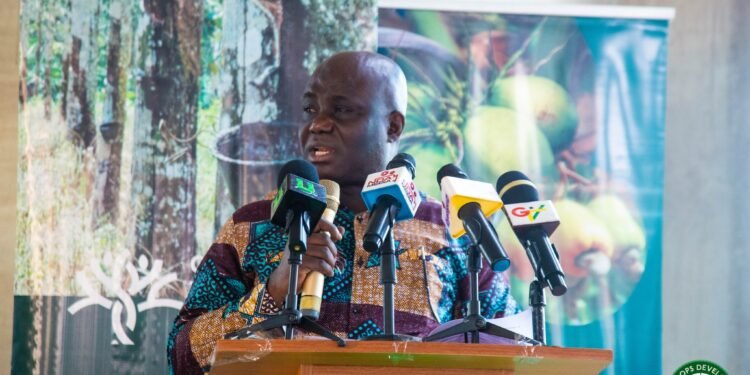
A civil society group, Patriotic Journalists Against Galamsey (PAJAG) has pledged that it will do everything within its capacity to support the country in the fight against illegal mining.
Mr Nana Otu Darko, Executive Director of PAJAG emphasized that the group will forever commit its production and media resources to serve as an extended intelligence and oversight mechanism for the National Anti-Illegal Mining Operations Secretariat (NAIMOS) and the Ministry of Lands and Natural Resources as far the fight against this environmental terrorism is concerned.
This unprecedented dedication of journalistic capacity underscores a crucial shift in the national anti-galamsey effort, moving beyond mere reportage to active, supportive surveillance and advocacy.
“The destruction of our water bodies and farmlands is not a political story; it is a survival story, and it threatens the very existence of our livelihood. To our colleagues in the media, this is not the time to be neutral. We will not keep quiet where there is backsliding, and we will right this with the urgency it deserves.”
Mr Nana Otu Darko
PAJAG’s decision aligns with the growing consensus that combating the illegal small-scale mining menace, or ‘galamsey,’ requires a multi-stakeholder, all-of-society approach, especially given the increasingly sophisticated and destructive nature of these unauthorized operations.
This strategic partnership is rooted in the alarming scale of environmental destruction wrought by galamsey across the country.
Media as the Watchdog: Unveiling Concealment

PAJAG’s primary role will leverage the inherent functions of the press: to investigate, expose, and inform.


The organization has pledged to deploy its media and production teams as additional “eyes and ears” for the state agencies tasked with enforcement.
In an environment where illicit operations are often concealed or protected by weak enforcement systems, political interference, and local corruption, the media’s power to expose is an indispensable deterrent.
The use of undercover journalism and sustained documentation of galamsey hotspots can provide NAIMOS with real-time, actionable intelligence, complementing the efforts of security operations such as ‘Operation Halt’ and ‘Operation Vanguard,’ which have historically faced challenges due to logistical constraints and the sheer difficulty of maintaining persistent surveillance over wide, remote areas.
By promising to “expose” concealment and “amplify” courage, PAJAG is creating a dual-layered accountability system that monitors both the illegal miners and the state’s response.
The Extent of an Existential Threat

The urgency of PAJAG’s commitment is underscored by the catastrophic extent of the damage. Data points reveal a staggering environmental loss that transcends mere local pollution to constitute a national security threat.
Mr. Out Darko cited grim statistics: of 284 identified forest reserves, 44 have been “destroyed,” which he equated to an area of 7,776 football pitches.
This figure reflects the aggressive deforestation and land degradation where illegal miners clear vegetation to access gold deposits, severely compromising biodiversity and the ecosystem services provided by these forests, such as climate regulation and watershed protection.
The contamination extends to major rivers like the Pra, Offin, and Ankobra, which have turned turbid, a visible sign of heavy sedimentation and the leaching of toxic substances into the water.
This widespread destruction confirms that galamsey is, as described by experts, an “ecological disaster” that threatens not only Ghana’s natural resources but also long-term sustainable development, particularly for the critical cocoa sector which has seen thousands of hectares of farmland devastated.
Civil Society’s Critical Role in Mitigating the Menace

The engagement of Civil Society Organizations (CSOs) like PAJAG is a critical non-military component in the holistic strategy to tackle galamsey.
CSOs bring a unique set of capabilities, including advocacy, research, community-level engagement, and the moral authority to depoliticize the issue. Instead of the often-alienating, top-down military interventions, CSOs can foster a bottom-up approach that prioritizes community mobilization and dialogue.
PAJAG, as a media-centric CSO, demonstrates how this can be operationalized by focusing on public awareness and shaping the national narrative. By framing galamsey as a “survival story,” they shift the conversation from a partisan political debate to an existential threat to all citizens.
Other CSOs, such as those focused on environmental conservation and local governance, can complement this by advocating for alternative sustainable livelihoods in mining communities, monitoring the effectiveness and transparency of anti-galamsey funds, and pushing for stronger legal and regulatory frameworks, like the proposed ban on mining in forest reserves.
A multi-stakeholder partnership, where groups like PAJAG act as persistent public watchdogs, provides the sustained pressure needed to maintain political will and enforce accountability, ensuring that the progress made against galamsey is both celebrated and maintained against the risk of “backsliding.”
The gravity of the threat requires the media to shed any notion of “neutrality,” recognizing that the defense of Ghana’s land and water is a patriotic duty and an urgent environmental necessity.
READ ALSO: Ghana Courts U.S. Capital at High-Powered Washington Business Forum