Ghana’s monetary policy outlook is tilting towards caution as high interest rates are expected to persist well into the first half of 2026.
According to IC Securities, a leading market and research firm, the Bank of Ghana is likely to maintain a tight monetary stance in order to contain inflationary risks and prevent second round effects arising from recent tariff hikes. This outlook suggests that hopes for rapid monetary easing may be premature, despite recent cuts to the policy rate.
The firm’s analysis indicates that the central bank remains committed to keeping the real policy rate in double digit territory, a strategy aimed at anchoring inflation expectations and safeguarding macroeconomic stability at a delicate point in Ghana’s economic recovery.
Recent rate cut signals caution rather than reversal
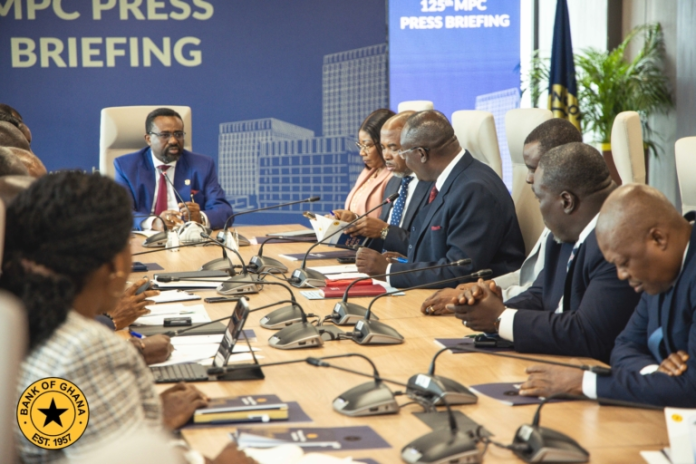
At its final Monetary Policy Committee meeting for 2025 held in November, the central bank voted by a majority decision to reduce the policy rate by 350 basis points to 18.0 percent. While the move marked a significant easing step, IC Securities noted that it was slightly below its maximum expected cut of 400 basis points. This outcome, according to the firm, reflects a cautious approach rather than a wholesale shift towards aggressive monetary accommodation.
“The magnitude of the rate cut was broadly in line with our expectation but came in 50 basis points lower than our maximum expected cut of 400 basis points. We view this deep, yet cautious, rate cut as a signal of the MPC’s continued preference for double digits real policy rate at every point in this phase of the rate cutting cycle which began in July 2025.”
IC Securities
Despite the reduction in the nominal policy rate, monetary conditions remain tight. The cut lowered the real policy rate from an estimated 13.5 percent before the MPC meeting to about 10.0 percent after the decision. According to IC Securities, this level still places Ghana’s monetary stance firmly within a restrictive zone.
Maintaining such restrictive conditions underscores the central bank’s determination to prioritise price stability over short term growth impulses. Analysts believe this posture reflects lessons learned from past episodes where premature easing contributed to renewed inflationary pressures and currency instability.


Pause expected in early 2026
IC Securities expects the Monetary Policy Committee to pause further rate cuts in January 2026. The firm’s analysis suggests that a likely increase in the real policy rate above the 12.0 percent mark by the end of 2025 will give policymakers limited room to continue easing in the near term.
This anticipated pause aligns with the broader policy objective of consolidating recent gains in inflation control. By holding rates steady, the central bank aims to assess the full impact of earlier easing measures while remaining vigilant against emerging risks in the domestic and global environment.
A key factor shaping the outlook for tighter monetary policy is the potential inflationary impact of tariff hikes. IC Securities warned that higher tariffs could trigger second round effects by pushing up production costs and consumer prices across various sectors of the economy.
“We expect this double digit real policy rate to persist through first half of 2026 as the authorities will seek to avert a potential second round effect from the tariff hike,” the firm said. This assessment highlights the balancing act facing policymakers as they attempt to shield households and businesses from rising costs while maintaining macroeconomic discipline.
Alignment with 2026 budget priorities
The projected monetary stance also aligns closely with the government’s fiscal outlook as outlined in the 2026 budget statement. According to IC Securities, the budget underscores a commitment to cautious and conditional monetary easing, with a clear emphasis on maintaining stability.
The budget notes that “monetary easing will be cautious and conditional on continued stability, and the Bank stands ready to act swiftly should inflationary risks resurfaced.” This policy coordination between fiscal and monetary authorities is seen as critical to sustaining confidence among investors and international partners.
For businesses, the prospect of prolonged high interest rates implies continued pressure on borrowing costs and investment decisions. Companies reliant on credit may need to adjust expansion plans, manage cash flows more conservatively, or seek alternative financing options. At the same time, a stable macroeconomic environment could offer longer term benefits by reducing volatility and strengthening the cedi.
Investors, particularly in fixed income markets, may find opportunities in a high rate environment that rewards patience and risk management. However, market participants will be closely watching inflation trends and policy signals for any indication of a shift in stance.
Overall, IC Securities’ assessment points to a monetary policy environment defined by vigilance rather than rapid easing. While recent rate cuts have provided some relief, the Bank of Ghana’s commitment to maintaining double digit real policy rates suggests that price stability remains the overriding priority as the country moves into 2026.
READ ALSO:Mahama Unites Africa and Diaspora @Accra Summit: ‘The Future Is Ours to Reclaim’