
Ghana’s Constitutional Review Committee (CRC) has proposed significant changes to the country’s presidential election calendar and the legal framework governing election petitions, recommending November elections and tighter timelines for resolving disputes.
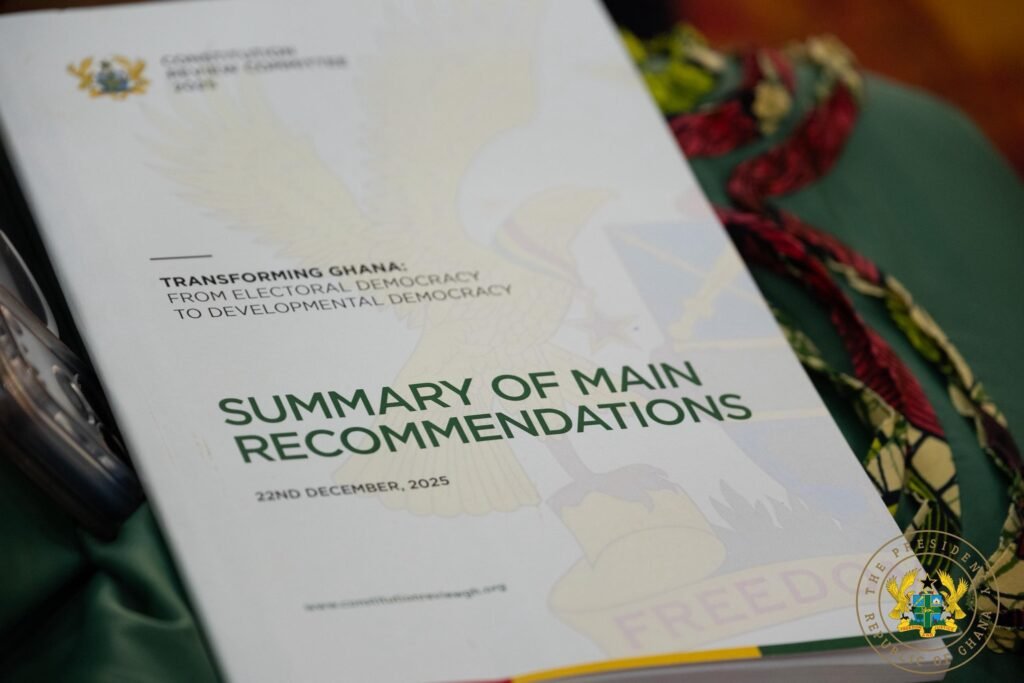
The proposals are contained in the committee’s final report, which was formally submitted to President John Dramani Mahama on December 22, 2025, following nearly eleven months of nationwide consultations and technical review.
The eight-member committee, chaired by Professor H. Kwasi Prempeh, has recommended an amendment to Article 63(2)(a) of the 1992 Constitution to shift the timing of presidential elections.
Under the proposal, presidential elections would be held on a date in the first week of November in an election year, to be specified by the Electoral Commission through a constitutional instrument.
Currently, presidential and parliamentary elections are held on 7th December, with the newly elected president sworn into office on January 7 of the following year. The CRC’s recommendation, if adopted, would extend the transition period between the election of a president and the assumption of office from approximately one month to two months.

According to the committee, the longer transition window is intended to improve governance continuity, allow for a more orderly transfer of power, and reduce the pressure associated with tight post-election timelines.


The CRC’s consultations revealed concerns from stakeholders about the adequacy of the current transition period, particularly in closely contested elections where disputes may arise.
Amendments to Article 64 of the Constitution
The proposed November election date is also linked to the committee’s recommendations on presidential election petitions. The CRC has suggested amendments to Article 64 of the Constitution to clarify who may challenge presidential election results and to impose firm deadlines on the Supreme Court for determining such cases.
Under the proposed amendment to Article 64(1), a petition challenging the validity of the election of a declared President-elect may be brought by any citizen of Ghana. Such a petition must be filed at the Supreme Court within fourteen calendar days after the declaration of the election results.
The committee’s report stresses that this timeline is designed to encourage prompt legal action while preserving citizens’ constitutional right to challenge electoral outcomes. In addition, the CRC recommends that the Supreme Court be constitutionally required to hear and determine any presidential election petition within thirty days of it being filed.

Constitutional Obligation on the Electoral Commission
This provision, the committee argues, would ensure the expeditious resolution of election disputes and prevent prolonged legal uncertainty during presidential transitions. To support the speedy determination of petitions, the committee has proposed a new constitutional obligation on the Electoral Commission.
In the event of a presidential election challenge, the Commission would be required to promptly furnish all relevant or contested data in its custody to the Supreme Court, the petitioner, and any other party to the case. This includes election results and any other materials necessary for the court’s scrutiny.
The CRC’s recommendations reflect lessons drawn from Ghana’s experience with presidential election petitions since the advent of the Fourth Republic. While election disputes have been resolved through the courts rather than violence, the committee notes that lengthy proceedings and disputes over access to electoral data have, at times, heightened political tension.
By aligning the election calendar with clearer and shorter judicial timelines, the CRC believes Ghana can further strengthen confidence in its democratic processes. The proposed two-month transition period would provide sufficient time for the resolution of any election petition before the inauguration of a new president, reducing the risk of governance disruptions.
A Major Milestone
The submission of the CRC’s final report marks a major milestone in Ghana’s ongoing constitutional reform agenda. Professor Prempeh and his colleagues were tasked with reviewing the 1992 Constitution to identify structural weaknesses and recommend reforms to improve accountability, efficiency, and democratic stability.
Their work involved extensive public engagement across all regions of the country, as well as technical analysis of constitutional practice in Ghana and comparable democracies.
President Mahama, upon receiving the report, announced that a dedicated Implementation Committee would be established in early 2026 to begin translating the CRC’s recommendations into actionable constitutional amendments. This process is expected to involve further consultations, parliamentary consideration, and, where required, national referenda.
The proposed changes to presidential election timing and petition procedures are likely to attract significant public and political debate. Supporters argue that earlier elections and faster court rulings would enhance certainty and stability, while critics may question whether the Supreme Court can consistently meet the proposed deadlines, especially in complex cases.
Nevertheless, the CRC has framed its proposals as part of a broader effort to modernize Ghana’s constitutional architecture and address recurring challenges identified over more than three decades of constitutional rule.

By recommending November elections and clearly defined timelines for election petitions, the committee aims to reinforce Ghana’s reputation for democratic resilience while reducing the strain associated with post-election transitions.
As the country prepares for discussions on implementation in 2026, the CRC’s proposals on presidential elections and petitions stand out as reforms with far-reaching implications for Ghana’s electoral calendar, judicial processes, and democratic governance.
READ ALSO: Denmark Summons US Ambassador Over Greenland Envoy Appointment