Ghana’s Constitutional Review Committee (CRC) has proposed far-reaching constitutional restrictions on the powers of an outgoing President and government during the post-election transition period, seeking to halt what it describes as a long-standing culture of last-minute appointments, contracts, and asset disposals after electoral defeat.
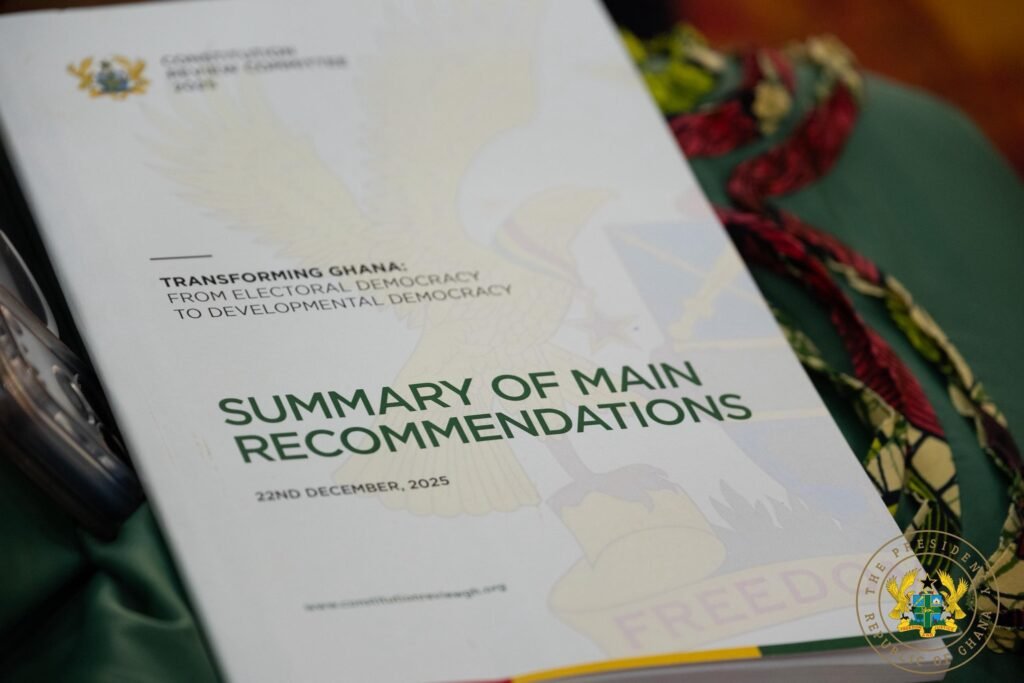
The recommendations form part of the committee’s final report submitted to President John Dramani Mahama on December 22, 2025. Chaired by constitutional law scholar Professor H. Kwasi Prempeh, the eight-member CRC has recommended amendments to Chapter Eight of the 1992 Constitution to introduce a new provision that would strictly regulate executive actions between the date of a presidential election and the assumption of office by a newly elected president.
The proposed transition period restrictions are intended to protect the public purse, preserve institutional integrity, and prevent binding commitments that could encumber an incoming administration.
Under the proposed amendment, a President or any member of the outgoing government would be constitutionally barred from making appointments, nominations, or offers of employment to public office where the term of service would extend into the next administration.
This provision is designed to address the common practice of post-election appointments made after electoral defeat, which critics argue undermines merit-based governance and constrains the discretion of incoming governments.

Restrictions on Public Spending and Contractual Commitments
The committee has also proposed restrictions on public spending and contractual commitments during the transition. Specifically, no new contract or commitment, including salary or wage increases, may be granted or offered unless it has already been approved in the current year’s appropriations.


According to the CRC, this measure is aimed at preventing outgoing administrations from locking the state into new financial obligations that were neither budgeted for nor contemplated before the election.
Another key recommendation seeks to halt the sale or disposal of state assets during the transition period. The CRC proposes that no transaction involving the sale, purchase, or grant of leasehold interests in public land, nor the sale of any public asset, may be commenced or concluded once the transition period begins.
The committee’s report reflects widespread public concern that such transactions, often undertaken hurriedly after elections, lack transparency and may not serve the long-term interests of the state.
In addition, the CRC recommends that no bill may be introduced into Parliament under a certificate of urgency during the transition period. Certificates of urgency allow legislation to be fast-tracked through Parliament, and the committee believes their use during transitions has been abused to pass controversial measures without adequate scrutiny.
Strong Legal Consequences for anyBreach
Crucially, the CRC has proposed strong legal consequences for any breach of these restrictions. Any action taken, or transaction entered into, in violation of the proposed provisions would be deemed void and would impose no obligation on the state in favour of any third party.
This means that contracts, appointments, or asset sales concluded in defiance of the transition rules would have no legal effect, regardless of whether third parties were involved.
The committee’s recommendations are rooted in Ghana’s recent political history, where post-election transitions have frequently been marked by disputes over last-minute executive actions.
Civil society organisations, governance experts, and opposition parties have long criticised the practice of outgoing governments using the transition window to make appointments, award contracts, and dispose of state assets, often after losing elections.
Although the CRC’s report does not single out specific administrations, its findings reflect concerns raised during nationwide consultations that incumbents routinely exploit constitutional gaps to exercise sweeping powers even after voters have decided to change government. The committee argues that clearer constitutional limits are necessary to uphold democratic accountability and respect the will of the electorate.

The submission of the CRC’s final report follows nearly eleven months of public consultations and technical analysis. The committee engaged a wide range of stakeholders, including political parties, traditional authorities, civil society groups, public servants, and ordinary citizens, many of whom called for stronger safeguards during transitions.
Presidential Commitment
President Mahama, upon receiving the report, announced that a dedicated Implementation Committee would be established in early 2026 to guide the process of converting the CRC’s recommendations into formal constitutional amendments. This process is expected to involve parliamentary debate and, where required under the Constitution, approval by referendum.
The proposed transition restrictions are likely to spark robust debate within political circles. Supporters argue that the reforms would enhance transparency, reduce waste, and ensure smoother handovers of power.
They contend that once an election has been held, especially where the incumbent has lost, executive authority should be exercised only to maintain continuity, not to make far-reaching decisions with long-term consequences.
Critics, however, may question whether the restrictions could unduly limit the functioning of government during the transition period, particularly in emergencies. The CRC appears to have anticipated such concerns by focusing its prohibitions on discretionary actions rather than routine administration.

If adopted, the proposed amendments would mark a significant shift in Ghana’s constitutional practice, redefining the scope of executive power during transitions and reinforcing democratic norms around electoral change.
As the country prepares for the next phase of constitutional reform in 2026, the CRC’s recommendations on transition governance stand as one of the most consequential efforts yet to address abuses associated with the transfer of power.
READ ALSO: Ato Forson Pressures Public Sector Institutions to Embrace Discipline