Author: Dr. John Osae-Kwapong, Democracy and Development Fellow, CDD-Ghana, and Project Director, the Democracy Project
One of the steps taken by the current John Mahama Administration on governance matters was the establishment of a Constitution Review Committee (CRC) whose main task was to identify areas of the 1992 Constitution in need of improvement to address areas of challenges and, more importantly, strengthen and safeguard Ghana’s democracy.
Unlike previous multiparty democracy attempts, the 4th Republic, built on the foundation of the 1992 constitution, has endured for thirty-two years uninterrupted. This is a testament to the durable nature of the document as well as democratic resilience built over the years.
The constitution has faced many tests and has been called upon to resolve difficult matters such as disputes over two major elections (2012 and 2020). The constitution has so far survived.
But over the years, voices have regularly emerged to express angst about the 1992 constitution with many poor governance outcomes blamed on its architectural defects.
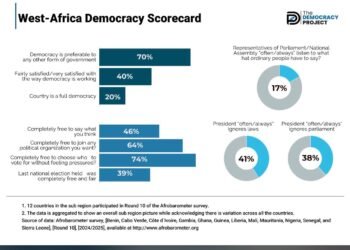
These poor governance outcomes have been well captured by good governance surveys and indices such as Afrobarometer, Press Freedom Index, Corruption Perception Index, Democracy Index, to mention a few.


In public conversations, proposals ranged from radical voices demanding a new constitution to moderate voices demanding reforms to carefully identified areas of defect.
It is within this context that the work of the CRC could not have come at a more opportune time. The report, presented on December 22nd, to the president, makes several recommendations. As the president noted, after the new year, active steps would be taken to implement the report’s recommendations.
Reflections on Selected Highlights
I am yet to fully digest the entire 127page document which has been made public. However, in addition to taking a cursory look at the document, plus watching the public presentation of it during which the chair of the committee provided highlights and context to some of the recommendations, here are the four that immediately caught my attention.
Term limits and length of term. With chatter emerging among certain quarters clamoring for a third term presidential term in violation of the current two-term limit prescribed in the constitution, the chair’s remark that there is no public appetite for tampering with term limits, as well as no ambiguity about what the constitution means by two terms, comes with great relief.
However, the committee recommends a change in the length of time for a term from four years to five years. If this recommendation passes, my hope is that it does not create an opportunity for exploitation, as happened in the case of a neighboring country where a sitting president managed to secure judicial validation of a “reset” of term limits because of a new constitution. While Ghana is not writing a new constitution, such avenues for any political mischief must be watched closely and resisted.
Members of Parliament as Ministers. The idea of having a true separation of these two branches of government by virtue of the recommendation that members of parliament may no longer be appointed to serve as ministers (executive) is an excellent idea. It potentially frees the majority of MPs, especially from political control by the executive which is embodied in the president. Also, and hopefully, it allows MPs to focus on the work of parliament without the distraction of executive demands while making them truly independent.
Cap on parliamentary seats. The committee recommends capping the number of parliamentary seats at the current 276 (the status quo). Over the course of the 4th republic, additional constituencies have been created, sometimes generating political controversy. In my opinion, capping the number of seats in parliament must be accompanied by periodic (after every census for example) redrawing of constituency boundaries to accommodate for any demographic shifts and changes.
Political party internal contests. Currently, when selecting candidates for presidential and parliamentary elections, political parties restrict those eligible to vote to an electoral college defined by the party’s rules. The committee recommends that all registered members of a party in good standing must be allowed to vote in such internal contests. It is an idea (open primaries) I have long supported to make these contests fairer. I have often argued, when people complain of the “buying of delegates” in these contests that it is easier to “buy” several delegates than it is to “buy” an entire constituency of voters across 16regions in a party primary. It will be interesting to see how political parties respond to this recommendation.
The faultlines of Article 146 (6). The recent removal of a sitting Chief Justice sharply divided our two main political parties, with accusations of threats to judicial independence. The process revealed the urgency to address the faultlines of the process.
The committee has made some important recommendations, such as scaling back the president’s role in the process on matters such as receipt of the petition or constituting the committee that investigates the prima facie case.
The CRC, however, leaves intact, the in-camera nature of the process and the private nature of the petition. Whatever the case is, it is my hope that the 146(6), if these recommendations are adopted, will become less susceptible to real or perceived political manipulation.
Next Steps
The country has an opportunity to address the often-discussed limitations of the 1992 Constitution. It does not mean that all the recommendations should be adopted. However, we owe it to ourselves to study these recommendations, educate our fellow citizens, and build consensus around those we end up accepting or rejecting.
READ ALSO: CRC’s Recommendations Best Shot at Fixing Ghana’s Institutional Plumbing – CDD Fellow