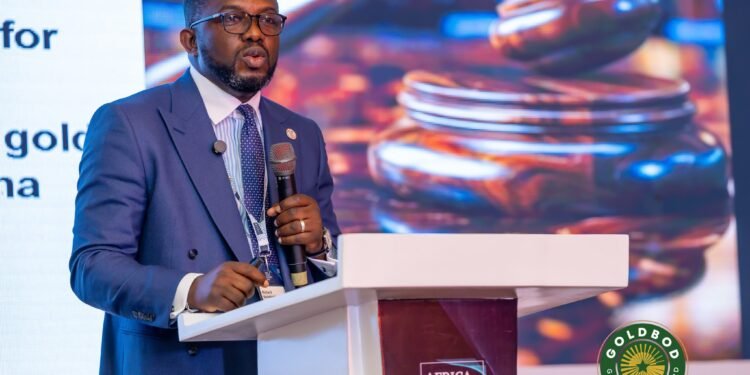
The Chief Executive Officer of the Ghana Gold Board (GoldBod), Sammy Gyamfi, has clarified that the Gold-for-Reserves (G4R) initiative is a programme of the Bank of Ghana (BoG) and not an operation designed, owned or managed by GoldBod.
His comments come amid growing public debate and political claims seeking to associate GoldBod with reported losses arising from the initiative.
“The Gold-for-Reserves programme we have been running this year is a Bank of Ghana programme introduced in 2022.
“It is funded by the Bank of Ghana, and it has always sat in the books of the Bank of Ghana in 2022, 2023, and 2024, when the NPP was in power.”
Sammy Gyamfi, Chief Executive Officer of GoldBod
G4R Accounts Never Belonged to GoldBod

Mr. Gyamfi stressed that the financial records associated with the programme have never appeared in the books of the Precious Minerals Marketing Company (PMMC), GoldBod’s predecessor, nor in those of GoldBod itself.
He explained that the structure of the initiative makes it clear that it is a central bank programme tied directly to the BoG’s balance sheet.
GoldBod, which was established less than a year ago, primarily oversees and regulates Ghana’s gold trading and export ecosystem.


Mr. Gyamfi argued that attributing losses under a long-running BoG policy to the newly formed GoldBod is both inaccurate and misleading. “So where from this claim that it is the GoldBod that has made losses? An eight-month-old company now responsible for the losses of BoG?” he questioned.
The Gold-for-Reserves initiative allows the Bank of Ghana to purchase domestically produced gold using local currency and hold it as part of its international reserves. Mr. Gyamfi described the programme as a non-profit monetary policy tool rather than a commercial trading activity.
He explained that the policy was designed to support the BoG’s core mandate of price stability by strengthening reserves, improving foreign exchange liquidity and reducing pressure on the cedi.
“The Gold-for-Reserves initiative is a non-profit monetary policy tool introduced by the BoG to support its core mandate of price stability.”
Sammy Gyamfi, Chief Executive Officer of GoldBod
According to him, analysing the programme through a purely commercial or profit-and-loss lens misunderstands its purpose and policy intent.
Losses Part of Policy Design

Addressing reports of losses associated with the initiative, Mr. Gyamfi acknowledged that the programme may record accounting losses but insisted these should not be interpreted as mismanagement or operational failure.
“That program, any loss under it is not attributable to an eight-month-old GoldBod, neither is it attributable to mismanagement or incompetence by the BoG.
“Dr Asiamah is a hero, he and that wonderful team at BoG, they have not through mismanagement or incompetence cause any loss.”
Sammy Gyamfi, Chief Executive Officer of GoldBod
He explained that the programme was intentionally structured to absorb strategic costs in pursuit of broader macroeconomic objectives, including stabilising the local currency and strengthening Ghana’s external buffers.
“So we are not saying we have not made a loss, but somebody has made a loss through mismanagement. No, that is the policy design,” Mr. Gyamfi said. He added that such costs are an expected trade-off in monetary interventions aimed at long-term stability rather than short-term financial gain.
Criticism of Political Narratives
Mr. Gyamfi criticised attempts to politicise the Gold-for-Reserves initiative, particularly by individuals and groups who were in government when the programme was introduced. He described such claims as inconsistent with the known policy framework and objectives of the initiative.
“It is so sad that those under whom the policy was introduced are now feeling ignorant about the policy objects and the policy design.”
Sammy Gyamfi, Chief Executive Officer of GoldBod
He maintained that linking GoldBod to losses under the G4R programme ignores the legal and operational boundaries between the Ghana Gold Board and the Bank of Ghana.
The GoldBod CEO urged the public and political actors to engage in a more informed discussion about Ghana’s gold and monetary policies.
He stressed that misrepresenting the roles of state institutions risks undermining public confidence in reforms aimed at maximising national benefit from Ghana’s gold resources.
Mr. Gyamfi reaffirmed that GoldBod remains focused on its core mandate of regulating gold trading, improving transparency, curbing smuggling and ensuring that Ghana derives maximum value from its gold production.
As debate continues over the Gold-for-Reserves programme, his clarification places renewed emphasis on the distinction between GoldBod’s regulatory role and the Bank of Ghana’s monetary policy interventions, underscoring the need for clarity in assessing responsibility and outcomes within Ghana’s evolving economic framework.
READ ALSO: Trump Claims US Strike In Venezuela, Maduro and Wife Captured