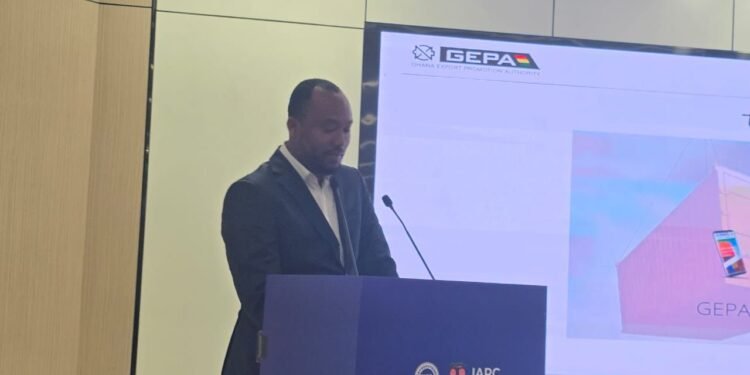
The Chief Executive Officer of the Ghana Gold Board (GoldBod), Sammy Gyamfi, has firmly rejected claims that the institution incurred losses under the Gold-for-Reserves (G4R) programme, insisting that GoldBod closed the 2025 financial year with a significant surplus.
Speaking amid public debate surrounding a reported US$214 million loss allegedly linked to the gold policy, Mr. Gyamfi described the claims as misleading and factually incorrect.
“Unequivocally, no. GoldBod has not recorded any losses,” he stated, adding that while the institution is not set up as a profit-making entity, its financial position remains robust.
According to Mr. Gyamfi, unaudited management accounts for 2025 show that GoldBod generated revenues exceeding GH₵960 million, while total expenditure for the same period was under GH₵120 million. He said the figures clearly point to a healthy income position at the close of the financial year.
“These figures are drawn from our management accounts, and all indicators suggest that we are heading towards declaring a healthy income surplus.”
Sammy Gyamfi, Chief Executive Officer of GoldBod
He explained that, unlike private commercial entities, GoldBod as a public institution declares surplus rather than profit, a distinction he said is often overlooked in public discourse.
Based on conservative projections, Mr. Gyamfi indicated that GoldBod is expected to post a surplus in the range of GH₵700 million to GH₵800 million for the 2025 financial year.


Transparency and Legal Compliance

The GoldBod CEO emphasised that the institution operates under strict legal and accountability frameworks. He pointed to Section 42 of the Ghana Gold Board Act, which mandates the publication of quarterly financial statements.
Mr. Gyamfi said GoldBod has fully complied with this requirement since its establishment. He further disclosed that the Auditor-General is expected to complete the external audit of the Board’s accounts by the end of the first quarter of 2026.
Once the audit is concluded, he said, the audited financial statements will be made publicly available to provide further clarity on the institution’s financial position.
Responding to suggestions that GoldBod may have transferred losses onto the books of the Bank of Ghana (BoG), Mr. Gyamfi dismissed the claim as illogical and unfounded. “How can an entity that has not made losses pass on losses to another institution?” he asked.
He reiterated that the Gold-for-Reserves programme is a policy initiative of the Bank of Ghana, introduced in 2022 and fully financed by the central bank. According to him, all financial records associated with the programme have consistently been reflected in the BoG’s accounts.
Questioning Attribution of Losses

Against this background, the GoldBod CEO questioned the rationale behind attempts to attribute any alleged losses from the programme to GoldBod, which has been operational for barely eight months. “On what basis does an eight-month-old institution become responsible for losses attributed to the Bank of Ghana?” he asked.
He maintained that GoldBod has fully accounted for all funds received from the central bank under the programme, supplied gold of equivalent value, and earned only the agency fees approved for its role.
Mr. Gyamfi said efforts to link GoldBod to losses under the Gold-for-Reserves programme risk distorting public understanding of Ghana’s gold policy and undermining confidence in new institutions created to strengthen oversight of the sector.
He reaffirmed GoldBod’s commitment to transparency, accountability and efficient management of Ghana’s gold resources, stressing that the institution’s early financial performance demonstrates its capacity to deliver value within its mandate.
As public scrutiny of Ghana’s gold policies continues, Mr. Gyamfi’s clarification places renewed focus on the distinction between GoldBod’s regulatory role and the Bank of Ghana’s monetary policy initiatives, while underscoring the Board’s strong financial footing in its first year of operation.
READ ALSO: Ghana on Track to Achieve 30% Renewable Energy Target