Ghana has launched its Cabinet-approved Pharmaceutical Manufacturing Policy to double domestic medicine production and position the country as West Africa’s primary pharmaceutical hub and boost pharmaceutical exports.
Launching the policy, Minister for Trade, Agribusiness and Industry Elizabeth Ofosu-Adjare explained that the framework seeks to reduce Ghana’s dependence on imported medicines, which currently account for 70 per cent of supply. It aims to increase the share of medicines manufactured locally from 30 per cent to 60 per cent, supporting President John Dramani Mahama’s target of 70 per cent pharmaceutical self-sufficiency.
“Medicines are not ordinary goods. A country that cannot produce its own essential medicines leaves its health, economy, and sovereignty vulnerable,”
Minister for Trade, Agribusiness and Industry Elizabeth Ofosu-Adjare
The policy establishes a coordinated framework to guide investment, regulation, public procurement, skills development and regional trade in support of Ghanaian pharmaceutical manufacturers.
Mrs Ofosu-Adjare warned that medicines are “not ordinary goods” and that dependence on foreign supply can leave a country’s health, economy and sovereignty vulnerable. She stressed that the sector required aligned support across government and industry to expand manufacturing capacity and improve the availability of locally produced medicines.

“This policy provides a single, coordinated framework to align investment, regulation, public procurement, skills, and regional trade behind Ghanaian manufacturers,”
Minister for Trade, Agribusiness and Industry Elizabeth Ofosu-Adjare
Quality Standards and Market Access for Local Producers
One of the policy’s six pillars focuses on quality and global standards. The government intends to assist local manufacturers to achieve World Health Organization Good Manufacturing Practice certification and prequalification, supporting their ability to meet recognised production requirements.
The framework also seeks to strengthen market access for medicines produced in Ghana. It proposes using public procurement and the National Health Insurance Scheme (NHIS) to prioritise quality, locally manufactured medicines.
The approach places government purchasing and health financing among the tools intended to support domestic manufacturers. By linking local production with public procurement, the policy seeks to create stronger opportunities for Ghanaian firms while maintaining a focus on medicine quality.

Financing to Expand Pharmaceutical Manufacturing
Access to long-term financing forms another pillar of the policy. The government plans to work with Development Bank Ghana, Ghana EXIM Bank and GIPA to deliver affordable financing for the sector.
The framework also aims to move the industry further up the value chain. Beyond packaging medicines, Ghana intends to expand into the production of active pharmaceutical ingredients, excipients and vaccines locally.
The policy identifies research and skills development as essential to the sector’s growth. It seeks to strengthen collaboration between academia and industry while equipping clinical pharmacists with the skills required for industrial manufacturing roles.
The inclusion of local vaccine production and pharmaceutical inputs signals an intention to extend domestic activity into more stages of the medicine supply chain. The policy outlines these priorities as part of its wider approach to building manufacturing capacity.
Ghana Targets Regional Pharmaceutical Markets
Regional trade expansion is the sixth pillar. The government intends to use opportunities under the African Continental Free Trade Area (AfCFTA) and the Economic Community of West African States (ECOWAS) to double the value of pharmaceutical exports.
The strategy places Ghana’s domestic manufacturing ambitions within a regional market, with export growth identified as a policy objective. Building local production capacity and meeting quality standards are central elements of the framework as the country seeks to strengthen its position in pharmaceutical trade.
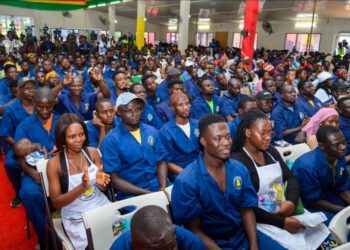
The policy launch brought together representatives from institutions involved in health, finance, regulation, investment and international cooperation. Participants included the Ministry of Health, Ministry of Finance, Food and Drugs Authority, National Vaccine Institute, Development Bank Ghana, GIZ, the World Health Organization and the European Union.

Policy Seeks to Reduce Import Dependence
Ghana’s current reliance on imported medicines provides the central challenge the policy is designed to address. By targeting a rise in the local market share of manufactured medicines from 30 per cent to 60 per cent, the government has set a measurable production objective while retaining a longer-term target of 70 per cent self-sufficiency.
The six pillars combine manufacturing standards, market access, financing, value-chain expansion, skills development and export growth. Together, they provide the framework through which the government intends to strengthen Ghanaian producers and develop the country’s pharmaceutical industry.
Mrs Ofosu-Adjare’s address placed medicine production within the wider concerns of public health, economic resilience and national sovereignty. The policy’s stated ambition is to reduce vulnerability linked to imported supply while positioning Ghana as a major pharmaceutical manufacturing centre in West Africa.
READ MORE: Ghana Sets 8% Public Sector Pay Increase for 2027, 10% for 2028