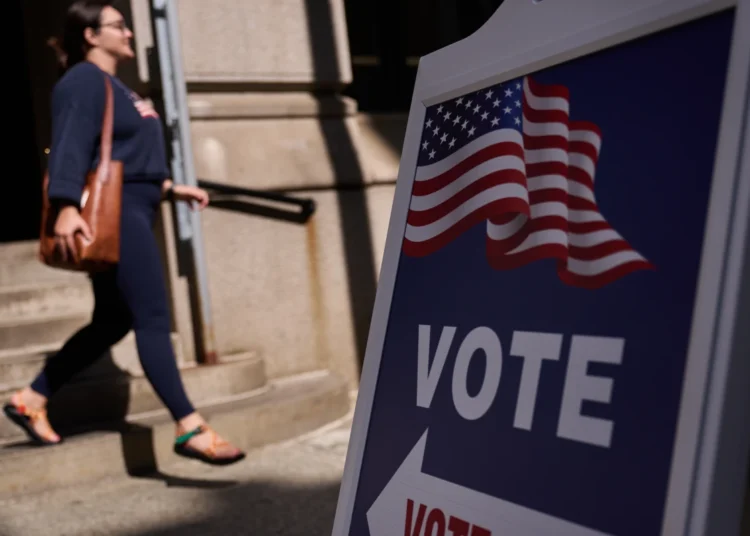
More than 54 million Americans have already cast ballots ahead of Tuesday’s US midterm elections, surpassing the early voting total recorded in 2022 as both parties make their final efforts to influence control of Congress.
According to data from the University of Florida Election Lab, early voting has exceeded the approximately 45.9 million ballots recorded before Election Day in the 2022 midterms by more than eight million. The figure includes ballots cast in person before Election Day and mail-in ballots returned early.
The elections on November 3 will determine control of the US House of Representatives and Senate, both currently held by Republicans. The results will shape the legislative environment for President Donald Trump during the remaining two years of his second term.
However, the increase in early voting does not establish which party will benefit. The outcome will depend on results across individual states and congressional districts, while early voting figures alone cannot determine how ballots will be distributed between the parties.
States with competitive Senate contests, including Texas, Maine and Kansas, have reported increases in early voting, according to the supplied account. South Carolina and North Carolina have also recorded higher participation than in 2022.
Trump Makes Final Campaign Push
Trump spent the final weekend of campaigning holding rallies in Iowa and Kansas, states he has previously won comfortably, as Republicans seek to retain their majorities in Congress.

The US President is expected to make his closing campaign pitch at the Lincoln Memorial Reflecting Pool today, the eve of Election Day. The appearance could also draw attention to his administration’s efforts to repair the site, a project that has faced criticism over its cost and progress.
The Republican campaign is unfolding against concerns about the party’s ability to maintain control of Congress, with the midterms serving as a public test of voter sentiment towards Trump’s second administration.
Democrats, meanwhile, are seeking to regain control of the Senate but have faced internal tensions in Michigan, where the party is contesting a closely watched race.
Former Democratic Senate primary candidate Haley Stevens endorsed Republican candidate Mike Rogers on Sunday. Stevens had lost the party’s August primary to Abdul El-Sayed, and her endorsement has reportedly intensified divisions among Democrats in the final days of the campaign.
The development adds uncertainty to the Democratic effort in Michigan, where party unity could be important to its attempt to secure a Senate majority.
Trump Administration Appeals Over California Ballots
Alongside the campaign activity, the Trump administration has appealed to the US Supreme Court in an effort to prevent thousands of disputed California mail ballots from being counted before voters’ citizenship status can be verified.
The emergency appeal, filed on Monday, followed lower-court decisions rejecting the administration’s request to set aside approximately 20,000 ballots associated with people the federal government suspects may not be US citizens.
The Justice Department has asked the Supreme Court for a limited injunction directing California officials to keep the disputed ballots separate from those considered valid while the legal case continues.
The federal government argues that the ballots should not be counted until the citizenship of the voters concerned has been confirmed. California officials, however, have challenged the reliability of the federal government’s list, arguing that it likely includes US citizens who are legally entitled to vote.
A district court judge previously rejected the administration’s request, warning that separating the ballots could disenfranchise eligible voters and disrupt the election. An appeals court also declined to grant the requested emergency relief.
US District Judge David O. Carter warned against excluding votes based on unproven allegations. “If the Executive can discount votes and threaten an ongoing election due to unproven allegations, then our democracy is in danger,” Carter wrote.
The Justice Department has argued that its request is intended to prevent potentially unlawful votes from being counted before the citizenship of the individuals involved is established. California officials maintain that the government’s list is unreliable and should not be used to withhold ballots from eligible voters.
Noncitizens are generally prohibited from voting in federal elections, although available evidence indicates that such voting is rare. The dispute centres on whether the people identified by federal authorities are actually ineligible and whether their ballots should be separated while that question remains unresolved.
California has sent mail ballots to its approximately 23 million registered voters, with voting underway since early October. Hundreds of thousands of ballots had already been processed when the legal dispute intensified.
The administration’s appeal adds a significant legal dimension to the final day of campaigning, as election officials continue preparations for Tuesday’s vote.
Control Of Congress At Stake
The early voting surge, campaign disputes and legal challenges come as both parties seek to mobilise supporters before polls close.
Republicans are defending their control of the House and Senate, while Democrats are attempting to win enough seats to shift the balance of power. The results will influence the administration’s ability to advance its legislative priorities and determine the extent of congressional scrutiny it faces during the remainder of Trump’s term.
Although the number of early ballots suggests substantial participation before Election Day, it does not reveal the final turnout or establish which party is positioned to win.
Attention now turns to tomorrow’s voting and the results from closely contested races, which will determine the next balance of power in Washington.
READ ALSO: Standard Chartered Ghana’s GH¢354m Profit Raises Fresh Questions Over Sale Value