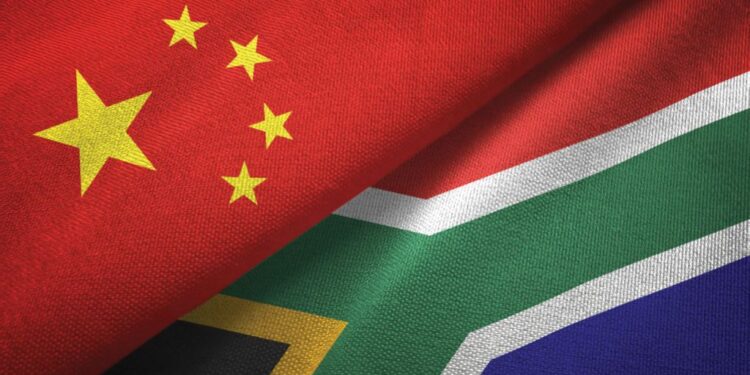
South Africa and China have strengthened their economic partnership with a renewed push for Chinese investments in key sectors, including mining, energy, and infrastructure. The announcement came during the ninth annual South Africa-China trade promotion conference held on Tuesday.
The new phase of cooperation arrives at a time when South Africa faces steeper import tariffs from the United States under the African Growth and Opportunity Act (AGOA). With tariff levels raised to 30% under the Trump administration, Pretoria is seeking alternative trade avenues while exploring improved terms with Washington.
Zhang Chaoyang, chairman of the South Africa-China Economic and Trade Association, revealed a major development in the mining sector. Gold One, owned by the Chinese state-owned Baiyin Nonferrous Group Company Ltd., will inject 4 billion rand ($230 million) into gold mining operations in Gauteng. In addition, the China-Africa Development Fund confirmed its intention to bid for South Africa’s independent energy transition projects, which aim to expand the nation’s electricity capacity through private sector involvement.
Chaoyang also highlighted plans by China State Construction to increase local procurement, signaling an expansion of Chinese commercial activity within South Africa.
Deputy Trade Minister Zuko Godlimpi described the growing economic relationship as pivotal to South Africa’s development strategy. He said the government is placing priority on Chinese investments in manufacturing, services, and infrastructure while underscoring the broader importance of energy transition. Calling the partnership an opportunity to build “a mutually beneficial future,” Godlimpi welcomed Beijing’s deepening role in South Africa’s economy.
Chinese firms already have a significant presence in the country. Companies such as Hisense, BAIC, Sinosteel, Faw, and Seraphim Solar have established major operations, embedding themselves within South Africa’s industrial landscape.
Bilateral Trade Strengthens Economic Partnership
Official figures reveal that Chinese foreign direct investment in South Africa reached $13.21 billion in 2024, compared with South Africa’s $8.05 billion investment in China. Minerals remain the backbone of South Africa’s exports to Beijing, accounting for 93%, while Chinese exports to Pretoria are dominated by manufactured goods at 92%. Both nations have acknowledged the need to rebalance this trade structure.
Chinese Ambassador Wu Peng emphasized that Chinese companies are committed to localizing production and accelerating their investments. “If you really want to look after your long-term interests, you must invest in South Africa,” he said, urging Chinese automakers in particular to speed up factory development.

Earlier in 2025, Beijing pledged to extend zero-tariff treatment to all 53 African nations maintaining ties with China. Peng noted that more than 30 countries had already signed framework agreements under this initiative.
South Africa and China’s trade relationship has grown steadily over the past two decades, with China emerging as South Africa’s largest trading partner. Bilateral trade now exceeds $50 billion annually, built largely on South Africa’s exports of raw commodities and China’s exports of manufactured goods, electronics, and machinery.
The partnership is bolstered by South Africa’s support for China’s Belt and Road Initiative, which has facilitated infrastructure investment and improved connectivity. However, concerns persist within South Africa over trade imbalances and the impact of cheaper Chinese goods on domestic manufacturing. Both governments have pledged to address these concerns through bilateral forums designed to expand and diversify cooperation.
As such, Pretoria aims to leverage its membership in the African Continental Free Trade Area to expand intra-African commerce, positioning itself as a gateway for Chinese investment across the continent. While challenges remain, the trajectory of trade and investment suggests that ties between South Africa and China will only deepen, cementing their mutual role in shaping Africa’s economic future.
READ ALSO: EC Declares NDC’s Alidu Seidu Winner in Tamale Central By-Election