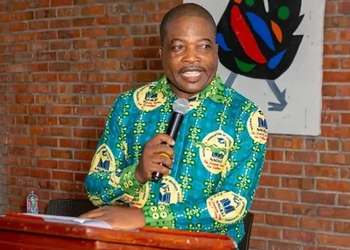

Dr. Peter Anti Partey, the Executive Director of the Institute for Education Studies (IFEST), has called for an urgent, fundamental shift in how Ghana analyzes and addresses the national decline in academic performance, following the release of the 2025 West African Senior School Certificate Examination (WASSCE) results.
Dr. Partey sternly warned that the nation’s fixation on broad, national averages and political point-scoring is masking a systemic “distribution crisis,” that requires scientific, micro-level diagnostics.
The 2025 WASSCE results showed a disturbing performance drop, notably in Core Mathematics, where more than 200,000 candidates failed, with only 48.73% obtaining passes. Social Studies also recorded a decline, with just 55.82% of candidates achieving a passing grade – figures that many stakeholders have branded as some of the worst in recent history.
The IFEST boss argued that the common public debate that erupts annually is lazy and unproductive, driven by mere assumptions and political narratives rather than evidence, stressing that without data-driven analysis, Ghana will continue to fail its children.
“People might want to talk about the issue and touch on everything but these are perceptual reasons. They are not scientifically founded because we are not undertaking any rigorous exercise to determine the linkage between these variables and the performance”
Dr. Peter Anti Partey, Executive Director of the Institute for Education Studies
The core of Dr. Partey’s critique was that the national average – the single figure that dominates headlines – hides the true nature of the problem: vast, chronic disparities in school performance.

He pointed out that while some Senior High Schools continue to push the national averages upwards with pass rates of 60 to 90 per cent, others have been consistently stuck below the 20 per cent mark for years. “The national averages… are just an aggregation of individual school performances,” he explained “if some people perform poorly, they drive the overall average down.”
He drew a compelling analogy to economics, arguing that trying to fix WASSCE performance by only looking at the national average is the same mistake economists would make if they tried to analyze inflation without breaking down the specific goods driving prices.
“To understand inflation, you do not examine the overall rate alone; you break it down. Is it food? Transport? Rent? Only then can you craft targeted solutions. Education is no different”
Dr. Peter Anti Partey, Executive Director of the Institute for Education Studies
He warned that focusing solely on whether Free SHS is working or failing – a favorite political pastime – masks the real issue: persistently low-performing schools that drag national outcomes down year after year.
Micro-Level Diagnostics
Dr. Partey’s call for a new approach was rooted in the necessity of scientific examination. He demanded that the Ministry of Education move away from the “lazy comfort” of national averages and embrace the “hard work of mirco-level analysis.”
This requires rigorous examination of the data, he revealed, including, item analysis – determining which specific exam questions students failed, and why; examiner reports – detailed feedback from WAEC examiners; and school-by-school performance breakdowns – publicly identifying which schools are excelling, which have improved, and which are perpetually deteriorating.

“We should ask the Ministry of Education to let us know which schools are pulling the national averages down and what interventions are the ministry ready to provide for these schools”
Dr. Peter Anti Partey, Executive Director of the Institute for Education Studies
For Dr. Partey, policymakers must be able to point clearly to what factors – teachers, facilities, leadership, or student preparation – explain the differences in performance. A school that has recorded 8 per cent pass rates for five straight years does not need the same support as a school performing at 70 per cent, yet current policies often treat them identically.
He further urged stakeholders to avoid allowing the debate to be co-opted by political commentators, stressing that such discussions do not help the individual student or the objective view of the situation.
Dr. Partey concluded that “Ghana does not face a national performance crisis as much as it faces a distribution crisis,” where a small cluster of perpetually underperforming schools determines whether the national average rises or falls.
He suggested that if even a fraction of these schools were supported to move from 10 per cent pass rates to 35 or 40 per cent, the national picture would change dramatically.
While the Ghana Education Service (GES) defended the outcomes, claiming the results reflect a more credible assessment of students’ abilities due to strengthened anti-examination-malpractice frameworks rather than deficiencies in teaching, Dr. Partey’s message remained.

For him, “a nation that measures properly can intervene properly,” and analysis must stop being a political ritual. Until the Ministry and GES adopt detailed school-level diagnostics, struggling schools will remain invisible in the data and in the policy response.
READ ALSO: Zelenskyy Draws a Hard Line in Paris as Macron Warns Russia Is Running Out of Time