Ghana’s push toward an export-led economy is gaining momentum as manufacturing firms increasingly turn to local sourcing of raw materials to strengthen value chains, create jobs and boost foreign exchange earnings.
The Minister of Trade, Agribusiness and Industry, Elizabeth Ofosu-Adjare, says this approach is central to Ghana’s industrialisation agenda and key to transforming the country into a manufacturing and export hub for West Africa and beyond.
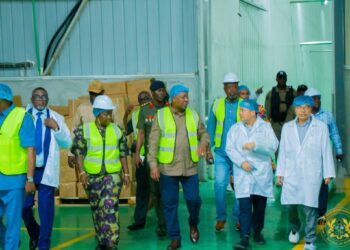
Speaking during a working visit to food manufacturing company GB Foods, the Minister praised the firm’s decision to venture fully into commercial farming next year to secure its raw material needs locally. She described the move as a model for other manufacturers operating in Ghana. “This is exactly what we are looking for. When raw materials are sourced locally, we can confidently say we are industrialising,” Mrs Ofosu-Adjare said.
Value chains that create jobs
According to the Minister, sourcing raw materials locally unlocks value across multiple layers of the economy, from agriculture and transportation to processing and export. She stressed that industrialisation must benefit not only factories but also farmers, logistics providers and other players along the production chain.
“If we enjoy the whole value chain, that is where we get all the value. Sourcing raw materials locally means jobs for our farmers, jobs for our transporters, and benefits for everyone along the chain.”
Elizabeth Ofosu-Adjare
She noted that by next year, between 90 and 100 per cent of GB Foods’ raw materials were expected to be sourced locally, significantly reducing reliance on imports while strengthening domestic production capacity.
Beyond local sourcing, the Minister commended GB Foods for maintaining high production standards, highlighting the company’s laboratories and strict processing systems that ensure quality before products reach the market. She said such standards were critical if Ghanaian-made products were to compete effectively on regional and international shelves.
The Minister also pointed to the company’s growing export footprint, with products already reaching markets such as Burkina Faso. She said exports of manufactured goods were essential for building a resilient economy and improving Ghana’s foreign exchange position.
“Manufacturing in Ghana and exporting to West Africa and beyond is the future. With the African Continental Free Trade Area headquartered here, Ghana is the right place to invest and export,” shesaid, referencing the opportunities created by African Continental Free Trade Area.
She reaffirmed government’s vision of positioning Ghana as a hub for industrialisation in Africa, citing the country’s stable democracy and investment-friendly environment as key advantages.
Water challenges raise production costs
While welcoming the policy direction, Director for Institutional Affairs and Agribusiness Africa at GB Foods, J. Teddy Ngu, called for stronger government support to address infrastructural challenges, particularly water supply.
He revealed that the company spent about €700,000 on water and relied on water tankers for roughly 90 per cent of its water needs due to infrequent supply from Ghana Water Limited. He said such costs placed pressure on production and competitiveness.
Dr Ngu disclosed that the company was pursuing backward integration and had secured about 6,000 hectares of land in the Afram Plains for large-scale farming. Under a pilot phase, tomatoes were already being cultivated, with some of the produce consumed locally.
Scaling up farming and processing
Plans are underway to scale up operations significantly. By next year, the company expects to operate a 2,000-metric-tonne-per-day factory supported by about 4,000 hectares of company-owned farms and 2,000 hectares cultivated by outgrowers.
The outgrower scheme will cover crops such as tomatoes, onions, ginger, garlic and turmeric. According to Dr Ngu, the initiative will create jobs, support farmers and ensure a steady supply of raw materials for processing and export.
“Today, Ghanaians are seeing products exported from Ghana to Burkina Faso instead of imports. This is the Ghana-made, export-led economy we are working towards.”
Elizabeth Ofosu-Adjare
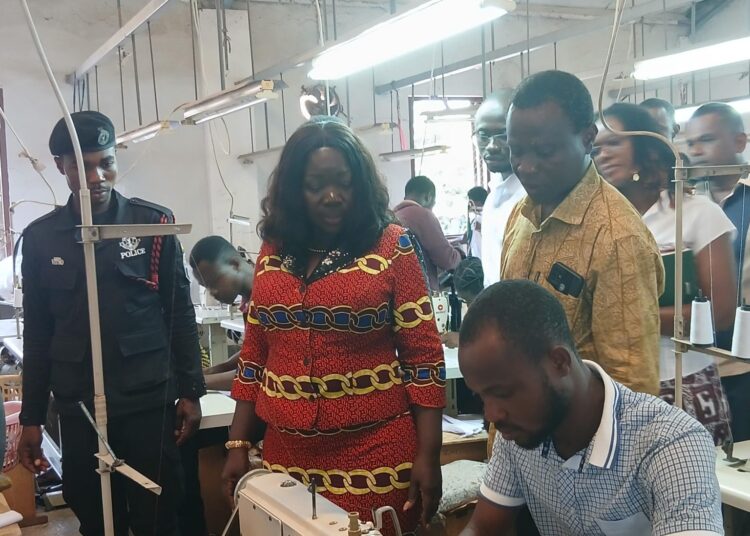
The Minister’s working visit also took her to Precious Textiles Company Limited in Tema, where she disclosed that government had developed a draft policy on garments and textiles. She announced plans to establish three new garment plants across the country as part of efforts to revive the sector.
“We are high on garments and textiles. As we prepare to roll out new plants, we are also looking at how existing factories like Precious Textiles can be supported to grow.”
Elizabeth Ofosu-Adjare
She noted that the company was operating at about 30 per cent capacity due to limited business and market access. To address this, government plans to prioritise local garment factories in the production of uniforms for security agencies. “We are putting together a committee to ensure that all security agencies sew their uniforms in Ghana. Factories like this will be brought on board so they can get part of these contracts,” the Minister said.
“The days where we go outside Ghana to sew while our factories suffer are over. With the right contracts and leadership, these factories can be revived, increase employment and eventually compete internationally.”
Elizabeth Ofosu-Adjare
Together, these initiatives signal a broader shift toward an export-led growth model anchored in local production, strong value chains and regional trade. As Ghana-made goods increasingly find their way into West African markets, policymakers and manufacturers alike see an opportunity to transform the economy, create sustainable jobs and position Ghana as a leading industrial force on the continent.
READ ALSO:Gov’t to Balloon Export Growth Via Credit Facilities for Exporters