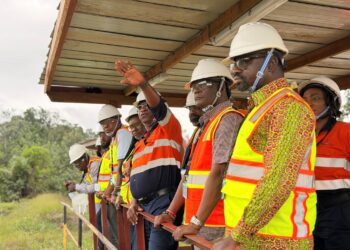
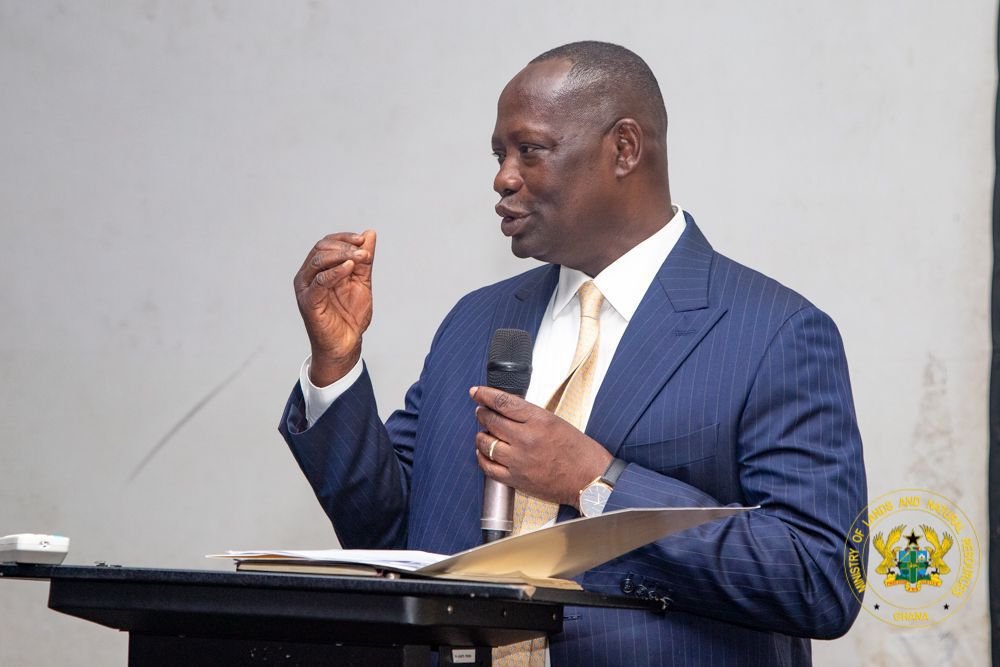
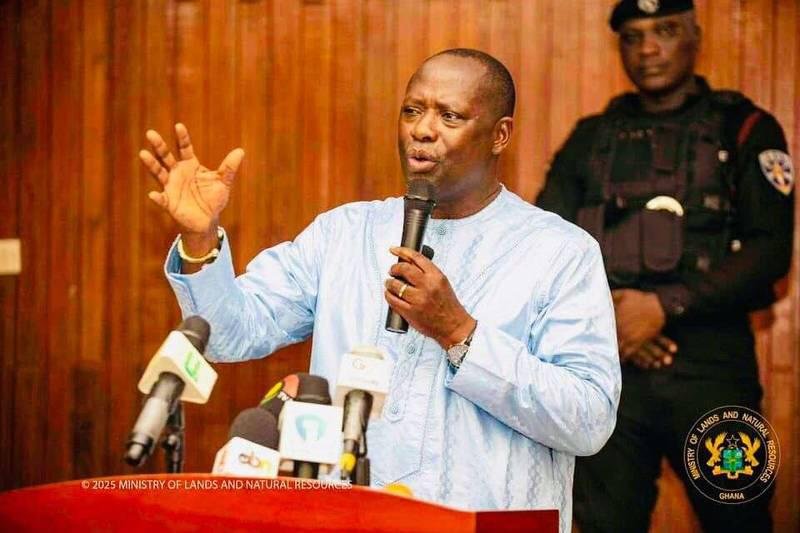
Minister of Lands and Natural Resources, Hon. Emmanuel Armah-Kofi Buah, has granted mining operating permits to the Anwia and Teleku Bokazo Responsible Cooperative Mining Society Ltd in the Ellembelle District of the Western Region.
The strategic intervention signals the commencement of the Responsible Cooperative Mining and Skills Development Programme (rCOMSDEP).
By transitioning local miners from unregulated activities into a structured cooperative framework, the government aims to harmonize economic empowerment with rigorous environmental stewardship.
The issuance of these permits follows extensive negotiations spearheaded by the Minister to secure an abandoned concession formerly held by Adamus Mining Limited.
This mineral-rich land, now returned to the state, serves as the primary site for the inaugural phase of rCOMSDEP, providing a legal and lucrative avenue for residents who have historically relied on subsistence farming and informal mining.
Beyond mere land access, the programme integrates a robust technical support system where cooperatives are equipped with mercury-free processing technologies and advanced water treatment facilities to mitigate the ecological footprint of their operations.
“The cooperatives will be guided by strict rules and regulations. Under this programme, we are introducing modern technologies that allow miners to extract minerals efficiently and in high volumes without the use of mercury.”
Hon. Emmanuel Armah-Kofi Buah
Paradigm Shift in Artisanal Mining Governance

The rCOMSDEP initiative represents a critical departure from traditional “galamsey” operations by institutionalizing accountability at the grassroots level.
According to Ing Frank Asare Pedro, Esq., the CEO of rCOMSDEP, the formalization of these cooperatives is the most potent weapon against illegal mining.
By bringing miners under the regulatory umbrella of the Minerals Commission, the Environmental Protection Agency (EPA), and the Water Resources Commission, the state can ensure that every ounce of gold is extracted in compliance with the Minerals and Mining Act, 2006 (Act 703).
This governance model is designed to be self-sustaining and inclusive. Unlike previous schemes, rCOMSDEP emphasizes a profit-sharing formula that prioritizes community development, with significant portions of revenue earmarked for local infrastructure and land reclamation.
The Western Regional Minister, Joseph Nelson, has lauded this approach, noting that it offers a “clear choice for illegal miners” to either embrace the law through these cooperatives or face the full rigours of the state’s enforcement agencies as they work to protect Ghana’s ravaged forest reserves and water bodies.
Advancing Responsible Mining Through rCOMSDEP
The importance of rCOMSDEP lies in its ability to bridge the gap between large-scale mining interests and community-led extraction.
By securing concessions from entities like Adamus Mining Limited, the government is effectively “democratizing” mineral wealth.
This provides a blueprint for how the Ministry can manage similar transitions in other mining hubs across the country.
The success of the Anwia and Teleku Bokazo model will serve as a proof-of-concept that small-scale mining can be both profitable and environmentally benign when backed by state-of-the-art technology and vocational training.
Furthermore, the programme addresses the socio-economic drivers of illegal mining by offering skills development.
Miners are not just given permits; they are transformed into professional artisanal miners who understand the chemistry of mineral processing and the biology of land restoration.
This holistic training ensures that once a concession is exhausted, the land is returned to a state suitable for agriculture, thereby safeguarding the long-term food security of the Western Region.
Future Prospects and Regional Scalability
As the first beneficiaries “break the ice,” the Ministry of Lands and Natural Resources is already looking toward a nationwide rollout.
The integration of “Blue Water Guards” and the National Anti-Illegal Mining Operations Secretariat (NAIMOS) into the monitoring framework of rCOMSDEP ensures that the high standards set at Anwia and Teleku Bokazo are maintained.
This initiative is not merely a local project but a national strategy to restore the integrity of Ghana’s extractive industry.
By fostering a culture of “responsible cooperative mining,” the government is positioning Ghana as a leader in ethical mineral sourcing.
This is crucial at a time when global markets are increasingly demanding transparency and sustainability in the gold supply chain.
For the people of Ellembelle, these permits are more than just legal documents; they are a gateway to a dignified livelihood and a cleaner, greener future for the generations to come.
READ ALSO: Chairman Wontumi’s Legal Woes Deepen as AG Indict Him in a ¢24m EximBank Loan Loss