
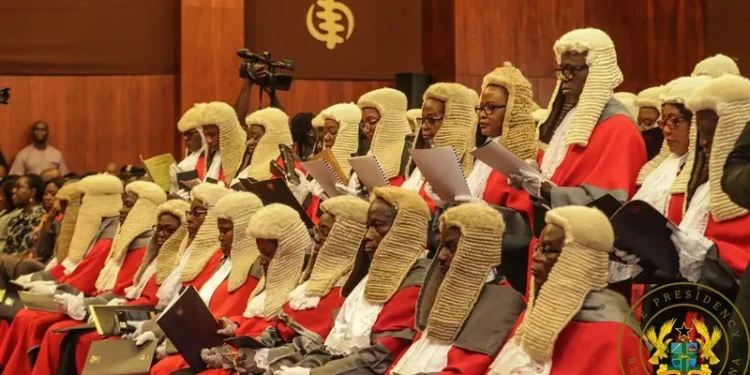
Ghana’s Constitutional Review Committee (CRC) has proposed far-reaching reforms to the structure, composition and governance of the judiciary, including a cap on the number of Supreme Court justices, new merit-based appointment procedures, and clearer rules for tenure and removal.
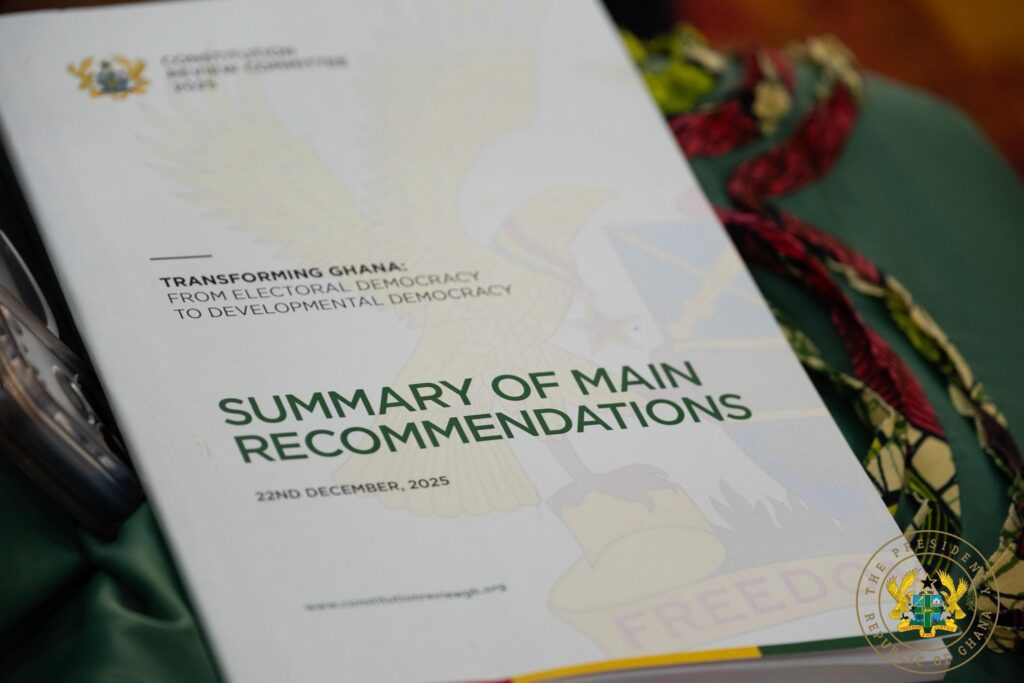
The recommendations form part of the committee’s final report submitted to President John Dramani Mahama on December 22, 2025, after nearly eleven months of nationwide consultations and technical analysis.
At the centre of the proposals is a recommendation to amend Article 128(1) of the 1992 Constitution to limit the size of the Supreme Court to a maximum of fifteen members, comprising the Chief Justice and no more than fourteen other justices.
According to the committee, prescribing an upper limit would preserve flexibility in appointments while preventing excessive expansion of the apex court, a concern that has grown alongside debates over judicial independence and efficiency.



The CRC explained that the proposed cap is tied to its broader recommendation to streamline the appellate jurisdiction of the Supreme Court in order to reduce its workload.
By narrowing the types of cases that reach the apex court and reorganising its internal structure, the committee believes the court can function more efficiently without the need for continuous expansion.

In contrast, the committee advised against imposing numerical limits on the Court of Appeal and the High Court, arguing that their composition should remain adaptable to population growth, rising caseloads and changing demands in justice delivery.
A Comprehensive Overhaul of Chief Justice Appointment
Beyond numbers, the CRC outlined a comprehensive overhaul of the qualifications and appointment processes for the Chief Justice and other justices of the superior courts.
For the position of Chief Justice, the committee recommended that eligibility be restricted to Ghanaian citizens who are either serving justices of the Supreme Court or distinguished legal practitioners with at least fifteen years of post-qualification experience at the Bar and no record of disciplinary sanctions.
Under the proposed appointment framework, a vacancy in the office of Chief Justice would trigger a public notice issued by the Judicial Council inviting applications from eligible candidates.
The Judicial Council would review submissions and shortlist qualified applicants before forwarding the list to the Council of State. The Judicial Committee of the Council of State would then conduct in-camera interviews and, in consultation with the Judicial Council, recommend two or three candidates ranked in order of merit.

From this shortlist, the President would nominate one candidate for parliamentary approval by a simple majority, following a transparent vetting process. Once approved, the President would formally appoint the nominee, with a requirement that a new Chief Justice be appointed within ninety days of a vacancy.
The committee further proposed that if Parliament rejects a nominee, the President must make a fresh nomination within ten days from the remaining names on the shortlist submitted by the Council of State. This, the CRC said, is intended to balance executive discretion with institutional checks and timely succession at the head of the judiciary.
Appointment of Other Justices of the Superior Courts
Similar merit-based processes were recommended for the appointment of other justices of the superior courts. For Supreme Court justices other than the Chief Justice, eligibility would be limited to practising lawyers or sitting Court of Appeal justices with at least fifteen years of post-qualification experience and no disciplinary sanctions.
Appointments would follow an advertised application process led by the Judicial Council, which would submit two names to the President for nomination and parliamentary approval.
For the Court of Appeal, the CRC proposed that appointees must be High Court judges or practising lawyers with a minimum of twelve years’ post-qualification experience and a clean disciplinary record.
High Court judges, in turn, would be drawn from the Circuit Court bench or the private Bar with at least ten years of experience. In each case, the Judicial Council would play a central role in identifying, evaluating and recommending candidates, reinforcing its position as the gatekeeper of judicial merit.
Checking the Powers of the Chief Justice
The report also seeks to curb the concentration of administrative power in the office of the Chief Justice. One recommendation calls for the removal of the Chief Justice as a member of the Court of Appeal and the High Court, limiting the role to presiding over the Supreme Court.
The committee argued that this change would preserve the hierarchical integrity of the courts and allow judges at each level to operate free from real or perceived interference.
To further enhance efficiency and predictability, the CRC proposed the creation of two permanent divisions within the Supreme Court: an Original Jurisdiction Division to handle constitutional interpretation and enforcement, and an Appellate Jurisdiction Division to hear appeals.
The Chief Justice would serve on both divisions and publish, at the start of each legal year, a list of justices assigned to each division. Any alteration to the list during the year would require approval from the Judicial Council.
Decentralisation of judicial administration is another key feature of the recommendations. The committee proposed the creation of a President of the Court of Appeal, drawn from the most senior justice, to oversee administration and empanelment alongside senior colleagues and the registrar.

For the High Court, supervising judges appointed by the Judicial Council in each region would manage operations, distribute cases, and maintain standards of efficiency and discipline.
Single, Non-Renewable Ten-Year Term for the Chief Justice
On tenure, the CRC recommended a single, non-renewable ten-year term for the Chief Justice, or retirement upon reaching the age of seventy, whichever comes first.
A Chief Justice whose term ends before the retirement age could elect to continue serving as a Supreme Court justice. Other justices of the Supreme Court and Court of Appeal would retire at seventy, while High Court justices would retire at sixty-five.
The report also standardised the grounds and processes for removing justices, citing mental or physical incapacity, incompetence, gross misconduct, violations of the judicial code of conduct, or bankruptcy.
Removal proceedings would begin with confidential petitions to the Council of State, followed by a structured tribunal process with clear timelines and safeguards, including in-camera hearings and representation from multiple institutions.
President Mahama has announced that an implementation committee will be established in early 2026 to translate the CRC’s recommendations into constitutional amendments, setting the stage for what could be one of the most significant judicial reforms since the promulgation of the 1992 Constitution.
READ ALSO: CRC Recommends Allocation of 3% Minerals Revenue to Host Communities