
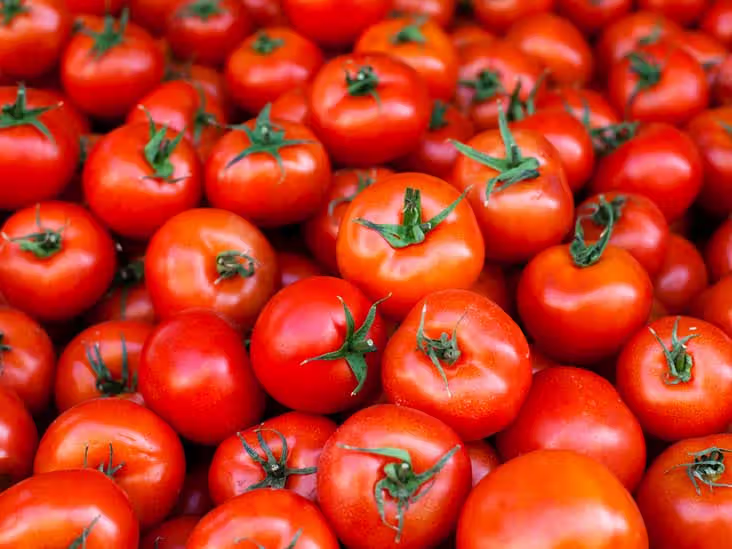
The Project Coordinator for the West Africa Food System Resilience Programme (FSRP) Ghana, Mr. Osei Owusu Agyeman, has overseen a transformative shift in Ghana’s agricultural logistics, as the Programme successfully delivered over 240 tons of fresh tomatoes to Accra’s major markets this week.
Mr. Agyeman confirmed that this breakthrough marks the first successful “dry season,” harvest under the innovative FSRP-FarmMate partnership – an initiative designed to tackle the perennial shortages that typically plague the Ghanaian market between December and May, effectively reducing the nation’s historical 66% reliance on imports from Burkina Faso.
“This project demonstrates that, with the right support, farmers can produce competitively even in the dry season and reduce the country’s reliance on imports.
“For many years, the dry-season production gap has necessitated significant imports… but improved agronomic practices and structured market linkages have been key to the early success recorded in the Upper East Region”
Mr. Osei Owusu Agyeman, Project Coordinator for the West Africa Food System Resilience Programme, Ghana
The arrival of the 240-ton consignment at hubs such as Agbogbloshie, the CMB Railway Market, and premium outlets like Palace Mall represents more than just a delivery; it is a proof of concept for a resilient local food system.
The Project Coordinator explained that by providing 1,500 farmers with “smart climate-resilient seeds,” and specialized fertilizers, the program has enabled year-round production in the Upper East Region – specifically in Zebila, Pwalugu, and Navrongo.
This strategic move directly addresses the $99.5 million annually lost to fresh tomato imports, keeping capital within the local economy.
A New Model
According to Mr. Agyeman, a cornerstone of the “tomato rescue” success is the transition toward a more equitable and transparent marketing system.
Traditionally, smallholder farmers were at the mercy of “market queens who determined prices based on arbitrary crate sizes.” Under the FSRP-FarmMate collaboration, a standardized weighing and payment system has been introduced.
This shift ensures that farmers are paid fairly based on the actual weight of their produce, a development that has significantly boosted farmer incomes and incentivized higher quality standards at the farm gate.
“The pricing is agreed collectively with the farmers, harvesting is done together, sorting is done on-site, and payment is prompt. This has significantly reduced post-harvest losses, and farmers are pleased”
Mr. Osei Owusu Agyeman, Project Coordinator for the West Africa Food System Resilience Programme, Ghana

The partnership currently covers over 200 acres nationwide, with 110 acres situated in the Upper East Region. By providing a guaranteed off-take, FarmMate Ltd has eliminated the “fear of the harvest” for local growers.
Mr. Agyeman added that farmers no longer have to worry about their produce rotting in the fields due to a lack of buyers; instead, tomatoes are now transported from the farm to urban markets in the Greater Accra Region within 24 to 36 hours.
Scaling for National Self-Sufficiency
Despite the early victory, the project leadership acknowledged that challenges such as free-grazing animals, water constraints, and pest pressure remain. However, the yields currently average 10 tons per hectare, with projections of reaching 15 tons per hectare by the end of the 2025 dry season.
The ultimate target for the FSRP Tomato Support Programme is to produce 6,000 metric tons of tomatoes, a goal that would fundamentally reshape the domestic vegetable trade and stabilize prices for the average Ghanaian consumer.
The involvement of the Ghana Standards Authority and the Council for Scientific and Industrial Research (CSIR) ensures that the produce reaching markets is not only local but also meets high safety and quality specifications
Mr. Agyeman further revealed that this focus on “chemical-free” and traceable production has already seen major hospitality players, such as the Accra City Hotel, opting to source directly from the FSRP-FarmMate project.
The successful delivery of 240 tons is viewed as a replicable blueprint for other agricultural value chains in Ghana. By merging public-sector oversight with private-sector efficiency, the FSRP is encouraging industrial-scale farming.
Plans are already in motion to expand production to at least 1,000 acres by the end of 2026, which would yield an estimated 4,000 tons of tomatoes annually for both the fresh market and local processing plants.
For Osei Owusu Agyeman and the FSRP team, the focus remains on entrenching the pillars of sustainability and ownership. By proving that the Upper East Region can feed Accra during the harshest dry months, the program is not just rescuing a supply chain – it is securing the future of Ghanaian food sovereignty.
READ ALSO: Amewu Backs Kennedy Agyapong’s Flagbearership Bid