The Government has announced the successful completion of three major coastal protection projects as part of a broader national strategy to address the growing threat of coastal erosion, flooding and community displacement along Ghana’s shoreline.
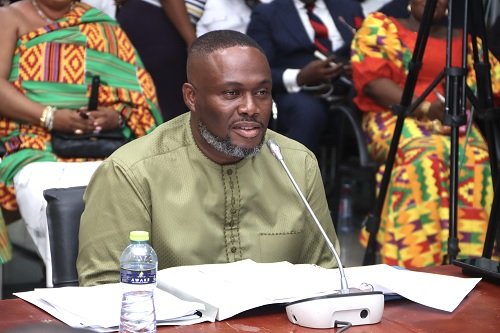
Speaking at the Government Accountability Series held at the Jubilee House, the Minister for Works, Housing and Water Resources, Hon Kenneth Gilbert Adjei, said the interventions demonstrate the government’s renewed commitment to safeguarding lives, livelihoods and critical infrastructure in vulnerable coastal communities.
“Ghana’s coastal belt continues to face significant threats due to the rising sea levels, resulting in flooding, shoreline erosion and community displacement. In response, my ministry has prioritised strategic coastal protection to safeguard lives, livelihoods and infrastructure.”
Minister for Works, Housing and Water Resources, Hon Kenneth Gilbert Adjei
Hon Adjei disclosed that coastal protection works have been fully completed at Komenda, Ningo Prampram and Elmina, marking a significant milestone in the government’s response to coastal degradation.
He noted that the three projects together have protected approximately fifteen kilometres of coastline, offering security to coastal settlements and preserving economic activity in the affected areas. At Komenda, the coastal protection project went beyond shoreline defence to include the construction of a critical bridge and a modern fish market.
These additional components, the Minister explained, were designed to improve connectivity and enhance livelihoods, particularly for fishing communities in British and Dutch Komenda. He said the completed infrastructure has already begun to support local economic activity by improving access to markets and easing movement within the area.
In Ningo Prampram, the intervention focused on extensive dredging works at the Ejale Lagoon Basin. Hon Adjei stated that the dredging has significantly improved protection for residential dwellings while restoring public access to the beachfront.
He described the project as an important balance between environmental protection and community access, noting that residents can now safely use coastal spaces that were previously threatened by erosion and flooding.
The third completed project forms part of the new Takoradi and Elmina emergency sea protection initiative. According to the Minister, the successful completion of the third phase has strengthened coastal defences in an area that has long been vulnerable to tidal waves and shoreline loss.
He emphasized that the combined impact of the three projects has delivered tangible relief to communities that had lived for years under constant threat from the sea.
Ongoing Coastal Protection Projects
Beyond the completed works, Hon Adjei outlined several ongoing coastal protection projects at various stages of completion across the country. He indicated that the Dansoman Sea Defence project is ninety five percent complete, while Phase Two of the Dansoman Emergency Sea Defence stands at fifteen percent completion.
Also, the Minister disclosed that the Disco Coastal Protection Project is thirty-six percent complete, with the Anomabo project reaching eighty one percent completion.
Further updates showed that the Cape Coast Coastal Protection Project Phase One is eighty percent complete, with Phase Two at twenty three percent. The Aboaze Coastal Protection Project has reached seventy five percent completion, while additional works at Axim are currently at twelve percent.
The Minister said these projects reflect a nationwide approach to addressing coastal erosion rather than isolated interventions. Hon Adjei also recalled the devastating tidal waves that struck parts of the Ketu South Municipality in March 2025, displacing thousands of residents in communities such as Salakope, Agavedzi and Amutinu.
He said President John Dramani Mahama personally visited the affected areas and made a firm commitment to address the destruction. According to the Minister, that promise is being fulfilled through the award of a contract for Phase Two of the Blekusu Coastal Protection Project.
He disclosed that the President officially cut the sod for the project in August last year and that work is progressing steadily, with the project currently twenty five percent complete. Hon Adjei noted that calm has already been restored along parts of the coastline, offering early relief to residents who had endured repeated tidal wave attacks.
In addition, the Minister announced that the Lower Volta Basin Sea Defence Corridor has been incorporated into the Waka Resilience Investment Project Phase Two. He said technical assessments and environmental impact studies are currently ongoing to guide implementation.
Feasibility Studies Underway for Future Coastal Protection Projects
Feasibility studies have also begun for future coastal protection projects at Shama in the Central Region, a second phase at Ningo Prampram, and Ada West in the Greater Accra Region.
Providing a broader context, Hon Adjei explained that the ministry’s recent progress forms part of a wider national reset aimed at strengthening communities and laying the foundation for sustainable development.
He stressed that coastal protection remains a critical pillar of this agenda, particularly as climate change continues to intensify environmental risks along Ghana’s coastline.
The Minister concluded that the government remains committed to expanding coastal protection interventions, improving urban drainage systems to mitigate flooding and ensuring that public infrastructure is resilient.
He said these efforts are essential not only for environmental safety but also for protecting livelihoods and promoting long term economic stability in coastal regions.