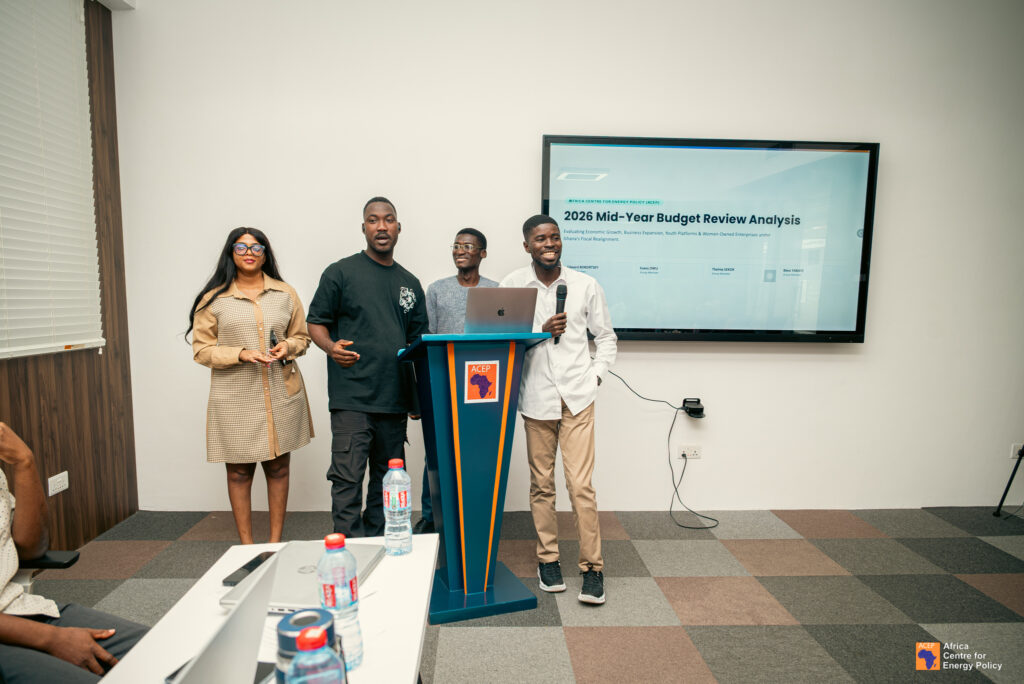
By: Evans Junior Owu, Bless Yaraye, Thelma Adzo, and Edward Bokortsey|| ACEP Media Fellows and Youth Champion for Fiscal Accountability Fellows
Ghana’s national accounts for the first half of 2026 showcase a compelling narrative of macroeconomic recovery, with real gross domestic product expanding by 6.4 percent in real terms.
Presented in the 2026 Mid-Year Fiscal Policy Review, this growth is paired with a notable reduction in national unemployment, which fell from 13.7 percent in 2024 to 12.8 percent in 2025.
State officials strongly attribute this upward trajectory not to a transient boom in extractive commodity prices, but to targeted structural reforms, major public infrastructure drives, and strategic energy-sector realignment designed to build long-term economic resilience.
Catalysts of Recovery: Infrastructure, Industrialization, and Energy Realignment
Historically, Ghana’s economic acceleration cycles have tracked international spot prices for crude oil, gold, and cocoa, exposing the domestic currency and national budget to severe external shocks.
The 2026 mid-year policy framework explicitly seeks to break this historical trap by anchoring growth in domestic industrial expansion, processing infrastructure, and structural energy reform.
Chief among these initiatives is the Agricultural Enclave Roads Programme, a US$523 million investment dedicated to constructing and upgrading 1,050 kilometers of targeted transport corridors to link rural farming belts directly to commercial centers. Alongside the broader Big Push Infrastructure Programme, these road networks are projected to generate roughly 25,000 direct and indirect jobs.

Simultaneously, industrialization efforts are expanding through the construction of three large-scale garment factories across the Bono East, Central, and Eastern regions, which are expected to add close to 27,000 direct jobs.
Agricultural value addition carries the boldest employment claim in the review through the Oil Palm Development Facility, which state planners project will create over 250,000 direct and indirect jobs across agricultural production, processing, and logistics.
In the midstream industrial space, a newly proposed Modular Gas Processing Facility is expected to add nearly 1,000 technical jobs while expanding domestic natural gas extraction.
The thermal power generation sector serves as another critical anchor of this mid-year policy review. Transitioning major baseload power assets from expensive imported liquid fuels to domestic natural gas has yielded immediate baseline cost reductions.
The operationalization of a 1,200-megawatt state-owned power plant is also set to create over 2,000 direct jobs while cutting power generation costs by 75 percent, saving the state GH¢3.08 billion in the first half of the year alone.
Government expects this facility to eventually push retail electricity tariffs down by 10 to 20 percent, directly easing overhead costs for industrial enterprises.
Fiscal Imperatives: Critical Accountability Questions and Vulnerabilities Ahead
However, a rigorous fiscal appraisal reveals that translating these headline growth figures and ambitious targets into verifiable economic returns requires confronting several critical accountability questions.
First, public finance managers must clarify how the US$523 million Agricultural Enclave Roads Programme is being financed, specifically whether these commitments are captured under primary budget ceilings or rely on off-balance-sheet vehicles that risk accumulating unrecorded public liabilities.
Clear accounting is essential to ensure that current infrastructure gains do not trigger future debt distress. Second, the government must clarify how the reported GH¢3.08 billion in energy savings is being utilized.
Crucial questions remain as to whether these funds are directly addressing legacy inter-company debts across the energy value chain, such as outstanding balances owed to Independent Power Producers and fuel suppliers, or if they are being redirected into non-revolving expenditures.
Furthermore, the methodology underpinning the projected 250,000 oil palm jobs requires transparent verification to distinguish between full-time formal employment with social security coverage and seasonal, informal labor.
Addressing these accountability gaps is urgent, as failure to institutionalize strict oversight over capital allocations exposes the current recovery to severe structural risks. Unbudgeted execution costs on large infrastructure projects risk widening the primary deficit and undoing hard-won macroeconomic stability.

Similarly, if fuel-switch savings are not applied systematically to resolve legacy energy debts, recurring liquidity shortfalls could impair natural gas deliveries, threatening grid stability and private enterprise productivity.
Ultimately, Ghana’s 6.4 percent growth in the first half of 2026 demonstrates the clear benefits of structural energy adjustments and targeted public investment. Moving from a temporary recovery to sustained economic transformation will require unwavering fiscal discipline, transparent debt reporting, and rigorous verification of labor metrics.
Ensuring that energy cost savings directly lower operational expenses for local businesses will determine whether this mid-year momentum marks a genuine structural shift or merely a brief pause before underlying fiscal vulnerabilities resurface.