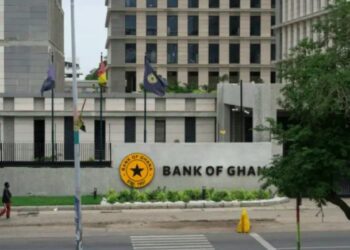
Ghana’s banking sector could be heading for another dangerous chapter if policymakers focus too heavily on raising capital while failing to confront the governance weaknesses that contributed to previous financial-sector failures.
Banking and finance expert Dr Richmond Akwasi Atuahene has issued a stark warning that simply demanding more money from banks and specialised deposit-taking institutions will not guarantee stability.
According to Dr. Atuahene, stronger capital requirements are important, but they could become an expensive illusion of safety if the Bank of Ghana fails to strengthen corporate governance, supervision and enforcement at the same time.
Capital Is Not the Whole Solution
The debate over higher minimum capital requirements has gained importance as Ghana seeks to strengthen financial institutions and prevent another banking crisis.
More capital can provide banks with greater capacity to absorb losses, protect depositors and withstand economic shocks. It can also encourage weaker institutions to attract new investors, merge with stronger firms or exit the market.
But Dr. Atuahene argues that capital alone cannot prevent reckless behaviour.
A bank could meet a new capital requirement today and begin destroying that capital tomorrow if directors approve questionable loans, shareholders use deposits to finance related businesses or executives override established risk controls.
The expert therefore believes Ghana must look beyond balance-sheet figures and focus on what happens inside the boardroom.
Governance Failures Could Destroy Fresh Capital
One of the biggest concerns highlighted by Atuahene is insider and related-party lending.
He points to instances where shareholders and managers allegedly extended large unsecured loans to themselves or affiliated companies without following normal credit procedures or respecting lending limits.
Such practices can quickly undermine a bank’s financial position.
For example, a shareholder could inject hundreds of millions of cedis into a financial institution to satisfy a new regulatory requirement. If that same shareholder can subsequently influence the institution to channel significant amounts of money into connected companies without proper assessment or collateral, the additional capital may simply become another source of funds to mismanage.
This is why Atuahene argues that capital increases must be accompanied by stronger governance structures.
Weak Boards Remain a Major Threat
The warning also focuses heavily on the effectiveness of bank boards.
According to the analysis, passive directors, weak risk oversight and excessive concentration of authority can create an environment where management decisions go unchallenged.
Banks require boards capable of questioning executives, examining major transactions and protecting depositors’ interests.
Independent risk-management and internal-audit functions are equally important because they provide an additional layer of protection against excessive risk-taking.
The concern is particularly serious because banks operate largely with other people’s money.
Depositors provide a substantial portion of the funding that financial institutions use. When governance fails, the consequences therefore extend beyond shareholders and executives to depositors, employees and potentially taxpayers.
Ghana Has Already Paid a Heavy Price
Ghana’s previous financial-sector crisis remains a powerful reminder of what can happen when weaknesses are allowed to accumulate.
Dr. Atuahene’s paper recalls the collapse of nine universal banks and more than 400 smaller financial institutions during the restructuring period.
The consequences included job losses, frozen funds and a significant loss of confidence among depositors.
The central lesson, according to the expert, is that financial institutions rarely collapse overnight.
Problems often begin with weak lending decisions, connected exposures, inadequate risk management and failures to comply with regulatory requirements.
As non-performing loans rise, earnings weaken and capital is gradually consumed. If regulators intervene too late, the eventual cost of resolving the institution becomes much higher.

BoG Must Move Before Crisis Explodes
At the centre of the debate is the Bank of Ghana’s supervisory role.
Dr. Atuahene argues that issuing rules is not enough. Regulatory directives must be backed by consistent enforcement.
If a financial institution repeatedly ignores supervisory findings without meaningful consequences, other institutions may conclude that regulatory requirements are negotiable.
The same problem arises when connected lending breaches are tolerated or when institutions fail to implement recommendations following examinations.
For Atuahene, effective supervision means identifying problems early and taking corrective action before depositors are endangered.
Bigger Banks Could Still Become Bigger Risks
There is also a warning against assuming that consolidation automatically produces safer financial institutions.
Higher capital requirements could push smaller institutions to merge, attract investors or surrender their licences. Some mergers could create stronger institutions with better technology, wider reach and diversified portfolios.
However, combining weak governance with larger balance sheets could create bigger institutions that are still poorly governed.
In other words, size does not automatically mean safety.
The Bank of Ghana must therefore examine ownership structures, board independence, management competence, internal controls and risk-management systems when assessing mergers and recapitalisation efforts.
Technology Could Transform Supervision
Dr. Atuahene also advocates greater use of digital regulatory reporting.
Modern supervisory systems could enable the Bank of Ghana to receive timely information on liquidity, asset quality, large exposures, related-party lending and capital adequacy.
Such systems could identify unusual developments before they turn into full-blown crises.
But technology alone will not solve the problem.
A digital dashboard can identify a breach, but only the regulator can enforce the rules and compel an institution to correct the problem.
The Real Test Comes After Recapitalisation
The coming reform should therefore be judged by more than how many institutions meet a new capital threshold.
The bigger questions are whether boards are genuinely independent, whether connected lending is properly controlled, whether risk officers can challenge powerful executives, whether auditors can report concerns freely and whether the Bank of Ghana will intervene quickly when serious breaches emerge.
Dr. Atuahene noted that capital can protect institutions from losses, but governance determines how those losses are created.
Ghana can raise the capital bar, but unless it strengthens governance and enforcement, the country could risk rebuilding the same vulnerabilities that contributed to its previous banking crisis.
The ultimate challenge is not simply getting banks to hold more money. It is ensuring that the money entrusted to them is managed responsibly and that regulators act decisively before confidence collapses again.
READ ALSO: Government Advances Steps to Restore VALCO’s Full Capacity