
Ghana’s August inflation reading has created an unusual monetary-policy configuration. Headline inflation is 5.0 percent, below the Bank of Ghana’s 6 to 10 percent medium-term target band, while the Monetary Policy Rate remains at 14 percent. With the next Monetary Policy Committee meetings scheduled for September 23 to 24, the gap between those two numbers is bound to intensify the debate over whether the Bank should cut again or keep its remaining policy buffer intact.
The case is less straightforward than subtracting 5 from 14. The policy rate is set with future inflation in mind, and the rates actually faced by government, banks, firms and households have already fallen considerably. The September decision is therefore a question of timing: has inflation fallen far enough, and are the risks contained enough, to justify further easing?
Inflation Below Target, But the Recent Path Mixed
The Ghana Statistical Service reports that annual inflation rose to 5.0 percent in August from 4.6 percent in July. That was a 0.4 percentage-point increase, but it did not extend an uninterrupted rise: inflation had been 5.3 percent in June before falling in July. August therefore points to renewed pressure after one month of easing, not yet to a sustained re-acceleration.
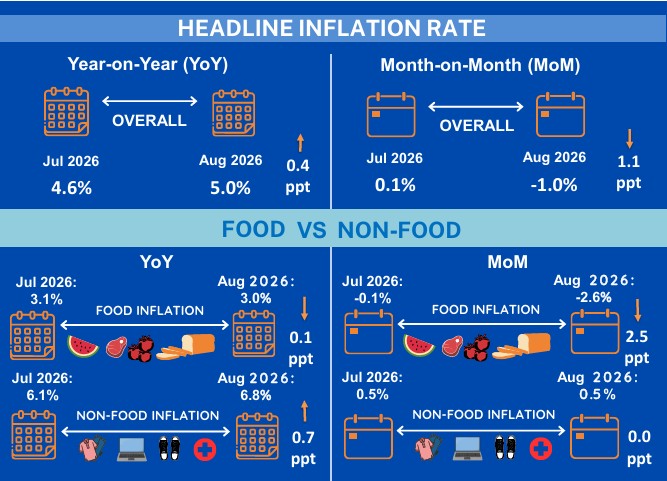
The simple contemporaneous spread between the 14 percent policy rate and 5 percent inflation is nine percentage points. That spread is useful as a first indication of how restrictive policy may look today, but it should not be treated as a definitive forward-looking real policy rate. Expected inflation, banking-system liquidity, exchange-rate risk, borrower risk and government-security yields all affect the monetary conditions that eventually reach the economy.
The Bank has already delivered a large easing cycle. Its policy-rate history shows the MPR at 28 percent in May 2025, before cuts to 25 percent in July, 21.5 percent in September, 18 percent in November, 15.5 percent in January 2026 and 14 percent in March. The issue facing the MPC is therefore not whether easing should begin. It is whether the next reduction should come now or after more evidence that the inflation outlook is secure.
Market Rates Have Moved Faster Than the MPR
The strongest reason to avoid reading monetary conditions from the policy rate alone is the behaviour of market interest rates. Bank of Ghana data for June put the Ghana Reference Rate at 10.0 percent, down from 23.8 percent a year earlier, while average bank lending rates fell to 15.6 percent from 27.0 percent. The 91-day Treasury bill yield was 5.3 percent in June and has since fallen below 5 percent.
Short-term government borrowing costs have therefore fallen much faster than the MPR. Private-sector credit has also accelerated: the July MPC record reported year-on-year growth of 41.2 percent in June, or 34.1 percent after adjusting for inflation. Those figures do not mean credit is equally accessible to every firm or household, but they do show that financial conditions have already loosened materially.
For businesses, lower lending rates can reduce the cost of working capital and make investment projects easier to finance. For households, they can improve the affordability of mortgages and other loans. The other side of the transmission is that very rapid credit growth can add to demand, especially if production does not expand at a similar pace. That is one reason the MPC must consider the whole financial system rather than the headline inflation number in isolation.
Why BoG Still Has Reasons to Wait
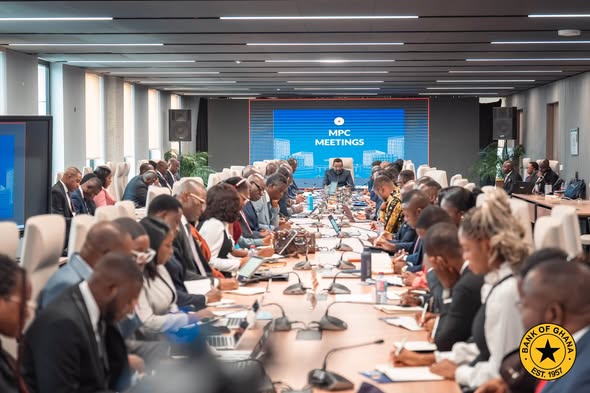
The July MPC submissions set out the arguments for caution. Members pointed to petroleum prices, utility tariff adjustments, food-supply risks, firmer inflation expectations and foreign-exchange demand as possible sources of future price pressure. One member put the concern plainly: “the persistence of this trend, rather than the level of any single inflation outcome, is what concerns me.”
That statement was made when the Committee had data through June, when inflation had risen for three consecutive months. The information set has since changed. July inflation fell to 4.6 percent and August rose to 5.0 percent, leaving the recent pattern mixed. The July MPC record also expected inflation to move gradually back towards the target band over the third quarter, while one submission anticipated a move into the band by August. The actual August reading remained below the 6 percent lower bound.
That softer-than-anticipated outturn strengthens the argument for reassessment, but it does not settle the September vote. Ghana remains exposed to imported fuel, machinery, medicines and industrial inputs, so renewed cedi weakness can still pass through to domestic costs. Utility tariffs and food-supply conditions can also lift prices even when the exchange rate is stable.
Credibility matters as well. Ghana’s recent disinflation followed a period in which inflation became deeply disruptive to household budgets and business planning. Cutting too quickly would become costly if it encouraged markets to expect that the Bank would tolerate a fresh inflation cycle. Holding too long, however, also has a cost if financing remains tighter than is necessary for price stability and productive investment.
September’s Choice Is About Calibration
A further cut would be easier to justify if inflation expectations remain anchored, the cedi is orderly, monthly price pressures stay contained and measures of underlying inflation do not accelerate. A hold would be easier to justify if the Bank sees persistent domestic cost pressures, stronger exchange-rate risks or evidence that rapid credit expansion is beginning to outrun the economy’s capacity to supply goods and services.
The key point is that the 14 percent MPR is no longer operating in the same environment in which it was set in March. Inflation is 5.0 percent, Treasury bill yields have fallen below 5 percent, bank lending rates have declined sharply and private credit is expanding quickly. At the same time, the Bank’s own July assessment still identifies credible upside risks to inflation.
That makes September a test of monetary-policy judgement rather than a mechanical rate-cut decision. Ghana has moved beyond the emergency phase of the inflation fight. The next challenge is to normalise interest rates without giving back the price and exchange-rate stability that made lower rates possible in the first place.
READ MORE: BoG Governor Reveals What Could Trigger Future Rate Cuts