United Nations Children’s Fund (UNICEF) has reported more than 38,000 verified grave violations against children in armed conflict in 2025, warning that children continue to face escalating threats despite three decades of international efforts to strengthen their protection.
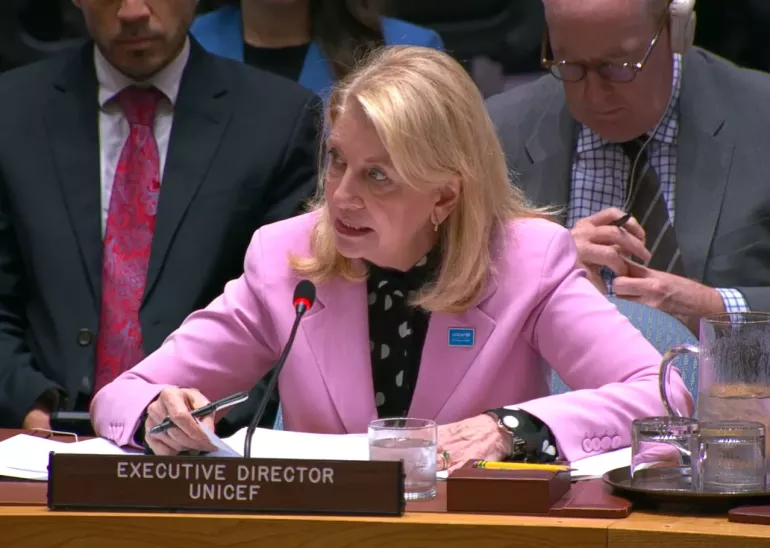
UNICEF Executive Director Catherine Russell disclosed the figures during a United Nations Security Council meeting marking 30 years of the Children and Armed Conflict agenda, established following Graça Machel’s landmark report on the impact of armed conflict on children.
According to Russell, the United Nations has verified more than 430,000 grave violations against children since 2005, with the highest number recorded in 2025 in the State of Palestine, the Democratic Republic of the Congo (DRC) and Nigeria.
She warned that the verified figures represented only a fraction of the actual scale of violations, as many incidents remained undocumented or could not be independently confirmed.
The violations include the killing and maiming of children, recruitment into armed forces and armed groups, sexual violence, abductions and the denial of humanitarian assistance.
“While the international community has built a strong framework to protect children in war, the reality for children living through conflict is increasingly dangerous.”
Catherine Russell
Meanwhile, United Nations has verified more than 44,000 incidents of denial of humanitarian access since 2005, including over 8,000 in 2025 alone, according to the UNICEF executive director.
She warned that restrictions on humanitarian operations prevented children from accessing essential healthcare, safe water, education and other services needed for their survival.
Humanitarian workers and facilities have also come under attack, further endangering those delivering assistance and the children who depend on it.
Russell identified the widespread use of explosive weapons in populated areas as another major concern, revealing that more than 70 per cent of verified child casualties in 2025 were caused by such weapons.
According to her, government forces were responsible for the majority of verified grave violations against children in 2025.
She also warned that emerging technologies were introducing new dangers, including the growing use of artificial intelligence in weaponry and targeting, armed drones in conflict zones, and digital platforms that could facilitate the recruitment, exploitation and abuse of children.
The Security Council’s adoption of Resolution 2832, addressing the impact of digital technologies on violations against children in armed conflict, was welcomed by both UNICEF and the United Kingdom as an important step towards confronting these emerging risks.
UK Permanent Representative to the UN, Ambassador Sarah MacIntosh, highlighted the impact of drone warfare on children, revealing that almost 80 percent of reported child casualties in Sudan during the first four months of 2026 were attributed to drone attacks.
She also cited Russian missile and drone attacks in Ukraine that have killed and injured children and damaged schools and hospitals, alongside the destruction of educational infrastructure in Gaza.
According to MacIntosh, approximately 700,000 students in Gaza were deprived of proper education because schools had been damaged or destroyed.
Thirty Years of Protection Efforts Deliver Progress Amid Funding Gaps
Despite the continuing scale of violations, Russell noted that the Children and Armed Conflict agenda had delivered significant results since its establishment three decades ago.
More than 40 action plans have been signed with parties to conflict to end and prevent grave violations, while more than 220,000 children have been released from armed forces and armed groups.
The initiative has helped children reunite with their families, return to school and access mental health and psychosocial support, providing opportunities to rebuild their lives after recruitment and exposure to violence.
However, Russell warned that the protection framework faced growing challenges as funding cuts undermined essential support services for survivors.
She also argued that the disparity between humanitarian funding and global military expenditure reflected decisions with direct consequences for children affected by conflict.
UNICEF Calls for Accountability and Political Solutions to Conflict
As the international community marks three decades of efforts to protect children affected by armed conflict, Russell urged governments to translate existing commitments into stronger action to prevent violations and address the conflicts driving humanitarian crises.
Her first call is for all parties to the conflict to cease and prevent grave violations against children and fully respect their obligations under international law.
She also urged member states with influence over parties to conflict to use diplomatic engagement, political pressure and other available measures to change behaviour and strengthen protection for children.
Russell’s second priority is to safeguard and strengthen the Children and Armed Conflict framework through sustained support for monitoring mechanisms, country-level task forces and the implementation of action plans.
She stressed that these mechanisms depended on political backing and adequate resources to ensure that international commitments resulted in concrete protection for children.
Her third call focused on preventing and resolving conflicts through sustained diplomacy, inclusive peace processes and durable agreements that place children’s rights and protection at their centre.
READ ALSO: Falling Sovereign Risk Could Trigger Foreign Investor Rush to Ghana’s Stock Market- Analyst