Tag: COVID Relief Packages

  • Yellen, Powell say more needed to limit US economic damage

    Yellen, Powell say more needed to limit US economic damage

    US Treasury Secretary, Janet Yellen and Federal Reserve Chairman, Jerome Powell have told Congress that more must be done to limit the economic damage from the coronavirus pandemic. And also to promote a full economic recovery in the United States.

    During their mandatory appearance before the House Financial Services Committee, the leaders were “optimistic” about the future of the economy; but also warned that the economy needs help.

    Yellen thanked Congress for passing President Joe Biden’s $1.9 trillion American Rescue Plan, approved only with Democratic support. All Republicans in the House and Senate opposed the measure.

    “With the passage of the Rescue Plan, I’m confident that people will reach the other side of this pandemic with the foundations of their lives intact.”

    Janet Yellen

    She also indicated that as a result of the “growing economy”, people will be met intact “at the other side”.

    “In fact, I think we may see a return to full employment next year.”

    Janet Yellen

    Powell testified that a recovery is far from complete. He also assured the Fed will “continue to provide the economy the support it needs for as long as it takes”.

    “The Fed will not lose sight of the millions of Americans who are still hurting, including lower-wage workers in the services sector, African Americans, Hispanics and other minority groups that have been especially hard hit.”

    Jerome Powell

    The March 2020 COVID-19 relief law requires the Treasury Secretary and Fed Chairman to testify before Congress on quarterly basis. This is to provide updates on the state of the economy impacted by the pandemic.

    This meeting marks the first joint appearance by the two economic leaders in their current jobs. It is also Yellen’s first congressional appearance since taking over as Treasury secretary.

    Rollout of 1.9 trillion relief package Yellen powell

    Yellen pledged a rapid roll-out from the Treasury of the new $1.9 trillion relief package. She also noted that the Treasury and Internal Revenue Service distributed more than 90 million direct payments of $1,400 to qualifying individuals. She asserted this was done within the first week the legislation was signed into law.

    Yellen indicated she has been focused on quickly getting relief to the areas of greatest need, upon taking office. She further indicated that these areas include “smallest, small businesses, which women and people of colour disproportionately own”.

    Treasury Secretary, Janet Yellen

    The Treasury Secretary also revealed that the Paycheck Protection Program created by last year’s legislation often didn’t reach the smallest businesses. She said the Treasury is working with the Small Business Administration to “tweak” the implementation of the programme. This is to ensure that the loans, which the government forgives if businesses don’t lay off their workers, can reach millions of more microbusinesses, especially those in rural and low-income areas.

    Yellen also assured that the relief package will provide over $30bn to help renters and homeowners at risk of eviction. She said Donald Trump’s administration put in place rules that required tenants and landlords to provide a large amount of documentation to get rental assistance – documentation that the Biden administration is reducing.

    “We’re cutting through the red tape for them, while still taking reasonable steps to prevent fraud and abuse.” Yellen powell

    Read Also:  Nigeria’s GDP to grow by 2% in 2021- Fitch Ratings

  • US Congress approves Biden’s $1.9 trillion relief bill

    US Congress approves Biden’s $1.9 trillion relief bill

    The US House of Representatives has given final approval to President Joe Biden’s $1.9 trillion Covid-19 relief bill. The bill is designed to mitigate the financial toll of Covid-19 and puts the US economy on a path to recovery.

    The House voted largely along party lines, 220-211, precisely seven weeks after President Biden was sworn in. The US Senate had earlier approved the bill and the President announced he’ll sign it on March 12.

    Help is here,” President Biden tweeted moments after the vote, which ended with applause from Democratic lawmakers. The President’s administration said he’ll address the nation about the bill in the evening on 11th March.

    The relief bill

    The 628-page bill, dubbed the American Rescue Plan is one of the largest spending packages in US history.

    The bill authorises $1,400 direct cheques to an estimated 160 million US citizens and extends federal jobless benefits of $300 a week to unemployed workers. It also provides hundreds of billions in subsidies and bailouts.

    In addition, the bill includes $350bn for federal aid to states, cities and tribal governments. This is to help cover budget shortfalls incurred during the pandemic.

    Signing of the American Rescue Plan. Image: AP

    It also provides $130bn in funding for primary and secondary public schools to begin to reopen. And includes $14bn for distribution and supplies of vaccines, as well as $8.5bn for rural healthcare providers.

    President Biden earlier announced plans to distribute enough vaccines from Pfizer, Moderna and Johnson & Johnson to vaccinate every US adult by the end of May. So far, more than 123 million doses of vaccine have been distributed, according to the US Centres for Disease Control.

    With millions out of work and unable to keep up with rent, the bill extends a federal moratorium on evictions through September. It also provides $45bn in rental and mortgage assistance.

    However, a provision to raise the federal minimum wage to $15 was deemed inadmissible under the reconciliation budget process Democrats used to bypass Republican opposition.

    Republican opposition

    Despite promising unity and bipartisanship, President Biden was unable to persuade a single Republican to vote for the measure. The republicans argued the bill is filled with liberal policies and ignored signs of economic recovery.

    They also said the bill is waste of federal resources that would further add to the US’s national debt. The opposition suggested that a better course of action would be to simply reopen the economy.

    Republican Representative, Marjorie Taylor Greene called the $1.9 trillion relief bill a “reckless, irresponsible and the wrong thing to do”. She warned that it would “enslave” future generations to a mountain of debt.

    Republican Representative, Marjorie Taylor Greene

    House Minority Leader, Kevin McCarthy added that the bill doesn’t “meet the needs of America families.”

    “This isn’t a rescue bill. It’s a laundry list of left-wing priorities that predate the pandemic and do not meet the needs of American families.”

    House Minority Leader, Kevin McCarthy

    Despite the opposition, Democrats stood united to pass what the House speaker, Nancy Pelosi, hailed as “the most consequential legislation that many of us will ever be a party to”.

    Read Also: US economy will need support for ‘some time’- Powell

  • US Senate passes budget resolution to allow passage of $1.9tn Covid relief package without Republicans

    US Senate passes budget resolution to allow passage of $1.9tn Covid relief package without Republicans

    The US Senate has approved a budget resolution that would allow Democrats push through President Joe Biden’s $1.9 trillion coronavirus relief plan without Republican support.

    With the vote tied at 50 apiece, Vice President Kamala Harris cast her first tie-breaking vote to make it 51-50 votes to the democrats.

    The budget will now return to the House of Representatives, where it will likely be approved again to reflect the changes made by the Senate.  

    VP Kamala Harris casts tie breaking vote

    Senate Majority Leader, Chuck Schumer called passage of the resolution the “first big step to putting our country back on the road to recovery.”

    The goal for the Democrats is to have COVID relief approved by March, when extra unemployment assistance and other pandemic aid expires. This means clearing the budget plan through the House quickly so that it can return to the Senate.

    “Next week, we will be writing the legislation to create a path to final passage for the Biden American Rescue Plan, so that we can finish our work before the end of February,” House Speaker Nancy Pelosi wrote in a letter to colleagues.

    The push for stimulus comes amid new signs of a weakening U.S. economy. The US Labour Department announced in a report that employers added just 49,000 jobs in January, after cutting 227,000 jobs in December. Restaurants, retailers, manufacturers and even the health care sector let go of workers last month, with state and local governments also letting go of non-school employees.

    The report also indicated that the unemployment rate fell to 6.3% from 6.7%, and there was a decline in the number of people who were either working or looking for a job, in a sign that some people are dropping out of the labour force.

    “The latest jobs report is another confirmation that Americans need relief now—and that’s why Senate Democrats took a big first step toward passing a historic COVID relief package early this morning, with Vice President Kamala Harris casting the deciding vote,” Jaime Harrison, the Chairman of the Democratic National Committee, said in a statement.

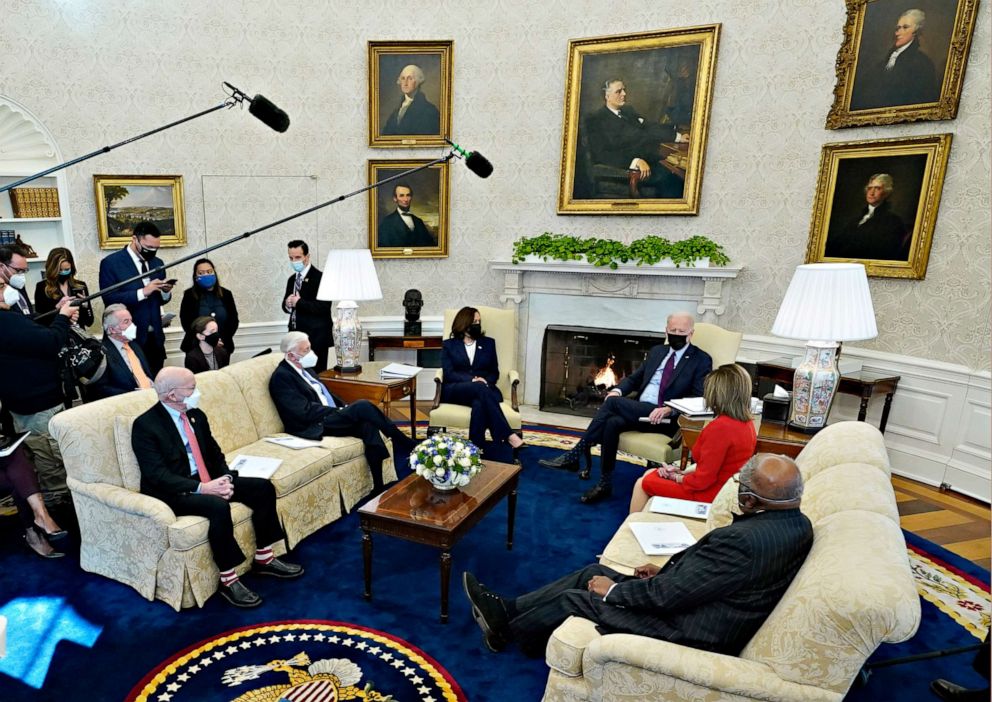
    President Biden meets House committee chairs at the White House. Image: AP

    Meanwhile, President Biden, who has been meeting with lawmakers in recent days to discuss the package, has sat down with the House committee chairs who will be assembling the bill under the budget process known as “reconciliation”, at the White House

    Speaking to reporters at the start of the meeting, the President emphasized the need to pass another massive coronavirus relief package. Mr Biden said the governmental response to the financial crisis had taught him the negative impact of going too small with relief proposals.

    “The one thing we learned is we can’t do too much here. We can do too little. We can do too little and sputter.

    “It’s not just the macroeconomic impact on the economy and our ability to compete internationally. It is people’s lives. Real live people are hurting and we can fix it. We can fix it and the irony and all ironies is; if we help them, we are also helping our competitive capacity through the remainder of this decade.”

  • B-BOVID donates relief packages to over 700 Farmers

    B-BOVID donates relief packages to over 700 Farmers

    Over 700 outgrower farmers from six zones in 60 communities in the Western Region have received Covid-19 relief items from B-BOVID, a leading agribusiness and social enterprise company at a brief ceremony in Takoradi in the Western Region.

    The items were presented to the farmers by the Chief Executive Officer of B-BOVID, lssa Quedraogo at the company’s premise in Takoradi. The items include machetes, Wellington boots, new and improved varieties of maize, pepper and garden eggs seeds.

    Speaking at the presentation ceremony, Issa Quedraogo said B-BOVID in partnership with AgDevco’s Smallholder Department Unit (SDU) decided to support the farmers as part of efforts to help alleviate the negative impact of Covid-19 on their farming activities. He noted that B-BOVID is supporting the outgrowers to engage in alternate livelihoods in order to benefit from multiple revenue streams as part of the company’s COVID-19 recovery relief package. He said as part of the strategy, B-BOVID is embarking on a program to find and create new markets and products for its outgrowers to promote diversity, economic reliance and sustainability.

    Speaking on behalf of the farmers, Sofohene Ango, one of the leaders of the group thanked B-BOVID for its continuous support for the farmers. He praised the company for its innovative, sustainable business model which has added significant value to their operations.

    B-BOVID is a social enterprise agribusiness company that promotes a new model of socially inclusive commercial farming that combines innovative agricultural practices with ecological farming. It promotes diverse land use as an alternative to monoculture and empowers smallholder farmers through capacity building and the provision of inputs thereby enhancing their livelihoods, while promoting agroforestry systems that mix staple and cash crops, thereby conserving and restoring the environment through biodiversity.

    COVID-19 Impacts on Agriculture

    Since March 12th 2020, when the first case of COVID-19 was recorded in Ghana, all of Ghana’s institutions have had to adapt to its reality. The COVID-19 pandemic has had a tremendous impact on nearly every facet of life, and food systems are no exception. It has magnified systemic challenges faced by smallholder farmers and value chain actors in the agriculture sector. Major disruptions to food and input supply chains have put the finances of smallholder farmers and food security of many at risk.

    The lockdown in Ghana, amidst the novel disease, led to disruptions in transport and logistics which impacted negatively on agricultural supply chain and the agribusiness activities. The three-week lockdown of some cities disrupted the food system and markets. This caused panic buying which caused food prices to spike across major urban areas. It also exacerbated the fear that farmers would not have access to inputs such as seeds, fertilizers and insecticides, thus disrupting the planting season. The limited access to the export market also affected the planting decisions by farmers, thus affecting food production.

    Fisherfolks were also not left behind with the adverse effects of COVID-19, particularly on transportation. The fisher folk from Central Region were not allowed to come into the Greater Accra Region, so they sent their goods off with drivers and asked their partners to pick up the fish from those drivers.  However, the system did not work too well because of the unscrupulous nature of some of the drivers and/or traders. Thousands of cedis worth of fish were lost in this process. Some transporters have still not recovered from the losses of this period.