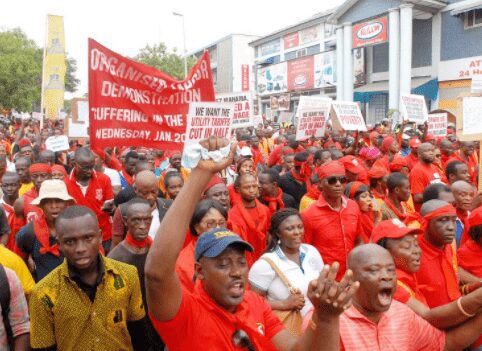
Ghana’s labor market over the years has been riddled with low levels of wages both in the formal and informal sectors. Workers in the formal sector, which is largely considered a privilege, continue to face the challenges of job insecurity and low incomes.
The majority of Ghanaians employed in the informal economy earn below the national daily minimum wage. While the national daily minimum wage is below US$2 a day, currently at GH₵ 18.15, perhaps the most appalling of all is the fact that about one-tenth of public sector employees receive salaries that are below the national poverty line
Over the years Industrial Strikes have therefore been an instrument used by various labor unions to demand better Conditions of Service from the various governments. The constant strike actions by different labor associations, which grant them a seat at the negotiation table, usually leave these associations mostly dissatisfied with the outcome.
Recently, even though it is still the first quarter of the year, about ten (10) labor unions in the country either threatened to engage in an industrial strike or actually engaged in an industrial strike. The main reason that cut across the need for these unions to embark on an industrial action is the issue of Conditions of Service or remuneration.
“The proposed and submitted allowances to the Fair Wages and Salaries Commission as indicated by the Executive Secretary during his regional working visit are not implemented to reflect on our March 2024 pay slip. We hereby bring to the attention of Management, that, we shall proceed on an indefinite strike on Monday, 25th March, 2024”
DPSWU, National Identification Authority
Furthermore, the unavailability of resources to conduct work has also been a recurring factor different labor unions mentioned as the reason for their industrial strikes.
Recently, three teachers’ unions – Ghana National Association of Teachers (GNAT), National Association of Graduate Teachers (NAGRAT), and Coalition of Concerned Teachers (CCT) – cited the government’s failure to provide laptops needed for teaching for all teachers as one of the reasons for the strike.
Also, accommodation, especially for teachers and health workers, has been a major factor triggering industrial actions. Pre-tertiary teachers at the basic level of education, for instance, have issues with accommodation and the government’s failure to invest in this venture leaves a lot of teachers stranded.
The Medical Doctors of the Komfo Anokye Teaching Hospital (KATH) also recently embarked on a strike due to the lack of accommodation for doctors which negatively affects their output at work.
Consequences
While strikes might be a necessary tool for the various labor unions to get the attention of the government to their needs, the industrial action nevertheless has its effect on labor and the various stakeholders involved.
Accordingly, strikes reduce productivity as they put a hold on all corporate activities until it is called off. The recent strike that was undertaken by the Tertiary Education Workers Union (TEWU) of Ghana affected the academic work on the various university campuses as students were unable to access key facilities like the university libraries to proceed with their research work and other academic activities.
Moreover, strikes lead to financial loss on the part of the various institutions as there is no work done within the strike period. This is particularly likely in the private sector where revenue generation is largely based on the amount of work done. In some cases, strikes lead to the loss of jobs of workers involved in the strike.
In the case of strikes in the health sector by healthcare givers, the lives of patients are largely at stake. More often than not, strikes embarked on by medical practitioners in Ghana bite the most as a lot of lives are at stake.
“I have also been given a new date to report here. The nurses say I should come in two weeks and till then we are praying for life. With my condition, I cannot visit a new facility. It is an operation that has to be performed on me so unless the doctors here at KATH, I have no choice but to come back”.
Patient, KATH
It is therefore important that the government does its best to make payment of adequate salaries, improve the working conditions of labor, and provide the necessary resources for workers. This is to ensure that workers are not hindered in conducting their work and also prevent them from embarking on numerous strikes that affect the various sectors of the country’s economy.
READ ALSO: Ghana’s Economy Takes a Hit from Data Service Disruptions