Tomatoes are a key component in the diets of Ghanaian households, and with a rapid growing population, it is no surprise that the demand for the produce has increased substantially over the years. Approximately 440,000 tons of tomato are consumed annually, equivalent to 40 percent of household vegetable expenditure. Although tomato consumption has increased steadily in the last decade, domestic production has not kept up with demand, despite expanding from 318,000 tons in 2009 to 420,000 tons in 2019 as revealed by MOFA’s estimates.
Smallholder farmers producing fruits and vegetables in developing countries are faced with postharvest losses because these crops are generally harvested with very high-water contents of over 90%, which makes them very perishable. Postharvest loss (PHL) is a major issue affecting food security especially with regards to food availability in Sub-Saharan Africa (SSA) where Ghana is not an exception. With an estimated 374 million people in SSA experiencing severe food insecurity and the prevalence of COVID-19 exacerbating the condition, it is prudent to ensure that the least amount of food is lost.
In SSA, an estimated 40% of all food crops are lost between harvest and pre-consumer levels, leaving only 60% of the food crop available on the market for the consumers to purchase. With such high levels of losses, there are sporadic food shortages and severe price fluctuations of food commodities, leaving the poor and vulnerable in the society food insecure. In horticultural crops such as vegetables and fruits, PHL are even much higher because of their perishable nature.
Tomato PHL in Ghana has been estimated to be between 20-50% by a study. This implies for instance that, a 100% increase in tomato yield may result with only 50% of the quantity produced being marketable. This would mean that projected revenues mainly at the producer level may not be realized. Due to production seasonality, high perishability, poor market access, and competition from imports, some Ghanaian farmers are unable to sell their tomatoes, which are left to rot in their fields. Poor postharvest handling has been identified as one of the main causes of losses, occurring from bruises during harvesting, rough packaging material such as wooden boxes, dense packing of tomatoes into single large wooden boxes and the poor road network.
Proper Postharvest Handling Practices
In order to maintain the postharvest quality and shelf life of harvested fruit like tomatoes, proper postharvest handling practices must be followed which includes precooling after harvest, cleaning and disinfecting, sorting and grading, packaging, transportation and storage. During harvesting, mature fruit is best removed by a “lift, twist and pull” hand picking technique and should be placed in a clean collecting container like plastic pails. Harvesters should have trimmed fingernails to prevent causing mechanical injury to the fruit. Harvested fruits must be cleaned by wiping them with moist cloth or by washing in chlorinated water to reduce microbial load prior to packaging.


In cleaning, the use of disinfectants can be employed to reduce both postharvest and food-borne diseases in fruits and vegetables. For instance, sodium hypochlorite solution can be used to sterilize tomato fruits in order to reduce the incidence of fungal infection before any postharvest treatment is applied. Dipping of tomato fruits in thiabendazole solution also reduces the microbial load on the fruits. According to a report by the Government of India, Salmonella, Cryptosporidium, Cyclospora, and hepatitis A virus are some examples of disease-causing organisms that have been transmitted to consumers through fresh fruits and vegetables, thus cleaning or disinfecting can help prevent the transmission.
Harvested fruit must be precooled to remove excessive field heat if harvested at times other than the recommended periods. The suitable temperature range of about 13–20°C for tomato handling can be attained either in the early hours of the morning or late in the evening. Precooling minimizes the effect of microbial activity, metabolic activity, respiration rate, and ethylene production, whilst reducing the ripening rate, water loss, and decay, thereby preserving quality and extending shelf life of harvested tomatoes. Dipping fruits in cold water (hydrocooling) mixed with disinfectants such as thiabendazole and sodium hypochlorite is a cheap but effective way of precooling harvested tomato. Tomato producers in developing countries such as Ghana assemble their harvested produce under tree shade in an attempt to reduce field heat.
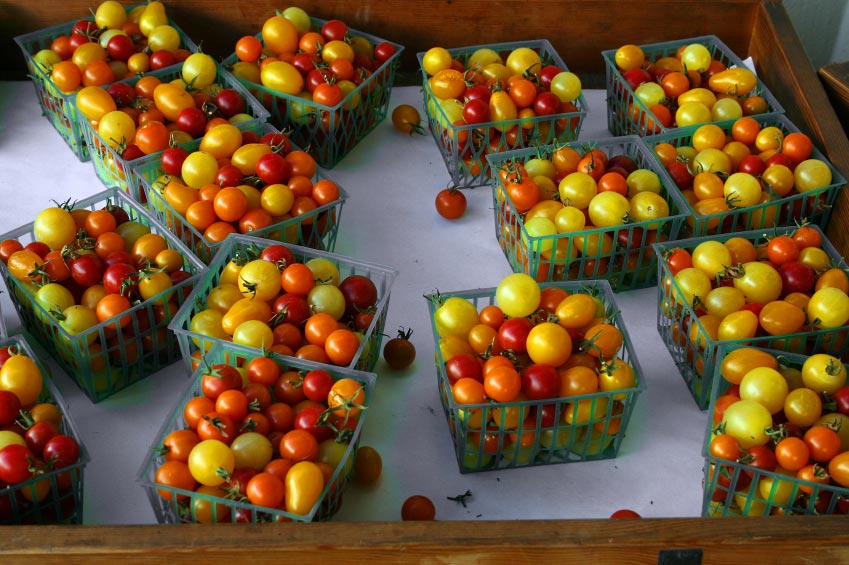
Good quality tomatoes are generally preferred by buyers thus sorting/grading is a necessary operation. Sorting is the grouping of tomatoes based on the criteria of the one classifying and there is no definite set of standards followed. After harvest, tomatoes are arbitrarily classified as “Class A” (excellent quality) or “Class B” (with minor defects). Packaging is also one of the important aspects to consider in addressing postharvest losses in fruits and vegetables as it encloses the produce to protect it from mechanical injuries, tampering, and contamination from physical, chemical, and biological sources. Some common packaging materials used in most developing countries include wooden crates, cardboard boxes, woven palm baskets, plastic crates, nylon sacks, jute sacks, and polythene bags. Plastic bags, plastic sack and red mesh bags do not provide adequate protection to the produce. They are readily damaged and will lead to fruit deterioration. Injuries often incurred include compression manifested as flattened areas and breaks in the skin. Tomatoes packed in rigid plastic crates thus providing adequate protection to its contents.
Storage extends the length of the processing season and helps provide continuity of product supply throughout the seasons. For short-term storage (up to a week), tomato fruits can be stored at ambient conditions if there is enough ventilation to reduce the accumulation of heat from respiration. For longer-term storage, ripe tomatoes can be stored at temperatures of about 10–15°C and 85–95% relative humidity. At these temperatures, both ripening and chilling injuries are reduced to the minimal levels. Very low temperature storage is detrimental to the shelf life and quality of many tropical fruits like tomatoes. For instance, refrigerating a tomato will reduce its flavour, a quality trait of tomatoes which is largely determined by the total soluble solids (TSS) and pH of the fruit. Thus, understanding the correct temperature management during storage of tomatoes is vital in extending the shelf life of the fruit whilst maintaining fruit qualities.
Read also: Post-Harvest Losses Cannot Be Avoided – Says Agricultural Economist