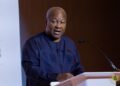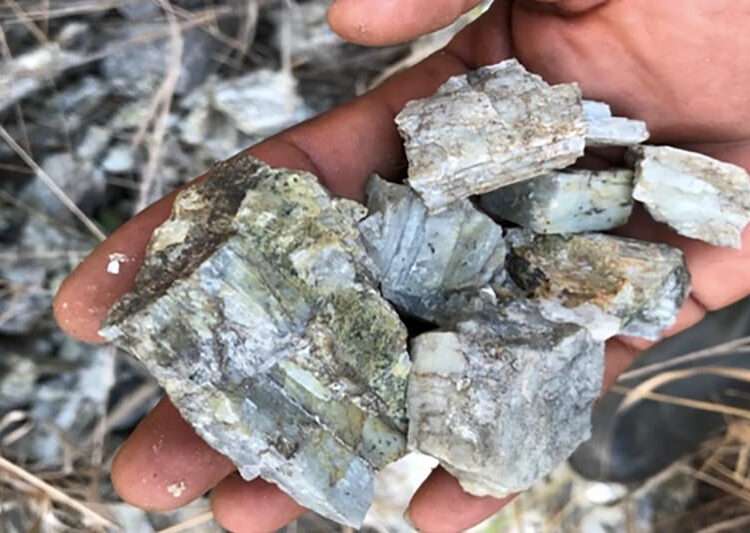
The President of the Republic, President Nana Addo Dankwa Akufo-Addo has hinted of banning the exportation of certain natural minerals in their raw state.
The President at the opening of a stakeholders dialogue on natural resources in Accra, outlined reasons why the state must not encourage the exportation of raw mineral resources such as lithium and other green minerals.
“We cannot forget lithium and the other green minerals which have been described as the minerals of the future due to the importance of the green energy transition.
“Fortunately, we have discovered lithium in commercial quantities, in occurrence with cobalt, nickel, copper, lead, and zinc in the country. We should not do with these minerals what we have done with our gold resources over the years.”
Nana Addo Dankwa Akufo-Addo
The President of Ghana, meanwhile, disclosed that the ministry of lands and natural resources is working on a document that will capture the future of these mineral resources.
“The Ministry of Lands and Natural Resources, under the leadership of Abu Jinapor, is finalising a policy document for the exploitation and utilisation and management of these crucial minerals for the consideration of cabinet in the next few years.”
Nana Addo Dankwa Akufo-Addo
The President, thus, delved deep into the Ghanaian laws that protect these natural resources, while noting that more regulations will be made to that effect to control the raw exportation of crucial minerals.
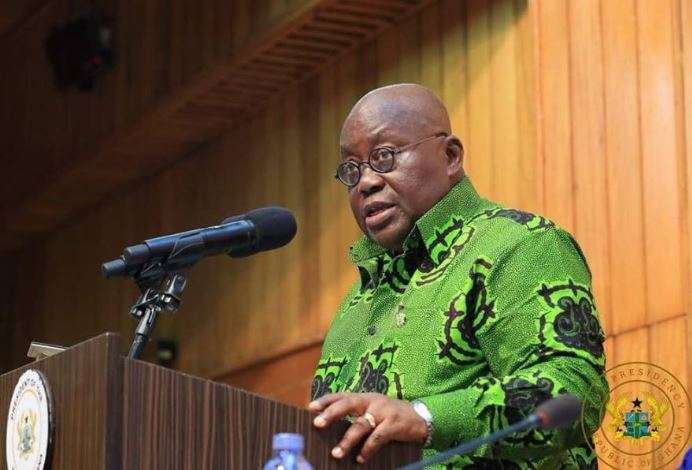
“By section 28 of GIDEC law, in section 30 of the GIFTECH law, the minister of lands and natural resources is empowered to make regulations to ensure that no bauxite or iron ore, in their raw state, is exported out of the country after five years of coming into force of these laws”.
Nana Addo Dankwa Akufo-Addo
Ghana Boasts of More Natural Mineral Resources
Ghana can boast of a wide range of natural mineral resources. Ghana is the leading Africa gold producing country, with a total mine production amounting to 117.6 metric tons in 2021.Gold is the most commercially exploited mineral in Ghana, accounting for about 95% of the country’s mineral revenue.
Other commercially exploited minerals in Ghana are manganese, bauxite, and diamonds. The country is also endowed with deposits of iron ore, limestone, columbite-tantalite, feldspar, quartz, and salt, and there are also minor deposits of ilmenite, magnetite, and rutile.
In 2018, Ghana discovered commercial quantities of lithium and is working with international partners to mine and develop lithium mining and processing.
Ghanaian mining production traditionally was state owned, but starting in the 1980s, Ghana moved toward privatization and state divestiture, including by attracting foreign investment.
Some of the major mining companies in Ghana are Newmont Goldcorp (American), as well as Chinese, Canadian, South African, and Australian companies.
Mineral rights are granted to private parties giving them the right to mine the minerals in the ground. However, the Government of Ghana is entitled to a 10% equity interest in the mineral operations, even if it does not make a financial contribution. The government can increase its participation in mineral operations by agreement with the investor. The small-scale mining industry is reserved exclusively for Ghanaians.
Despite the numerous mineral resources the country is endowed with, most of the crucial resources are exported in their raw form, earning the country a little revenue. It is therefore, a call in the right direction from the President of the Republic, Nana Addo Dankwa Akufo-Addo.
READ ALSO: New FDA Policy Permits More Gay Men To Donate Blood