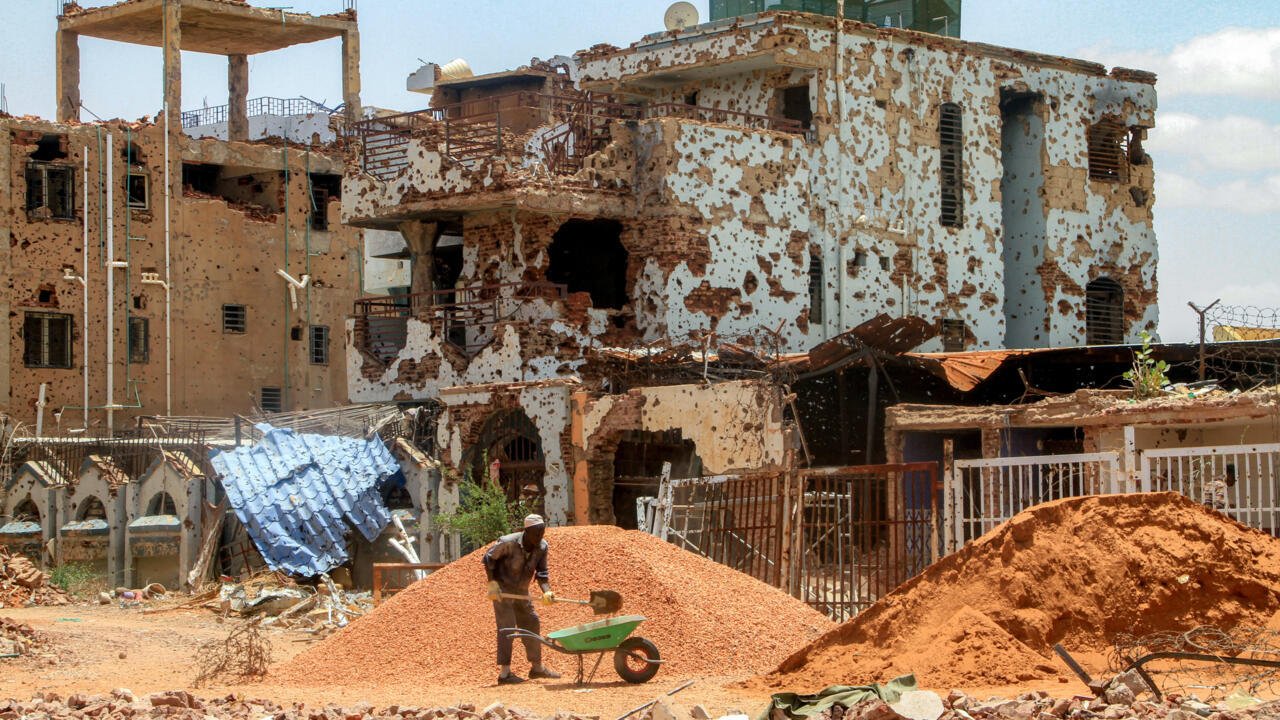
After more than two years of brutal conflict, Sudan’s capital, Khartoum, is slowly stirring back to life. Families who fled the city during the fighting between the Sudanese army and the paramilitary Rapid Support Forces are beginning to return, only to find their homes and neighborhoods in ruins.
For many, the homecoming has been deeply painful. “We lost precious belongings that we had for a long time. We lost many things, stuff that we concealed under the house floor and we found that it was taken,” said Afaf al-Tayeb, who returned to her home in the Al-Qawz district in June. Her frustration was echoed as she listed the scale of the losses.
“I had gold, brand new food mixers, our clothes that we concealed were all taken, they left nothing for us except the clothes we are wearing, we wash it and wear it again.”
Afaf al-Tayeb
The scars of war are everywhere in Khartoum. When the civil war erupted in April 2023, the capital became the epicentre of fighting. Homes, schools, and government buildings remain riddled with bullet holes or destroyed entirely.
Afaf’s son, Mohamed al-Khedr, recalled what they found on their return. “After the liberation we came to find the house as you can see it, a shell that hit the house and burnt everything.”
Despite the devastation, thousands have been making their way back since the army announced its recapture of Khartoum earlier this year. Yet, the challenges ahead are immense, with basic services wiped out and critical infrastructure severely damaged.
Infrastructure In Shambles, Residents Face Huge Obstacles
According to officials, the city’s entire power grid has been crippled. Altayeb Saad al-Din, spokesperson for Khartoum province, detailed the extent of the destruction.


“The destruction has completely affected the electric infrastructure, all the electric facilities starting from the huge electrical substations of Khartoum which hosts more than seven or eight electrical substations that are completely damaged and looted as well as the electrical transformers which distributes electricity inside the residential neighborhoods.”
Altayeb Saad al-Din, spokesperson for Khartoum province
The United Nations has projected that nearly 2 million displaced people may return to Khartoum by the end of this year. However, with reconstruction costs running into billions of dollars, rebuilding the capital will take years.
The broader humanitarian toll has also been staggering. Since the start of the war, more than 12 million people have been displaced across Sudan, while at least 40,000 lives have been lost.
Even as families attempt to rebuild in Khartoum, other regions face new threats from natural disasters.
In eastern Kassala state, flooding from the seasonal Gash River has cut off entire villages. On Sunday, the Sudanese army deployed helicopters to evacuate residents stranded by rising waters. In a press statement, the army confirmed its air force was carrying out evacuations under the directive of Army Commander General Abdel Fattah al-Burhan.
Military helicopters were seen delivering food aid to Tandlai village, which has been completely isolated by floodwaters for two days. Residents have long appealed for the construction of an 18-kilometre road to connect them to the national highway, a measure they say could protect against annual floods during the rainy season.
Meanwhile, in Northern State, the rising Nile has prompted urgent warnings. Authorities in Merowe locality advised residents downstream of the Merowe Dam to take “the highest necessary precautions” to safeguard lives and property. Vulnerable communities in low-lying areas, along river islands, and operators of agricultural projects and water stations were specifically cautioned.
Officials explained that water levels are expected to remain dangerously high until late October. The Merowe Dam administration issued a bulletin on August 10 predicting the rise and confirmed that spillway gates will be gradually opened in response to upstream surges.
As Khartoum’s returning residents struggle to restore their shattered lives, the combination of war’s destruction and seasonal floods underscores the immense challenges Sudan faces in trying to move forward.
READ ALSO: Tetteh Warns Against Mob Justice In Officer’s Murder