
Renowned legal scholar and Fellow at the Ghana Centre for Democratic Development (CDD-Ghana), Professor Stephen Kwaku Asare, has called for a fundamental reform in how Ghana’s Auditor-General reports on public financial irregularities, urging that audit reporting must evolve “from a numeric listing to a diagnostic analysis.”
In a detailed essay titled “Dechemicalization of Irregularities,” Professor Asare argued that the omnibus use of the term “irregularities” in audit reports has become a double-edged concept—one that shields wrongdoers while confusing citizens and oversight bodies about the true nature and seriousness of financial lapses in the public sector.
“Nananom, Anuanom, Nnamfonom, and Yaanom, permit me to disturb your peace with a boring but important technical matter — the dechemicalization of irregularities. I do so grudgingly, only because the potential civic benefit outweighs the risk of putting you to sleep.”
Professor Stephen Kwaku Asare
He explained that while “not every irregularity is a crime,” every irregularity nonetheless signals “a failure somewhere—of integrity, of compliance, or of control.”
According to him, the habit of lumping all irregularities together—whether they stem from fraud, negligence, or procedural lapses—has made it difficult for the public and Parliament to distinguish between what constitutes criminal wrongdoing and what merely reflects administrative weakness. “When all are lumped together,” he said, “the serious and the trivial become indistinguishable, giving cover to wrongdoing and confusion to oversight.”
Narrowed Focus
Professor Asare observed that although the Auditor-General (AuG) currently fulfills the constitutional mandate under Article 187(5) of the 1992 Constitution by submitting annual reports to Parliament that highlight irregularities in public accounts, the existing approach focuses too narrowly on numbers without providing diagnostic insights into their causes or implications.
Article 187(5) requires the Auditor-General to “draw Parliament’s attention to any irregularities in the accounts audited,” but Section 13 of Act 584, he explained, places a wider responsibility on the Auditor-General to determine whether accounts are properly kept, whether public monies are fully accounted for, whether expenditure is for authorised purposes, and whether programmes are carried out with efficiency and economy.
“The Act extends the Auditor-General’s role beyond listing irregularities to evaluating control sufficiency, procedural soundness, and performance quality. In short, to explain why irregularities occur and how they reflect on the efficiency and integrity of governance systems.”
Professor Stephen Kwaku Asare
He pointed out that the 2024 Auditor-General’s Report, for instance, identified total irregularities of about GH¢18.4 billion across public boards, corporations, and statutory institutions—a 32 percent decline from the previous year. Of this, GH¢15.6 billion represented recoverable irregularities such as unpaid loans, while GH¢2.8 billion represented administrative lapses.
While this meets constitutional requirements, Professor Asare said, the report does not analyse why such receivables remain uncollected, or whether the systems meant to recover them are effective.
From Transactional Inventory to a Diagnostic Classification System
To address this, he proposed a shift from what he termed a “transactional inventory” to a “diagnostic classification system” that classifies irregularities based on their intent or nature, control severity, and accountability impact.
Explaining the first dimension, intent or nature, he said irregularities differ fundamentally in motivation and should therefore be categorised as fraudulent, illegal, or erroneous.
Fraudulent irregularities involve deliberate deception for personal or institutional gain, such as the creation of ghost names on payrolls or the inflation of contract sums.
Illegal acts result from wilful or negligent breaches of statutory provisions, like failing to remit taxes or violating procurement laws. Errors or misstatements, however, are unintentional lapses that arise from carelessness or poor record-keeping.
On the second dimension, control severity, he said irregularities could be classified as material weaknesses, significant deficiencies, or control deficiencies. “Material weaknesses,” he explained, “are serious control failures that could lead to significant loss, such as persistent non-reconciliation of cash and bank accounts.”
Significant deficiencies are moderate lapses requiring attention, while control deficiencies are minor inefficiencies that, although not fraudulent, reflect weak internal discipline.
The third dimension, accountability impact, would focus on whether irregularities lead to recoverable losses, non-recoverable losses, or procedural infractions.
“This tripartite classification helps Parliament and the public grasp not only how much went wrong but what kind of failure occurred, where controls broke down, and what remedy each situation requires”.
Professor Stephen Kwaku Asare
Transform Dormant Statutory Principles into Practical Audit Criteria.
Professor Asare stressed that this analytical framework is not an amendment to the law but rather the realisation of its intent. By giving operational meaning to Section 13 of Act 584, he said, the Auditor-General would effectively transform “dormant statutory principles into practical audit criteria.”
He further observed that adopting this approach would align Ghana’s public audit system with international standards such as the International Standards of Supreme Audit Institutions (ISSAIs), which require auditors to differentiate between fraud, error, illegal acts, and control deficiencies. “Doing so enhances accountability, clarifies risk, and promotes proportional, evidence-based responses,” he said.
Professor Asare emphasised that such reform would provide tangible benefits for parliamentary oversight and public accountability. For instance, the Public Accounts Committee (PAC) would be able to clearly distinguish between fraudulent acts that require prosecution, illegal acts that demand administrative sanction, and control weaknesses that call for institutional reform.
“Anchoring this new framework in Act 584 will convert PAC hearings from recovery exercises into systemic accountability sessions,” he wrote. Ministries, Departments, and Agencies (MDAs), he added, would also gain a better understanding of the root causes of irregularities and adopt targeted reforms to strengthen their internal control systems.
Beyond Parliament and MDAs, Professor Asare argued that the public and media would also benefit from a clearer understanding of what irregularities represent.
“Citizens would understand that while some irregularities indicate looting, others point to inefficiency or poor controls. Such clarity builds informed trust in the audit process.”
Professor Stephen Kwaku Asare
The proposed analytical model, he continued, would also strengthen the constitutional powers of the Auditor-General under Article 187(7)(b) to disallow unlawful expenditures and surcharge responsible officials.
Targeting Deliberate Wrongdoing
By distinguishing between fraudulent, illegal, and erroneous acts, the Auditor-General could provide stronger evidentiary bases for recoveries and ensure that prosecutions target deliberate wrongdoing rather than minor procedural mistakes.
“Conversely, irregularities identified as errors or control deficiencies could be addressed through corrective training or administrative sanction, ensuring that enforcement is both targeted and proportionate.”
Professor Stephen Kwaku Asare
In conclusion, Professor Asare reiterated that while the Auditor-General’s current reports meet constitutional expectations, they fall short of the broader evaluative function envisioned under Act 584. “By classifying irregularities by intent, control severity, and accountability impact, the Auditor-General would not be changing the constitutional framework but realising its full legislative purpose,” he argued.
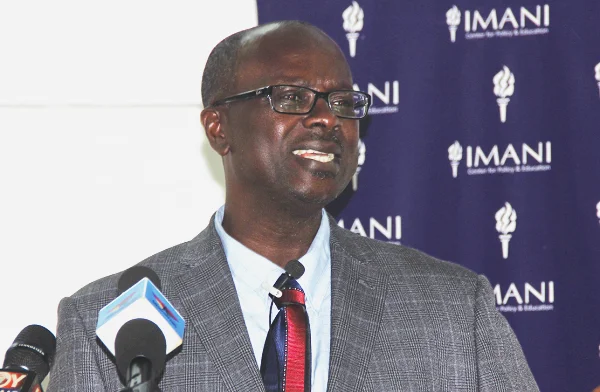
He expressed optimism that such reforms would transform Ghana’s audit regime from a focus on numbers to one that promotes understanding, learning, and prevention.
“The result, would be a reporting model that enables Parliament to govern, the Executive to reform, and the public to comprehend—not merely that irregularities exist, but why they arise and how they can be prevented.”
Professor Stephen Kwaku Asare
In his words, Ghana’s audit system must now progress “from formal reporting to functional accountability—from detecting deviations to diagnosing governance, and from enumerating losses to learning from them.”
READ ALSO: IMF Names Dan Katz as First Deputy Managing Director — A New Era of Global Economic Leadership Begins.