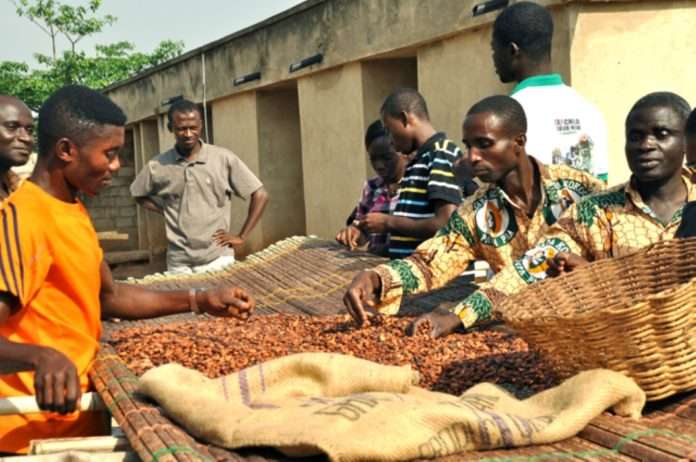
The global cocoa industry is booming — at least on paper. Prices for cocoa beans have surged to record highs, driven by global demand for chocolate and tightening supplies. Yet, behind this price rally lies a grim paradox: millions of smallholder farmers in West Africa, who grow most of the world’s cocoa, remain trapped in poverty.
According to the 2025 Cocoa Barometer, released this week, the cocoa sector’s ongoing transformation hides deep inequities and governance failures. The report paints a stark picture of an industry that continues to enrich global traders and confectionery giants while leaving farmers, especially those in Ghana, Côte d’Ivoire, and Nigeria, struggling to survive.
The 2025 Cocoa Barometer reveals that despite soaring cocoa prices, smallholder farmers are not reaping the benefits. Côte d’Ivoire and Ghana, which together produce over 60% of the world’s cocoa, have seen export prices climb to unprecedented levels. Nigeria is also emerging as a key player, expected to produce 350,000 tonnes in the 2024/25 season.
Yet, the report finds that forward-selling mechanisms — where cocoa is pre-sold before harvest — have delayed the transmission of higher prices to farmers. Many are still being paid at outdated rates, even as global markets profit from the surge. Compounding the crisis, yields continue to decline due to aging trees, erratic rainfall, and crop diseases linked to climate change.
The Barometer bluntly states, “Three things are happening simultaneously in the cocoa sector: it is bad, it is better than before, and there is a lot of room for improvement.”
The Poverty Trap: Root Cause of Cocoa’s Dark Side
Farmer poverty, the Barometer emphasizes, is the root of nearly every major issue in the cocoa industry — from deforestation and child labour to gender inequality and exploitative wages. While global chocolate brands post billion-dollar profits, cocoa farmers often live on less than $1.50 a day.
The report calls for a “living income” to be recognized as a human right for all cocoa farmers, describing fair pay as both a moral and legal obligation. Yet, political resistance, particularly in Europe, threatens progress on new legislation designed to enforce corporate accountability on human rights and environmental standards.
The Barometer’s findings are grim: 1.5 million children still work under hazardous conditions on cocoa farms in Ghana and Côte d’Ivoire. Many handle machetes, carry heavy loads, or work with toxic chemicals.
At the same time, deforestation driven by cocoa expansion is spreading into new regions in West Africa. Forests that once acted as carbon sinks are being cleared to make way for plantations, worsening climate change. “High prices are driving a production boom,” the report warns, “but this boom could collapse into oversupply and falling prices, just as it did in 2016.”
Women, who make up the backbone of cocoa farming — from planting and harvesting to processing — remain marginalized. They perform most of the labour but have little to no say in household or community decision-making, and they rarely share in profits.
Governance Gaps and Market Failures
A critical theme in the Cocoa Barometer 2025 is weak governance. The report accuses both governments and multinational companies of failing to implement supply management systems that protect farmers from price volatility.
Lack of transparency in cocoa sales — including how farmgate prices are determined — continues to obscure accountability. While producing countries like Ghana and Côte d’Ivoire have introduced price stabilization schemes, corruption, bureaucracy, and weak enforcement dilute their impact.
Without policy reform and a coordinated international response, the Barometer warns, farmers will continue to shoulder the risks of a system designed to benefit traders and manufacturers.
Despite the challenges, the Cocoa Barometer’s message is not entirely bleak. It insists that systemic change is possible through stronger collaboration between farmers, governments, civil society, and industry leaders.
The report outlines four urgent priorities for the global cocoa sector: committing to fair pay through living income benchmarks for all cocoa farmers; enforcing a global moratorium on deforestation linked to cocoa cultivation; promoting gender equality by recognizing women as equal decision-makers and ensuring equitable profit-sharing; and strengthening transparency and accountability by establishing open reporting and traceability systems across the entire cocoa supply chain. The Barometer emphasizes that the industry must move beyond voluntary commitments and adopt binding regulations to achieve real and lasting impact.
The 2025 Cocoa Barometer serves as a wake-up call to policymakers, corporations, and consumers alike. While the world enjoys its chocolate treats, the hands that make them possible are often exploited and impoverished.
Unless bold reforms are enacted, today’s cocoa boom could collapse under the weight of its own contradictions — rising prices, deepening inequality, and environmental destruction. The report concludes that the path forward depends on fair compensation, stronger governance, and genuine accountability.
READ ALSO: BoG’s $1.15bn FX Injection Sparks Clash with IMF and World Bank Over Cedi Stabilization