The European Union has hailed Ukraine’s progress on reform to join the bloc despite concerns over its efforts to tackle corruption.
In a series of enlargement reports, the EU Enlargement Commissioner, Marta Kos said the progress toward membership made by Ukraine and Montenegro, but also Albania and Moldova, “shows that reforms pay off.” “This should serve as a strong motivation for all countries engaged in the process,” she added.
The European Commission praised Ukraine for advancing key reforms but it said that only “limited progress” had been made on combating corruption. A bill seen as undermining the independence of anti-corruption agencies sparked a public outcry this year and the first major protests since the war began, before it was withdrawn.
The commission noted that the agencies and civil society groups report growing pressure from the state and security services. It said that “these developments cast doubts on Ukraine’s commitment to its anti-corruption agenda.”
Still, the Commission said that Ukraine is committed to the “ambitious objective” of concluding accession talks by the end of 2028. To meet the goal, Brussels said, “an acceleration of the pace of reforms is required, notably with regards to the fundamentals, in particular rule of law.”
The EU also needs to make its decisions faster, with Hungary’s staunchly nationalist government blocking Ukraine’s membership path.
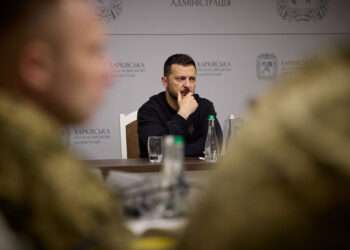
Ukraine’s President, Volodymyr Zelenskyy welcomed the report via video-link in Brussels. as proof of what can be achieved during wartime.
“We have implemented the widest, the broadest anti-corruption infrastructure in Europe. And I don’t know about any country who has that many anti-corruption authorities. We are doing everything possible.”
Volodymyr Zelenskyy
The small Balkan country of Montenegro was also hailed for making “significant progress” toward accession over the last year.
The Commission urged the government there to seek broad political consensus so that it can wind up its membership talks by the end of 2026. “Subject to maintaining the pace of reforms, Montenegro is on track to meet this ambitious objective,” it said.
Serbia, Georgia Warned About Democratic Backsliding
Serbia was warned that public concerns about corruption, the excessive use of force against protesters and a perceived lack of transparency “has led to a serious erosion of trust.”
The European Commission warned that reforms have “significantly slowed down.” It stressed that Serbia is expected to overcome the standstill in the area of judiciary and fundamental rights overall and urgently reverse the backsliding on freedom of expression and the erosion of academic freedom.
It also noted that Serbia’s decision to fast-track visa-free travel rights in Europe for Russian citizens by granting them Serbian citizenship “poses potential security risks for the EU.”
In 2024, the EU put Georgia’s membership talks on hold and cut financial support after the introduction of a “foreign influence” law widely seen as a blow to democratic freedoms. A year on, the commission said, “the situation has sharply deteriorated, with serious democratic backsliding marked by a rapid erosion of the rule of law and severe restrictions on fundamental rights.” It said that it “considers Georgia a candidate country in name only,” and urged the governing Georgian Dream party to alter course.In Tbilisi, Georgian Parliament Speaker Shalva Papuashviliat rejected the report, saying that “if anyone is regressing as a result of such unjust, biased, anti-democratic, polarisation-oriented, and destructive attitudes, it is precisely the current governing institutions of the European Union.”
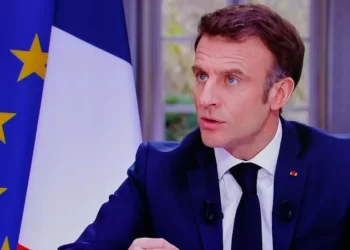
France, notably, has insisted that the EU is too unwieldy and must itself reform before taking more countries on board. National vetoes wielded by Hungary and increasingly Slovakia have slowed decision-making and action in the world’s biggest trading bloc.
The commission is even weighing whether to recommend that countries be put “on probation” when they join, restricting their use of vetoes.