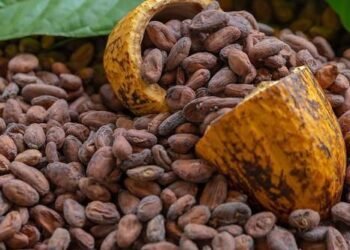
Ghana’s cocoa sector has been beaming with renewed vigor, with production more than doubling while the government seeks to further boost the sector’s capacity.
Cocoa has been one of Ghana’s major prides in export commodities. The sector held on grimly to that status while ravaged by several unsolved challenges. In recent years, other commodities, like gold and oil, have surpassed this imperative sector in Ghana’s export accounts.
The cocoa industry plays a major role in Ghana’s economy, employing some 800,000 farm households in 10 out of the country’s 16 administrative regions. The government has therefore set out to solve some of these challenges of the sector, resulting in improved export earnings and farmer welfare.
Ghana’s Cocoa Export Performance
Cocoa export in Ghana as of March 2025 amounted to US$1,595.2 million compared to US$495.5 million recorded in 2024. Ghana’s cocoa exports rose to US$2,167.5 million in June 2025, as against US$762.5 million exported in the same period in 2024.
As of September, cocoa exports for the first nine months of 2025 accumulated to US$2,560.4 million, while in the same period last year, US$989.9 million of cocoa was exported. Cocoa exports for 2025, from January to October, reached a record high of US$2,817.7 million compared to US$1,178.2 million in the same period of 2024.

Clearly, the export of Cocoa in 2024 has more than doubled in 2025. Some of the challenges of the sector are being addressed, and stringent measures in terms of efficiency in management, tighter systems, and leak sealings have revamped the sector.


The total value of cocoa exported for 2024, January to December, stood at US$1,938.4 million. This is less than the amount exported in 2025 as of June. Cocoa exports have increased substantially this year, and experts project that by the end of the year, December, total cocoa exported out of Ghana will be valued at US$3,300million with an error margin.
The Government’s Effective Measures
The Vice President of Ghana, Prof. Naana Jane Opoku-Agyemang, has in recent months advocated strongly for the cocoa sector. She called for greater institutional and financial backing for small-scale cocoa processors, particularly in rural areas, to ensure that the benefits of value addition are broadly shared.

Ghana, the world’s second-largest cocoa producer after Côte d’Ivoire, exports most of its beans in raw form. The government’s latest initiative reflects a broader push across West Africa to diversify export earnings and reduce exposure to volatile global commodity prices.
The government has instituted a series of strategies to reap the outstanding export earnings of the sector for this year. Other external factors complement the government’s effort to boost production and streamline the supply chain.
The government increased the farmgate price of cocoa paid to farmers twice this year, first to GhȻ51,660 per ton (GhȻ3,228.75 per bag) in August and then later to GhȻ58,000 per ton (GhȻ3,625 per bag) in October for the 2025/2026 season. The government aimed to encourage increased production and disincentivize smuggling to other countries.
COCOBOD introduced the National Cocoa Rehabilitation Program to assist aging and diseased farms, as well as the reintroduction of the free supply of farm inputs like fertilizer, spraying machines, insecticides, and fungicides. These contributed to the boost in production this year.

Cocoa smuggling became a huge issue in Ghana, where reports were made of farmers selling their cocoa beans illegally outside the borders of the country. Resourcing and giving farmers fair earnings for their labor has reduced smuggling, and the country is benefiting from the high yields. Also, the ongoing efforts to clamp down on illegal mining, locally known as ‘galamsey’, have preserved cocoa farms.
COCOBOD rolled out the National Traceability System in the 2025/2026 crop season to trace the cocoa beans from the farms to the ports to ensure compliance with the European Union’s Deforestation Regulation (EUDR)
Value Addition – Processing Capacity
The government has again pioneered measures to attract investment into the cocoa sector, especially in local processing. Ghana is striving to add value to the cocoa beans in the form of chocolate, cocoa butter, and cocoa powder, to further increase export earnings.
“Our shared challenge now is to move beyond trade based on commodity dependence towards a partnership built on value addition, sustainability, and fairness. For Ghana, processing more of our beans at home is both a legitimate aspiration and a strategic imperative.”
Vice President, Prof. Naana Jane Opoku-Agyemang
According to the Vice President, the new measures the government is introducing aim at reducing the country’s dependence on raw commodity exports by accelerating value addition in the cocoa sector, as well as other key sectors of the economy.
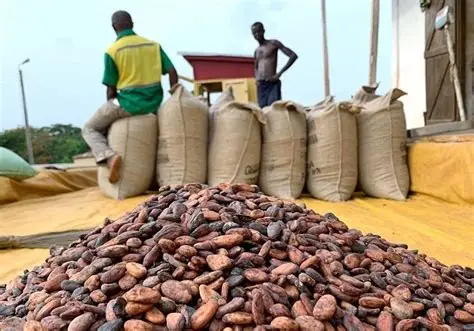
She clarified that the government’s policy shift is “designed to expand domestic cocoa processing, boost job creation and strengthen Ghana’s position in global trade negotiations.”
The nation’s cocoa processing capacity has increased to about 500,000 tons due to government incentives, she declared, further describing it as a milestone that underscores efforts to capture more value locally in one of Ghana’s most important export industries.
READ ALSO: Ghana’s Cedi Emerges as the Calm in Africa’s Chaotic Currency Storm