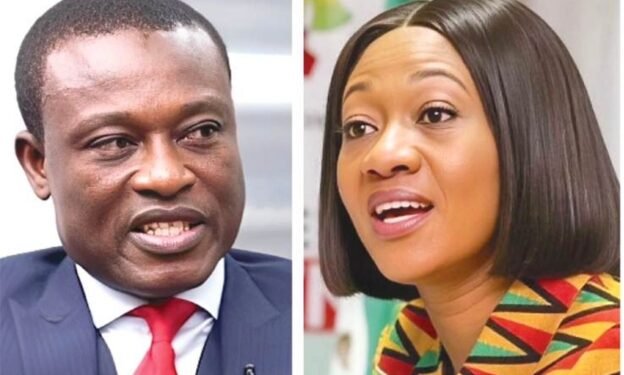
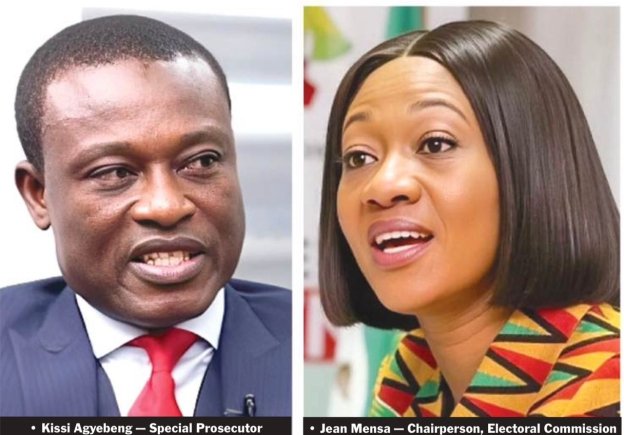
President John Dramani Mahama has formally referred multiple petitions seeking the removal of Electoral Commission Chairperson Jean Mensa, her deputies Dr. Bossman Asare and Samuel Tetteh, and the Special Prosecutor, Mr. Kissi Agyebeng, to the Chief Justice for appropriate constitutional action.
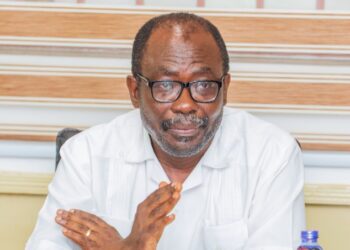
The confirmation was delivered by Presidential Spokesperson and Minister for Government Communication, Hon. Felix Kwakye Ofosu, who explained that the President had acted strictly in line with the procedures defined under Ghanaian law.
Speaking in a media interview, Hon. Kwakye Ofosu disclosed that President Mahama received the petitions “sometime last week,” following weeks of public agitation and widespread calls for changes within the leadership of the Electoral Commission and the Office of the Special Prosecutor.
Although earlier reports suggested that as many as ten petitions had been submitted to the Presidency, the spokesperson declined to confirm the exact number, focusing instead on the constitutional process that has now been set in motion.
“Every process that needed to be on it has been undertaken, and the process for doing so is quite clear. So, I heard your resource person in the studio take you through the process, and that is precisely what the President has followed. That is what I can say for now.”
Presidential Spokesperson and Minister for Government Communication, Hon. Felix Kwakye Ofosu
The petitions arrive at a time when the performance and credibility of both institutions have become the subject of national debate. Critics of the current Electoral Commission leadership have repeatedly cited concerns about transparency, public trust, and the management of previous electoral exercises.

Similarly, the role and conduct of the Special Prosecutor have sparked extensive public conversations, fueling renewed demands for accountability and institutional reform.


Removal of an Electoral Commissioner and Special Prosecutor
Under Ghana’s 1992 Constitution, the removal of an Electoral Commissioner is a highly structured and insulated process designed to protect the independence of the Commission. Article 146 outlines the mechanism: once a petition is presented to the President, the President is required to transmit it to the Chief Justice.
The Chief Justice must then determine whether the petition establishes a prima facie case. If it does, a committee is appointed to inquire into the allegations, make findings, and recommend whether the Commissioner should be removed on grounds of stated misbehaviour or incompetence.
This process mirrors what occurred in 2018, when then-President Nana Addo Dankwa Akufo-Addo removed EC Chairperson Charlotte Osei and her deputies after a committee established by the Chief Justice found procurement-related breaches warranting their dismissal. That precedent remains a major reference point in current public discussions, as many observers draw parallels between past and ongoing petitions.
However, the removal of a Special Prosecutor follows a separate legal pathway outlined in Section 15 of the Office of Special Prosecutor Act, 2017 (Act 959). The law stipulates that any person seeking the removal of the Special Prosecutor must address a petition to the President.
Once the petition is received, the President has seven days to forward it to the Chief Justice. The Chief Justice must then, within thirty days, assess whether the petition makes a prima facie case.

If the threshold is met, a three-member committee—including a Supreme Court Justice, a lawyer with at least fifteen years’ standing, and a professional with investigative expertise—must be constituted to conduct a full inquiry.
President’s Compliance with Constitutional Guidelines
Given the clearly defined legal frameworks governing both processes, Hon. Kwakye Ofosu stressed that President Mahama’s responsibilities ended once he transmitted the petitions to the Chief Justice.
“At this stage, the process has left the hands of the President. Beyond conveying the petitions to the Chief Justice for the processes to continue, there’s little else that the President does in this particular instance. So, everything now rests with the Chief Justice, who I believe will act in accordance with Ghanaian law.”
Presidential Spokesperson and Minister for Government Communication, Hon. Felix Kwakye Ofosu
With the matter now formally before the Chief Justice, public attention is expected to shift to the next procedural steps: the determination of whether a prima facie case exists against any of the individuals cited, and, if so, the establishment of the relevant committees to investigate the allegations.
The coming weeks are therefore likely to be pivotal, as the Chief Justice begins to engage with the constitutional and statutory requirements underpinning the petitions.
The handling of the cases will serve as a crucial indicator of the country’s commitment to due process, institutional accountability, and constitutional governance. While the content of the petitions remains undisclosed, the developments point to a significant moment for two of Ghana’s most consequential independent bodies and set the stage for potentially far-reaching institutional decisions.
READ ALSO: Strong Reserves Become Cedi’s Lifeline as It Braces for 2026 Debt Wave