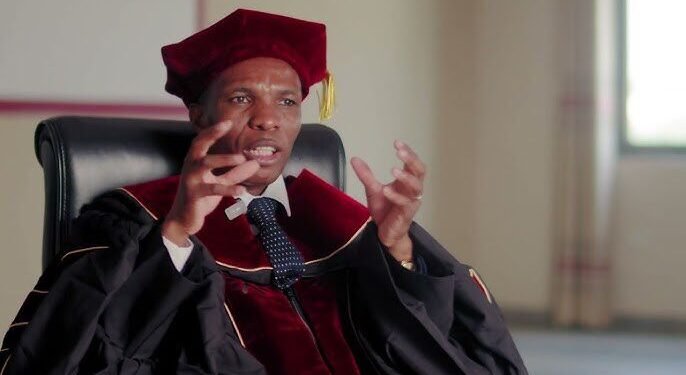

President Bola Ahmed Tinubu has nominated former Chief of Defence Staff, General Christopher Gwabin Musa, as Nigeria’s new Minister of Defence.
The nomination, formally communicated to Senate President Godswill Akpabio on Tuesday, follows the sudden resignation of Alhaji Mohammed Badaru Abubakar on Monday. General Musa, a seasoned military officer with more than three decades of service, is expected to play a central role in the administration’s efforts to tackle mounting insecurity across the country.
In his letter to the Senate, President Tinubu expressed strong confidence in the 58-year-old retired general, describing him as a leader with the experience and composure needed to strengthen Nigeria’s national security institutions.
“The President expressed confidence in General Musa’s ability to lead the Ministry of Defence and further strengthen Nigeria’s security architecture,” the statement signed by Special Adviser to the President on Information and Strategy, Bayo Onanuga, said.
General Musa’s appointment comes at a time of intensified national and international concern regarding Nigeria’s security situation. Recent months have seen an escalation of violent incidents, including renewed attacks in several northern communities, the continued abduction of school children, and persistent allegations of targeted persecution of Christians in parts of the country.
The situation has drawn global attention, culminating in a public statement from U.S. President Donald Trump condemning the violence and commissioning the U.S. Congress to investigate the rising persecution of Christians in Nigeria. That inquiry has since been taken up by the U.S. House Appropriations Committee, which recently opened a joint briefing on the matter.



Against this backdrop, the nomination of General Musa is widely seen as a strategic move by President Tinubu to reinforce public confidence in Nigeria’s security leadership. General Musa brings to the ministry a long career marked by operational command experience, crisis management, and international military coordination.
Born in Sokoto in 1967, General Musa completed both his primary and secondary education in his home state before attending the College of Advanced Studies in Zaria.
He proceeded to the Nigerian Defence Academy in 1986 and graduated in 1991 with a Bachelor of Science degree, the same year he was commissioned into the Nigerian Army as a Second Lieutenant.
His early professional years included a wide range of key operational and administrative roles that would later shape his credentials as a senior military strategist.
Throughout his career, he served in several critical positions, including General Staff Officer 1, Training and Operations at the Headquarters of the 81 Division; Commanding Officer of the 73 Battalion; and Assistant Director of Operational Requirements at the Department of Army Policy and Plans.
He also served as Infantry Representative and Training Team Member at the Headquarters of the Nigerian Army Armour Corps. These assignments exposed him to planning, operational readiness, and troop training—elements that have been repeatedly cited as essential for Nigeria’s security revival.
By 2019, General Musa had taken up a higher-profile role as Deputy Chief of Staff for Training and Operations at the Infantry Centre and Corps Headquarters. Later that year, he was appointed Commander of Sector 3 under Operation Lafiya Dole, the long-running military campaign against Boko Haram and ISWAP insurgents.

In the same period, he served as Commander of Sector 3 of the Multinational Joint Task Force (MNJTF) in the Lake Chad Basin, coordinating efforts with forces from Chad, Cameroon, and Niger.
His leadership in the Lake Chad region earned him recognition for operational effectiveness and for strengthening multinational counter-insurgency collaboration.
His performance would later be a significant factor in his appointment in 2021 as the Theatre Commander of Operation Hadin Kai, which replaced Operation Lafiya Dole and expanded the military’s strategic mandate in combating terrorism in the Northeast.
In subsequent years, General Musa rose to become Commander of the Nigerian Army Infantry Corps, where he supervised structural reforms and training improvements.
In 2023, President Tinubu appointed him Chief of Defence Staff, a position he held until October 2025. His tenure as CDS was marked by intensified operations against insurgent groups and renewed emphasis on inter-service cooperation.
General Musa also won the prestigious Colin Powell Award for Soldiering in 2012, which recognized his leadership excellence and professional conduct. His familiarity with Nigeria’s complex security landscape and his direct involvement in counter-terrorism operations make him one of the most experienced military officers to take up the role of Defence Minister in recent years.

His nomination signals the administration’s intent to consolidate operational leadership with political authority for faster decision-making in the fight against insecurity. President Tinubu’s decision, however, also comes with heightened expectations.
With international actors calling for greater accountability and stronger government action—especially following allegations of targeted religious violence—the incoming Defence Minister will be under pressure to demonstrate quick, decisive, and transparent leadership.
His confirmation by the Senate, widely expected given his service record, will deepen the focus on how he intends to respond to Nigeria’s evolving security challenges.
Special Adviser Bayo Onanuga said the President expects the retired general to provide “firm stewardship” of the ministry at a time when Nigerians are eager for improved safety and stability.
READ ALSO: Blame the Escape, Not OSP — CDD Fellow Demands Freeze on Ofori-Atta’s Assets