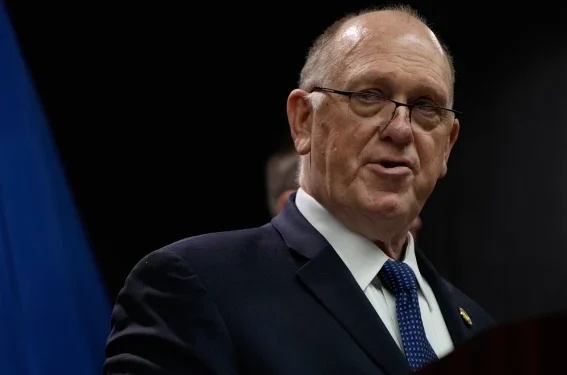
South Korean President Lee Jae Myung has announced that he is seriously considering issuing an apology to North Korea for cross-border incidents allegedly orchestrated by his predecessor.
Speaking during a press conference in Seoul, Lee said he believes “I feel I should apologise,” but he stopped short of committing to a formal apology, citing concerns about domestic political fallout.
“I worry that if I do, it could be used as fodder for ideological battles or accusations of being pro-North.”
South Korean President Lee Jae Myung
The underlying allegations stem from a case in which a special prosecutor last month indicted former President Yoon Suk Yeol and several top defence officials for allegedly ordering drone flights over Pyongyang to drop propaganda leaflets, a move prosecutors claim was meant to provoke North Korea and stoke military tension.
Lee’s comments came as South Korea observed the first anniversary of Yoon’s ill-fated declaration of martial law, a dramatic bid for power that triggered widespread protests and political chaos. The attempt was rapidly overturned, and the Supreme Court later deemed it unconstitutional.
At that time, many analysts speculated the leaflet and drone operations were intended to provoke a security crisis that could justify extraordinary measures. The recent indictments have lent those speculations additional weight, although the allegations remain to be proven in court.
Efforts to Reset Inter-Korean Relations
Since assuming office in June, Lee has sought to reset a more conciliatory tone toward North Korea. As part of his efforts, he removed frontline propaganda loudspeakers and backed legislation banning the launch of leafleting balloons toward the North.


Yet, those gestures have not yielded a breakthrough: Pyongyang has so far rebuffed repeated overtures. North Korea’s leader, Kim Jong Un, has publicly declined any engagement, leaving Seoul’s diplomatic efforts stalled.
Lee indicated that Seoul may consider reducing or suspending regular joint military exercises with the United States, seen by Pyongyang as provocations, in hopes of opening a path to renewed dialogue.
“If it is needed to build momentum for dialogue … we can discuss it,” he said, casting himself as a “constant facilitator” of peace.
Even as Lee contemplates reconciliation gestures, South Korea remains deeply divided. Conservatives and supporters of Yoon’s hard-line posture toward the North have criticized any apology as eroding national pride and undermining military deterrence.
Conversely, others argue that only clear admission and remorse can help heal inter-Korean relations and restore credibility to Seoul’s diplomatic outreach.
But Lee appears aware of the tightrope he walks: he wants to pursue rapprochement, yet he must balance domestic political risks.
Uncertainty Ahead as Indictment and Investigations Continue
The alleged drone and leaflet operations which reportedly occurred several times in October 2024 remain under investigation. The military has not publicly confirmed these nighttime missions, and disclosure of such activity would break long-standing precedent.
Until the courts decide, any apology by Seoul might be viewed by critics as premature or politically motivated. That potential backlash appears to be a major reason for Lee’s cautious approach. “That’s all I will say for the time being,” he declared.
Despite the delicate domestic landscape, Lee’s willingness to consider an apology highlights a broader shift in South Korean strategy toward North Korea: from confrontation to diplomacy.
Lee’s restrained stance an attempt to decouple inter-Korean issues from internal political strife, while re-opening channels for negotiation.
Some observers believe this pragmatic diplomacy could set the stage for future breakthroughs, especially if the United States and other regional powers support Seoul’s outreach.
Lee punted to Washington, suggesting that if Pyongyang values deals with external powers, U.S. influence could help drive renewed engagement with the North.
Whether Pyongyang ultimately responds remains unclear. But by publicly acknowledging the moral weight of past inter-Korean provocations and debating an apology, President Lee appears to be betting on dialogue over escalation, a bold gamble in a country still reeling from last year’s constitutional crisis.
READ ALSO: Suhuyini Demands UG Flexibility on WASSCE Failure, Slams Zipline Termination Calls