India and the European Union have reached a free trade agreement to deepen economic and strategic ties.
The accord, dubbed the “mother of all deals,” comes after nearly two decades of negotiations.
The deal is also one of the biggest bilateral engagements on commerce and could impact as many as 2 billion people.
India and the EU also agreed on a framework agreement for deeper defense and security cooperation, and a separate pact aimed at easing mobility for skilled workers and students, signaling their partnership extends beyond commerce.
The deal, further integrating supply chains and strengthening joint manufacturing power, will also cut up to 4 billion euros ($4.7 billion) in annual tariffs for exporters and create jobs for millions of workers in India and in Europe.
A formal signing of the deal could come later this year after a legal scrubbing of the text while it is expected to go into effect sometime early next year, after ratification by the EU Parliament.
According to statements from both sides, India is expected to reduce or eliminate tariffs for 96.6% of EU exports, while Brussels will reciprocate with similar reduction covering nearly 99% of India’s shipments by trade value in a phased manner.
India’s sectors poised to gain from the deal include textiles, apparel, engineering goods, leather, handicraft, footwear and marine products while the EU’s gains will be in wine, automobiles, chemicals and pharmaceuticals, among others.
A quota system for automobiles, wines and whisky has been agreed on, bringing down steep duties. The European Commission said that tariffs charged by India on cars will gradually go down from 110% to as low as 10%, while they will be fully abolished for car parts after 5-10 years.
It added that tariffs ranging up to 44% on machinery, 22% on chemicals and 11% on pharmaceuticals will also be mostly eliminated.
On European wine, the tariffs in India would come down from 150% to 20% for the premium range. New Delhi has excluded from the deal dairy products such as milk and cheese along with cereals citing “domestic sensitivities” about those products.
Officials at Indian Trade Ministry said that the EU for its part won’t allow concessional tariffs on imports of Indian sugar, meat, poultry and beef products.
The deal comes as Washington targets both India and the EU with steep import tariffs. Washington is targeting both India and the EU with steep tariffs, disrupting established trade flows and pushing major economies to seek alternate partnerships.
The negotiations for the India-EU deal got a new impetus after US President Donald Trump’s strong-arm tactics over tariffs and Greenland.
India-EU Agreement Hailed
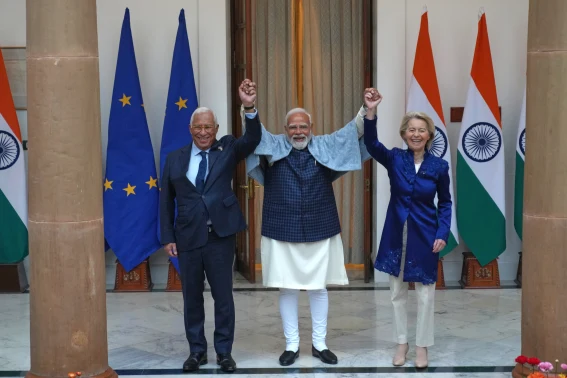
Speaking at a joint news conference in New Delhi with European Commission President Ursula von der Leyen and European Council President António Costa, Indian Prime Minister Narendra Modi said that the partnership with the EU “will strengthen stability in the international system” at a time of “turmoil in the global order.”
Modi said in a virtual address to an energy conference, that this agreement will bring major opportunities for the people of India and Europe. He added, “It represents 25% of the global GDP and one-third of global trade.”
Von der Leyen said in a post on X, “Europe and India are making history today,” adding, “We have concluded the mother of all deals”
In a speech later, she said that the accord was a tale of “two giants;” the world’s second and fourth largest economies, “who chose partnership, in a true win-win fashion.” She also said that it sends “a strong message that cooperation is the best answer to global challenges.”
India is looking to diversify its export destinations as part of a strategy to offset the impact of higher US tariffs, including an extra 25% levy on Indian goods for its unabated purchases of discounted Russian oil, bringing the combined tariffs imposed by the United States on its Asian ally to 50%.
For the EU, the deal offers the bloc expanded access to one of the world’s fastest-growing major economies, and helps European exporters and investors reduce their reliance on more volatile markets.
READ ALSO: Trump Hikes South Korea Tariffs to 25%