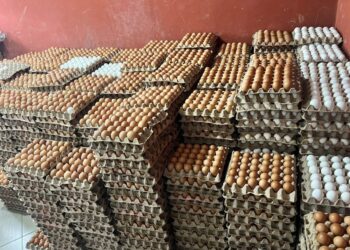

The Government of Ghana, through the Ministry of Food and Agriculture (MoFA), has initiated a shift toward industrial egg powder production to absorb the nation’s massive poultry surplus and stabilize farmer incomes. The pivot seeks to neutralize the recurring “glut” cycles that have decimated the profit margins of local poultry producers.
According to Mr. Kwesi Etu-Bonde, the Chief Technical Advisor to the Minister of Food and Agriculture, transitioning from primary production support to advanced value addition will transform a perishable liability into a stable industrial raw material.
Addressing the paradox during a stakeholder dialogue, he described the intervention as a central pillar of the proposed National Poultry Master Plan, a comprehensive policy blueprint to stabilize market prices, extend product shelf life, and insulate the sector from the volatile boom-and-bust cycles that characterize unregulated agricultural markets.
“Eggs can be processed into powder, and that is part of the value addition we want the poultry master plan to address. The egg glut has come to our attention. Last year, the ministry supported the production of grains such as maize and soya, and that has brought feed prices down. As a result, more people have been incentivised to go into poultry production”
Mr. Kwesi Etu-Bonde, Chief Technical Advisor to the Minister of Food and Agriculture
For years, the poultry sector has been trapped in a cycle of seasonal oversupply. During these periods, farmers find themselves with millions of crates of eggs that cannot be stored or transported fast enough to meet demand, leading to rapid spoilage and financial ruin.
The move to explore egg powder processing represents an administrative recognition that traditional consumption alone cannot solve the problem of systemic overproduction, guiding the government towards a product that can be stored for years rather than weeks – opening up vast new market opportunities in the bakery, pharmaceutical, and processed food industries.

The current crisis of oversupply is, ironically, a byproduct of the government’s successful interventions in other areas of the agricultural supply chain. Subsidizing the production of maize and soya – the two primary components of poultry feed – lowered the barrier to entry for poultry farming, leading to a massive surge in the number of birds being raised nationwide.
While this was intended to boost local production and reduce imports, the lack of a corresponding increase in processing capacity has created a supply-side shock that the local market cannot absorb.
Mr. Kwesi Etu-Bonde noted that the egg glut is no longer a localized issue but a national economic challenge that requires a technical, rather than purely social, solution. The goal is to ensure that the increased productivity gained from lower feed costs is not wasted through post-production losses by dehydrating eggs into powder.
An Economic Shield
The proposed National Poultry Master Plan was framed as an economic shield for Ghanaian farmers, with a focus on value addition as the primary mechanism for price stabilization. With the establishment of egg powder plants, the government can effectively set a “floor price” for eggs.
During periods of surplus, excess stock can be diverted to these processing facilities, preventing the market price from collapsing, ensuring that farmers can maintain a consistent revenue stream regardless of seasonal fluctuations in consumer demand.
Industry players have long argued that without such a plan, the poultry sector would remain a high-risk investment. The financial losses associated with selling eggs at heavily reduced prices just to clear stock are often enough to drive small and medium-scale farmers out of business.

Beyond creating a more resilient ecosystem that can attract larger investments and encourage modernization, the shift toward egg powder also allows Ghana to look beyond its borders, as powdered eggs are a highly tradable commodity that can be exported to regional markets under the African Continental Free Trade Area (AfCFTA) framework.
While the long-term goal is industrial processing, the government has also moved to provide immediate liquidity to the market through state-led consumption. President John Dramani Mahama has issued a direct mandate for the National School Feeding Programme to prioritize the purchase of eggs from local farmers.
This serves as a critical short-term off-taker, injecting cash directly into the poultry sector and providing essential nutrition to students across the country. The dual-purpose strategy addresses both the economic survival of the farmers and the national health priorities of the state.
However, the administration is clear that the School Feeding Programme is a relief measure, not a permanent solution to the glut. The structural problem of oversupply requires the infrastructure for storage and conversion.
Mr. Etu-Bonde emphasized that while the state can act as a buyer of last resort through social programs, the ultimate objective remains the creation of a private-sector-led processing industry, and this will involve incentivizing investors to build the specialized facilities required for egg breaking, pasteurization, and spray-drying.
The transition to egg powder production marks the beginning of a more sophisticated era for Ghanaian agriculture. For too long, the sector has been defined by the sale of raw, perishable commodities.
The Ministry of Food and Agriculture’s focus on the poultry value chain indicates a broader shift toward agro-industrialization, where the state provides the policy framework and infrastructure necessary for high-value processing.

This move is expected to not only protect farmers from the immediate threat of gluts but also create a more robust and self-sufficient food system that is less reliant on imported processed goods.
READ ALSO: Valco Hits $3.1m Profit in 2026 1st Quarter Turnaround