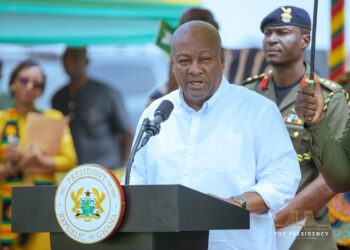
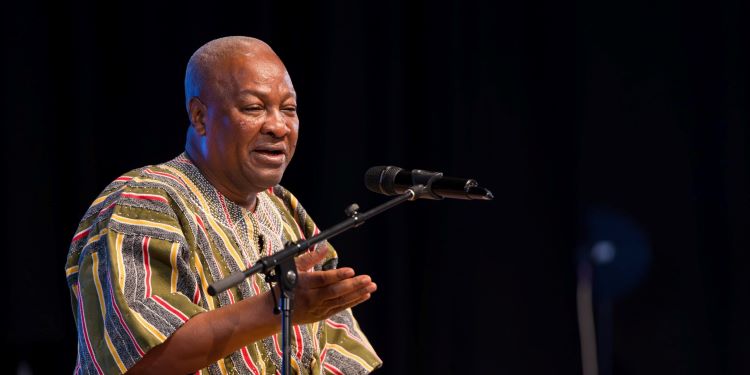
Speaking at the Ghana-UK Investment Summit in London today, President John Dramani Mahama has presented global investors and economic policymakers with a sweeping structural blueprint to transition the country from a primary commodity exporter to a fully integrated, production-led industrial power.
At the center of this economic pivot is a coordinated policy approach that explicitly links accelerated export development with the administration’s flagship 24-hour economy strategy, focusing on optimizing domestic output, expanding manufacturing capabilities, and fundamentally altering how Ghana interfaces with global value chains.
“The 24-hour economy is not merely a slogan. It is a deliberate national productivity strategy that is designed to maximise the utilisation of infrastructure, industry, labour, logistics, sports, and energy systems around the clock. It is intended to increase productivity, stimulate manufacturing, create jobs, boost exports, deepen regional trade, and improve competitiveness”
President John Dramani Mahama
In his address to international capital allocators, President Mahama redefined the formalization of the 24-hour economy policy, clarifying that it extends far beyond labor market adjustments or standard shift work.
According to President Mahama, the framework is engineered as a macro-level productivity tool intended to maximize the operational runtime of Ghana’s capital assets, infrastructure networks, and public utilities by addressing persistent inefficiencies in energy utilization and logistical throughput.
The program aims to lower the structural cost of doing business while boosting domestic production capacity. To achieve this round-the-clock operational baseline, the state is aligning an array of regulatory incentives and infrastructural supports.
These include the deployment of dedicated power reliability frameworks – such as targeted Time-of-Use power tariffs and modernized smart metering – alongside tailored fiscal incentives, advanced transport networks, and specialized skills-development pipelines. The President detailed the structural scope and sectoral intent behind this round-the-clock economic push.

He noted that the shift is structured to directly benefit capital-intensive industries such as logistics management, commercial warehousing, cold chain infrastructure, advanced ICT systems, and industrial park development, providing corporate entities with the regulatory predictability required to run continuous production lines.
Transforming Agriculture
A major component of this production-led transformation is the modernization of the domestic agricultural value chain under the Feed Ghana programme.
For a long time, Ghana’s agricultural sector has faced systemic challenges, including significant post-harvest losses, low levels of commercial irrigation, and a heavy reliance on raw commodity exports that leave the country vulnerable to international price shocks.
The Feed Ghana framework corrects these structural imbalances by treating agribusiness as a core driver of manufacturing and export growth rather than a baseline subsistence industry. The strategy focuses heavily on establishing dedicated agro-industrial enclaves across the country’s primary economic zones.
President Mahama explained that through deploying expanded irrigation infrastructure, subsidizing commercial farming technologies, and building integrated cold chain logistics systems, the initiative seeks to stabilize domestic food security while processing raw inputs onshore.
The policy targets a diverse mix of agricultural sub-sectors, including cocoa processing, oil palm refining, cashew and shea value addition, horticulture, poultry, rice production, and coastal fisheries. President Mahama outlined how these synchronized investments will capture regional and global market demand.
“Under our Feed Ghana programme, we’re modernising agriculture and positioning agribusiness as a major pillar of industrial growth and exports expansion. We’re establishing agro-industrial enclaves across the country, improving irrigation systems, supporting commercial farming, and expanding food processing and agricultural export”
President John Dramani Mahama

Ghana’s goal is to build a highly reliable supply chain that feeds directly into the nation’s broader manufacturing hubs and export channels by embedding processing facilities directly within these agricultural enclaves.
Beyond agriculture, President Mahama noted that the administration’s economic master plan demands a parallel transformation within Ghana’s industrial and mineral extraction sectors.
As global demand rises for critical transition minerals, Ghana is adjusting its regulatory architecture to ensure that mineral wealth drives domestic industrialization, with current industrial strategy mandates that key resources – particularly cocoa lithium, gold, bauxite, and manganese – must undergo primary and secondary processing within the country.
This value-addition model is to support a wider domestic manufacturing ecosystem that includes advanced automotive assembly, pharmaceutical production, textiles, and petrochemical manufacturing.
President Mahama summarized the ultimate objective of this regulatory shift, stating that the days of functioning purely as a resource supplier are drawing to a close. “Our objective is simple. Ghana must become a production hub, not merely a source of raw commodities,” President Mahama stated emphatically.
Combining the operational capacity of a 24-hour economy with targeted agro-industrial and mineral processing policies, Ghana is positioning itself to maximize its geoeconomic advantages under the African Continental Free Trade Area (AfCFTA).
The strategic focus on high-level value addition ensures that Ghanaian-manufactured goods cleanly satisfy strict regional rules-of-origin criteria, unlocking tariff-free market access across Africa.
For international investors looking at West Africa, the structural policies in the President’s address at the London summit signal a clear and deliberate move away from passive commodity reliance toward a highly structured, round-the-clock industrial economy.
READ ALSO: Mahama: Ghana Has Become the Poster Boy for Economic Recovery