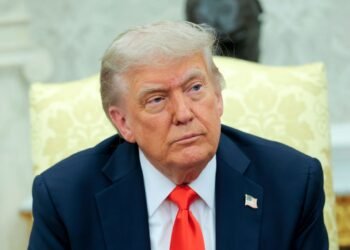

President Donald J. Trump has issued an extraordinary directive declaring that all official documents signed by President Joseph R. Biden Jr. using an autopen are invalid, escalating a political and constitutional dispute that has simmered since late 2025.
In a sharply worded statement, Trump announced that any document authenticated through what he described as the “now infamous and unauthorized ‘AUTOPEN’” holds no legal legitimacy.
“Any and all Documents, Proclamations, Executive Orders, Memorandums, or Contracts, signed by Order of the now infamous and unauthorized ‘AUTOPEN’… are hereby null, void, and of no further force or effect”.
President Donald J. Trump
He further warned that recipients of clemency documents signed in this manner are affected as well. “Anyone receiving ‘Pardons,’ ‘Commutations,’ or any other Legal Document so signed, please be advised that said Document has been fully and completely terminated, and is of no Legal effect.”
Trump’s proclamation, made months into his second presidency after his victory in the November 4, 2024, election, marks an unprecedented attempt by a sitting President to retroactively invalidate portions of a previous administration’s official actions. It also thrusts into the center of national conversation a longstanding administrative tool used by Presidents of both parties for decades.

The autopen, a mechanical device that reproduces a President’s signature, has been employed for routine correspondence and, occasionally, for urgent legislative or administrative actions when the President is geographically distant.
While automated or assisted signatures date back to Thomas Jefferson’s polygraph machine, modern autopen use became more widely documented during the administrations of George W. Bush, Barack Obama, and Donald Trump himself.


In 2011, President Obama became the first to use the autopen to sign a bill into law—an extension of the PATRIOT Act—after receiving authorization from the Department of Justice. Legal precedent has been consistent: an autopen signature, when authorized by the President, carries the full weight of presidential authority.
A 2005 memo from the Justice Department’s Office of Legal Counsel, under the Bush administration, explicitly concluded that the U.S. Constitution does not require the President to physically sign legislation to authenticate it. Courts have never ruled that a document’s validity hinges on the mechanics of the signature itself.
Trum’s Direct Departure
Despite that history, President Trump’s announcement signals a direct challenge not only to Biden’s administrative decisions but also to the legal understanding of presidential authority.
His insistence that the autopen was “unauthorized” during Biden’s tenure stands in sharp contrast to statements from Biden’s aides, who have maintained that the former President personally reviewed and approved every document signed with the device.
According to reports from the time, Biden’s staff often went to great lengths to secure his signature in person, even arranging flights to deliver documents when necessary. The autopen was used sparingly, typically under circumstances involving travel or security constraints.

Political tensions around the issue intensified after the Republican-led House Oversight Committee released a report in late 2025 recommending that the Justice Department investigate Biden’s use of the autopen.
The report, however, largely recirculated claims already in the public domain and offered little evidence to support allegations that aides acted without the president’s knowledge. Nonetheless, it helped fuel public skepticism among some segments of the electorate and provided a foundation for Trump’s later declaration.
Dismissal of Trump’s Claim
Legal experts have reacted with near unanimity in dismissing Trump’s claim that he can nullify a prior president’s actions on this basis. Constitutional scholars note that presidential powers are forward-looking and do not include authority to revoke the official acts of a predecessor, especially once those acts have taken legal effect.
This limitation includes pardons, which are considered irrevocable once issued. The Constitution does not prescribe any specific method by which a President must sign a pardon or commutation, and historical practice treats the President’s intention—rather than the mechanics of his signature—as the determining factor.
For that reason, President Trump’s attempt to “terminate” clemency documents has no legal effect, even though it may carry significant political implications. The directive appears aimed more at shaping public perception of the Biden presidency than at creating enforceable policy. It allows Trump to cast doubt on Biden’s competence and legitimacy while reasserting his authority in stark terms.

The Biden camp has not formally responded to Trump’s statement. However, former aides have repeatedly emphasized that autopen use under President Biden was above board, limited in scope, and always authorized by the former president himself. They argue that Trump’s move is an attempt to manufacture controversy where administrative practice has long been clear.
What remains uncertain is how federal agencies, courts, and affected individuals will navigate the political aftershocks of Trump’s declaration. While no legal framework supports the nullification of autopen-signed documents, the rhetoric surrounding the issue may contribute to broader debates about institutional trust, executive power, and the boundaries of presidential authority.
READ ALSO: Financial Stocks Soar: GSE-FSI Climbs to 4,459.35 in Stunning Market Rally