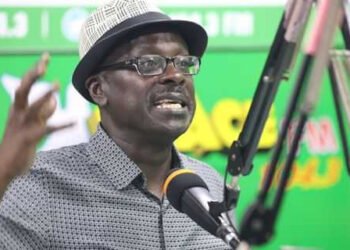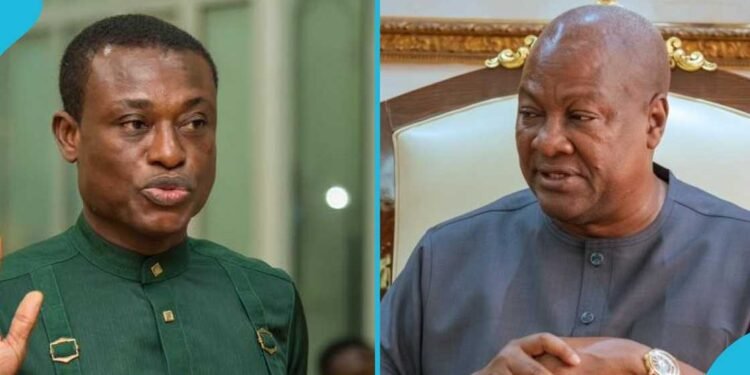

A leading voice in Ghana’s governance and legal reform space, Professor Stephen Kwaku Asare—widely known as Kwaku Azar and a Democracy and Development Fellow with CDD-Ghana—has issued a strongly worded critique of growing calls to repeal the Office of the Special Prosecutor Act.
His argument, detailed, urgent, and deeply rooted in six decades of institutional experience, challenges what he called Ghana’s “national habit of diagnosing the wrong disease and prescribing the wrong medicine.”
Professor Asare’s intervention comes amid intensified public debate instigated by demands in some political and parliamentary circles for the abolition of the Office of the Special Prosecutor (OSP) on grounds that it has not produced the “rapid results” expected of it.
But for the CDD-Ghana fellow, this argument fundamentally misunderstands both the purpose of the OSP and the complex terrain it was created to navigate. Scrapping the OSP, he warned, “is like burning down the hospital because there are sick people inside.”
According to him, the real issue is not the existence of the OSP but the country’s failure to equip it with the tools, legal space, and political protection required to succeed.
He argued that those calling for repeal “are attacking the wrong target,” because the OSP’s struggles reflect a structural design problem rather than a conceptual flaw. “The OSP is not struggling on its own,” he wrote. “It is struggling because we set it up to struggle. Many are invested in its failure.”


AG’s Institutional Failures
Recounting Ghana’s anti-corruption history, the Professor noted that for sixty years, the Office of the Attorney-General—tasked with criminal prosecutions—has proven unable or politically unwilling to confront high-level corruption.

“This is not opinion. It is history,” he stated bluntly. Ordinary policing tools, in his view, cannot confront elite looting because “you cannot fight political corruption with the same tools used to arrest mid-level white-collar criminals.”
For him, what elite corruption requires is specialised intelligence, forensic capacity, political independence, and legal muscle—precisely what the OSP was established to provide.
Without a strong OSP, he warned, Ghana’s anti-corruption architecture collapses, enabling elite impunity, eroding public trust, weakening oversight institutions, and damaging the nation’s international reputation.
Strengthening the office, he insisted, is a highly cost-effective national investment: “Corruption costs us billions. Strengthening the OSP costs a fraction of that.”
OSP’s Instruments Denied to Succeed
Yet despite its importance, the OSP remains weak—not because of inherent flaws but because it has been denied the instruments needed to succeed. Professor Asare outlined ten key reasons for the OSP’s struggles, beginning with what he described as courts structurally unsuited for prosecuting elite economic crimes.
Endless adjournments, rotating judges, and slow dockets, he said, mean that “corruption cases die quietly in this system.” He pointed out that the OSP lacks access to basic investigative tools such as lifestyle audits and automatic access to asset declarations—tools that are standard in Kenya and Malawi.
With weak witness protection systems and a political climate that exposes the OSP to pressure without offering it protection, the office finds itself constantly accused of witch-hunting while lacking the independence required to handle politically sensitive cases.
Another major hurdle is the OSP’s financial dependence on the Ministry of Finance—an arrangement he described as a “structural absurdity,” especially when the Ministry or its agencies may themselves be subjects of investigation. Even approved budget allocations, he noted, are not always released in full or on time.
Besides these constraints, Professor Asare highlighted procedural fog and litigation traps that clog the OSP’s work. Every investigative step attracts injunctions, challenges to jurisdiction, or human rights suits, forcing the office to expend more energy defending its right to act than on actual prosecutions.

Compounding these complexities, he observes, is the unrealistic public expectation for rapid outcomes in a justice system “deliberately calibrated for slowness.”
Equally limiting is the OSP’s narrow statutory jurisdiction, which excludes many of the ways corruption manifests in the real world—through money laundering, procurement abuses, tax evasion, and illicit enrichment networks.
And in a societal environment where “we do not treat looting as a serious crime,” the fight becomes even more difficult, as public sympathy often gravitates toward the politically connected.
Perhaps one of the most crippling constraints is reliance on other state agencies—including ministries, the GRA, the Auditor-General, the PPA, and EOCO—for documents and cooperation, which are often delayed or denied. “This would cripple any institution,” he emphasised.
A Comprehensive Reform Blueprint
Drawing from these weaknesses, Professor Asare offered a comprehensive reform blueprint targeted at empowering the OSP to deliver real results. Central to his reform proposals is the creation of specialised anti-corruption courts staffed with permanently assigned judges trained in financial crimes, with strict timelines ensuring cases are resolved within nine to twelve months.
He advocated granting the OSP critical investigative tools: lifestyle audits for politically exposed persons, automatic access to asset declarations, and the authority to pursue illicit enrichment patterns. These tools, he noted, are “necessities, not luxuries,” and would shift the evidential burden when unexplained wealth is discovered.
Strengthening witness protection and whistleblower systems is also essential. “Without protection, evidence never surfaces,” he warned, adding that fear largely explains why even minor public incidents—such as identifying someone who said “tweaaa”—remain unresolved, let alone testifying against powerful political financiers.

A politically insulated OSP, he argued, must be shielded from interference by political actors, with interference itself classified as a removable offence. He further called for an independent budget directly charged to the Consolidated Fund, operational autonomy from uncooperative agencies, the closing of litigation loopholes, and a broader, clearer jurisdiction that captures real-world economic crimes.
In his concluding verdict, Professor Asare rejected claims that the OSP is a failed idea. “It is a good idea crippled by poor implementation,” he maintained. Ghana, he argued, built “an institution for a gunfight and handed it a whistle.”
The solution, therefore, is not to take away the whistle, but to provide the right equipment: clear jurisdiction, financial independence, specialised courts, forensic capacity, and political protection.
“Repealing the OSP Act shows fear, not reform. Strengthening the OSP shows seriousness,” he asserted. And the ultimate national question, he declared, is whether Ghana truly wants to fight corruption or is content to normalize it as a routine function of political life.
READ ALSO: Developing Countries Restructure $90bn in Debt — But Rising Costs Spell Trouble for Ghana