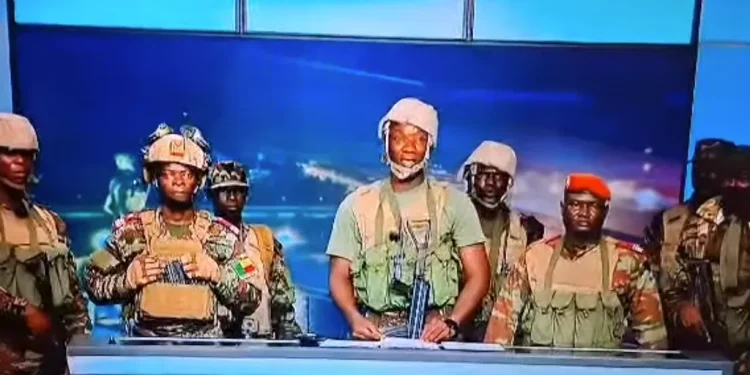
International condemnation has intensified following a coup attempt in Benin, after soldiers appeared on state television to announce the removal of President Patrice Talon, the closure of borders and suspension of political parties.
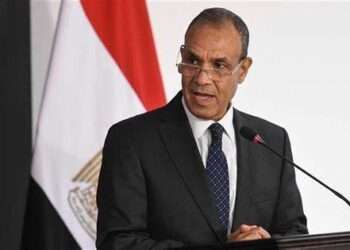
In a statement, AU Commission Chairperson, Mahmoud Ali Youssouf “strongly and unequivocally condemns the military coup attempt” in Benin, stressing that any form of military interference in political processes is “a grave violation of the fundamental principles and values” of the AU.
The statement also reaffirmed the bloc’s support for Talon, the legitimate authorities of Benin and its people.
“The African Union stands ready, in coordination with regional and international partners, to accompany the Government and People of Benin toward the full restoration of constitutional normalcy and the strengthening of democratic institutions.”
Mahmoud Ali Youssouf
In another statement, the Economic Community of West African States (ECOWAS) said that it strongly condemned the attempted military coup in Benin and would support efforts by the government to restore order.
ECOWAS called for full respect for Benin’s Constitution and commended the government and the Republican Army for efforts to restore and maintain control of the situation.
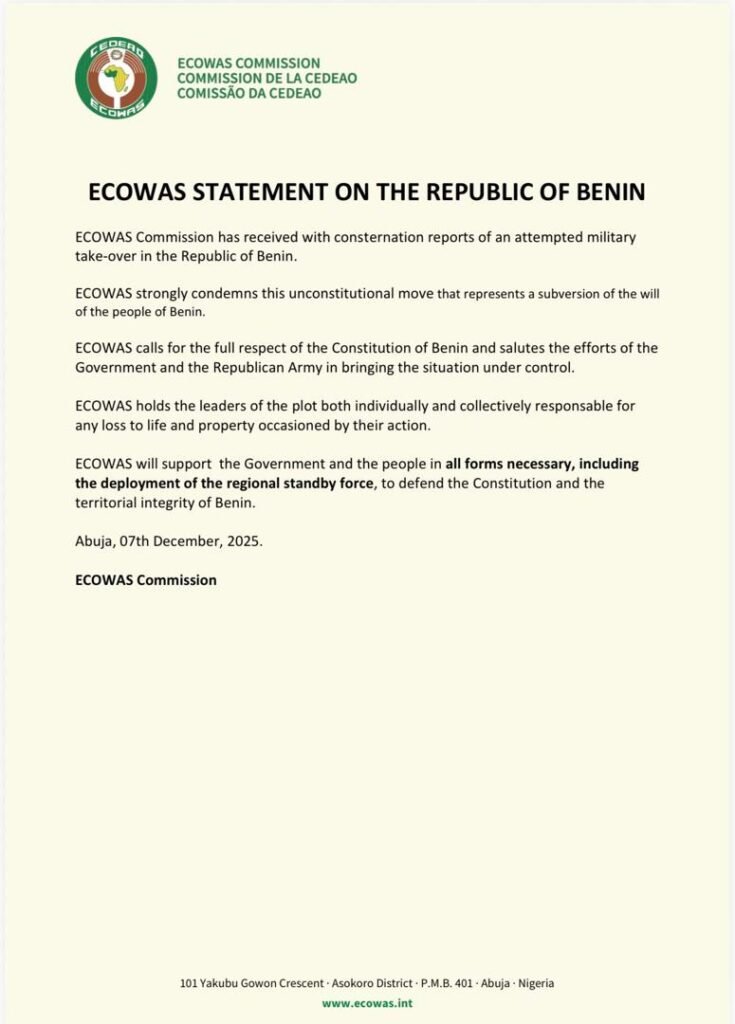
The bloc further warned that the leaders of the plot would be held both individually and collectively responsible for any loss of life or destruction of property resulting from their actions.


Foreign Minister Olushegun Adjadi Bakari said on Sunday that the coup plotters had taken control of state TV only and that the signal had been cut for several minutes.
A group of at least eight soldiers led by Lieutenant Colonel Pascal Tigri had appeared on screen to claim the overthrow of President Patrice Talon, who has been in power since 2016, as well as all state institutions.
They also claimed that the country’s borders had been closed and that all political parties had been suspended. The troops referred to themselves as part of the “Military Committee for Refoundation” (CMR).
A statement read by one of the soldiers said, “The army solemnly commits to give the Beninese people the hope of a truly new era, where fraternity, justice and work prevail.”
The coup attempt has come as Benin is preparing for a presidential election in April that would mark the end of the tenure of Talon, who has been in power since 2016.
Last month, Benin adopted a new constitution that extended the presidential mandate from five to seven years, in what critics said was a power grab by the ruling coalition, which nominated Finance Minister Romuald Wadagni to be its candidate.
The opposition Democrats party, founded by Talon’s predecessor, Thomas Boni Yayi, saw its proposed candidate rejected because of what a court ruled was insufficient backing from lawmakers.
Talon has been credited with reviving economic growth, but the country has also seen an increasing number of attacks by fighters that have wreaked havoc in Mali and Burkina Faso.
Following the takeover attempt, the President’s office stated that Talon was safe.
Coup Attempt Foiled
Benin’s government said that loyalist soldiers and national guard had regained control after a group of soldiers announced on state television that they had seized power in an apparent coup attempt.
Interior Minister Alassane Seidou said in a video shared online that the country’s armed forces had foiled the coup bid.
He noted that in the early morning of Sunday, December 7, 2025, “a small group of soldiers launched a mutiny with the aim of destabilising the state and its institutions.”
“Faced with this situation, the Beninese armed forces and their hierarchy, faithful to their oath, remained committed to the republic. Their response allowed them to maintain control of the situation and thwart the attempt. Therefore, the government urges the population to go about their business as usual.”
Alassane Seidou
The latest event adds to the number of coups that have taken place across the continent in recent years, especially in West Africa.
Just last month, army officials in Guinea-Bissau seized power in a military coup with General Horta Inta-A named as the head of a one-year transitional government. The country has experienced nine coup attempts since its independence from Portugal in 1974.
In 2023, military leader Brice Oligui Nguema toppled Gabon’s then-President Ali Bongo Ondimba, a leader whose family had held power in the country for almost 56 years.
That same year, a coup removed Niger’s Mohamed Bazoum, a democratically elected leader who ruled for just two years before he was forced out of office. A military government was then installed, led by President Abdourahamane Tchiani.
In 2022, Burkina Faso’s military leader, President Paul-Henri Damiba, was deposed in the country’s second coup in a year, as army Captain Ibrahim Traore took charge.In Mali, General Assimi Goita led soldiers to seize power in a 2020 coup.
READ ALSO: Mahama Attends Doha Forum 2025 as Ghana–Qatar Relations Deepen