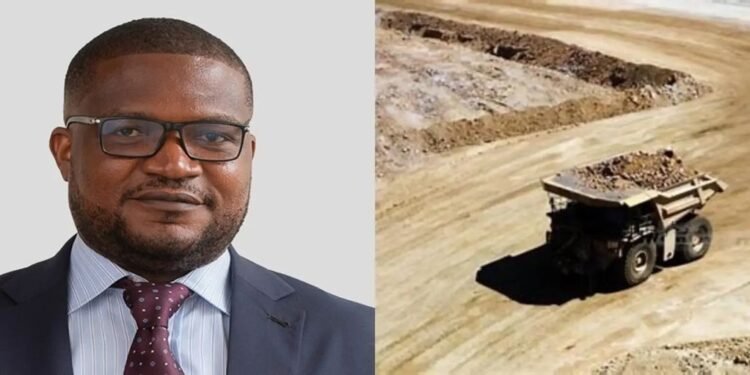
The Africa Centre for Energy Policy (ACEP) has raised fresh concerns about Ghana’s approach to lithium fiscal policy following Parliament’s withdrawal of the Ghana–Barari DV Lithium Agreement, warning that attempts to significantly alter agreed royalty terms after exploration success could undermine investor confidence and weaken the country’s position in the global critical minerals market.
In a policy note, ACEP Executive Director Benjamin Boakye explains that while the withdrawal reflects growing public engagement in extractive sector governance, it also exposed weaknesses in policy communication and fiscal signalling that have real economic consequences.
The immediate fallout, ACEP notes, was “a sharp decline of about 30 percent in Atlantic Lithium’s share price, despite Ghana’s own equity exposure through the Minerals Income Investment Fund (MIIF) .”
At the centre of the withdrawn agreement is the issue of royalties. ACEP stresses that the core policy question is not whether Ghana should benefit from its lithium resources, but how value can be captured “in a manner that is legally sound, globally competitive, and resilient across commodity price cycles.”
“Under the original agreement signed in 2023, the royalty rate was negotiated at 10% of gross production value. In the agreement later laid before Parliament, this rate was revised downward to 5%, triggering public criticism and policy debate.”
CEP Executive Director Benjamin Boakye
Mining and Petroleum: Different Processes, Same Fiscal Logic
In his analysis, Mr. Boakye draws parallels between Ghana’s mining and petroleum regimes, stressing that while administrative processes differ, fiscal intent should remain consistent.
In the petroleum sector, exploration and production rights are governed by a single agreement from the outset, with fiscal terms locked in despite later acreage relinquishments after commercial discovery.


In mining, by contrast, companies first obtain exploration licences and later apply for mining leases once deposits are proven. However, Mr. Boakye insists this administrative sequencing should not be interpreted as an opportunity to renegotiate fiscal terms.
“The separation of licences reflects spatial and technical considerations, not a reopening of fiscal intent.”
CEP Executive Director Benjamin Boakye
He noted that investors assess geological risk and project viability based on the statutory fiscal regime at the time exploration rights are granted. Altering those expectations after discovery, he warned, undermines regulatory predictability.
Mr. Boakye’s interpretation is reinforced by Ghana’s legal framework. The Minerals and Mining (Amendment) Act, 2015 (Act 900) empowered the Minister to prescribe royalty rates by regulation, but it preserved the existing 5 percent rate until new rates were formally set. As such, when Atlantic Lithium’s exploration licence was granted in 2016, the applicable royalty rate was 5 percent.
“Treating the mining lease stage as a discretionary trigger for materially higher fiscal terms blurs the line between administrative process and fiscal policy.”
CEP Executive Director Benjamin Boakye
Investment Risk and Policy Signalling
Attempts to impose significantly higher fiscal terms after exploration success carry broader implications beyond a single project. Mr. Boakye warned that such moves signal fiscal instability, particularly in emerging sectors like lithium, where Ghana is still building credibility.
While Atlantic Lithium reportedly expressed willingness to accept higher royalties during the lithium price boom of 2022–2023, Boakye cautioned against using short-term price spikes to set long-term policy.
“Fiscal frameworks must be designed for durability, not price peaks,” he said, pointing to Ghana’s petroleum sector experience, where aggressive post-discovery fiscal ambitions ultimately deterred serious operators.
Globally, hard-rock lithium royalties tend to cluster within a narrow range, with rates above 5 percent of gross production value considered atypical.
Mr. Boakye noted that a 10 percent royalty pushes all-in sustaining costs above $600 per tonne, among the highest in the industry, compared with under $400 in countries like Mali.
Moreover, Ghana’s Ewoyaa project represents only about 0.5 percent of global lithium reserves. “Ghana does not yet possess the reserve concentration or market power to dictate fiscals far above global norms,” Mr. Boakye said.
Case for Sustainable Fiscal Design
Beyond royalties, Boakye stressed that government revenue from mining includes corporate income tax, community development levies, indirect taxes, employment effects and dividends from state participation. These components must be assessed holistically rather than focusing narrowly on royalty rates.
He also highlighted the cyclical nature of lithium markets, warning that high fixed royalties are regressive during downturns and threaten mine viability.
“Royalties are the most sensitive fiscal instrument. If a mine fails, all other benefits disappear,” he noted, pointing to global shifts toward progressive, price-linked fiscal mechanisms.
While the withdrawal of the agreement reflects healthy democratic debate, Boakye argues it should prompt a broader policy reset rather than project-specific reactions. Clear, credible and upfront fiscal expectations are essential, he said, so investors can assess risk with certainty before committing capital.
As Ghana refines its lithium strategy, the challenge will be balancing value capture with competitiveness and long-term sustainability.
The lessons from the Barari DV agreement, Mr. Boakye suggests, could help shape a more coherent framework that supports investment while safeguarding national interests in the green minerals era.
READ ALSO: Developing Countries Restructure $90bn in Debt — But Rising Costs Spell Trouble for Ghana