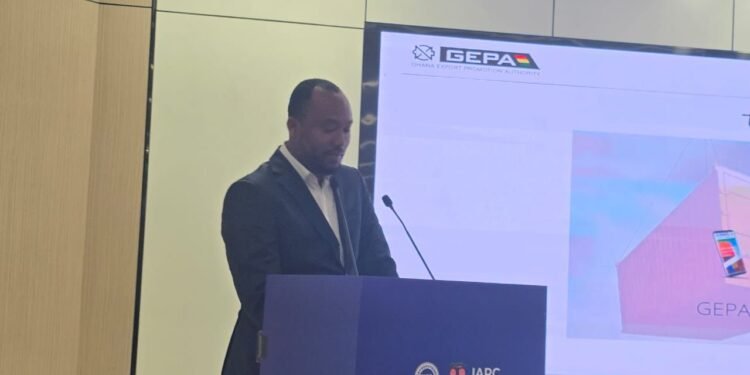
Policy analyst and natural resource governance advocate, Dr. Steve Asare Manteaw, has called on the government to consider passing a dedicated minerals revenue management framework.
This proposed legislation is designed to strategically direct a portion of the significant financial gains derived from gold, a primary commodity for the nation to bolster local industrial output, thereby enhancing the country’s productive capacity.
Crucially, the framework would also serve as a vital mechanism for the Bank of Ghana (BoG) to execute effective interventions in the foreign exchange market, a measure intended to stabilise the local currency and ensure the continuity of the current forex market equilibrium.
“I strongly urge government to consider passing a mineral revenue management framework to direct some of the windfall from gold to support domestic production and to smoothen out BoG’s intervention in the forex market.”
Dr. Steve Asare Manteaw
The ultimate goal, as Dr. Manteaw posits, is to infuse a much-needed layer of financial prudence and economic rationality into the management of the nation’s precious mineral endowments, safeguarding them particularly through the turbulent periods of global commodity price fluctuations, often referred to as “boom and bust cycles.”
The call for this new fiscal legislation stems from the recognition that Ghana has successfully implemented a comparable legal structure, the Petroleum Revenue Management Act (PRMA), for its oil and gas sector.
Case for Parity: Gold and Oil Revenue Governance

Ghana, as one of Africa’s largest gold producers, continues to rely heavily on the mineral sector as a major source of foreign exchange and government revenue.


However, unlike the oil and gas sector, which is governed by the robust PRMA, the gold sector’s revenues are largely channeled directly into the Consolidated Fund under the existing framework of the Minerals and Mining Act, 2006 (Act 703).
“This will help sustain the forex stability we currently enjoy. Better still, we may want to harmonize the proposed mineral revenue management framework with the Petroleum Revenue Management Act to create a common natural resource revenue management framework.”
Dr. Steve Asare Manteaw
This disparity according to Dr. Manteaw, creates significant loopholes in revenue governance.
A lack of specific ring-fencing mechanisms like the Stabilization and Heritage Funds proposed by Dr. Manteaw means that gold windfalls are frequently treated as general budgetary revenue, leading to pro-cyclical spending and making the national budget highly vulnerable to unpredictable global gold price movements.
This operational mechanism prevents the accumulation of substantial long-term savings for future generations or the creation of adequate fiscal buffers for economic downturns, a principle known as “inter-generational equity.”
One critical “extractive loophole” often highlighted by policy experts is the opaque nature of royalty disbursements.
While Act 703 provides for a share of royalties to be returned to the Minerals Development Fund (MDF) and the Office of the Administrator of Stool Lands (OASL) for onward distribution to local authorities, the absence of clear guidelines on the utilisation of these funds at the district level means they are often misappropriated or used for recurrent expenditures rather than transformative capital projects, failing to deliver tangible development benefits to mining communities.
Furthermore, the lack of a PIAC-type oversight body for minerals, as advocated for by Dr. Manteaw, severely limits citizens’ ability to track mineral revenue flows and hold officials accountable, diminishing public trust and exacerbating local grievances, a situation often remedied by the transparent reconciliation report to Parliament as the ultimate “citizen oversight tool.”
Addressing Loopholes: The Impact of a New Framework

The proposed Minerals Revenue Management Framework is designed to systematically seal these governance gaps, providing a transparent and efficient roadmap for resource wealth utilization.
By institutionalising a Stabilization Fund, the framework would ensure that excess revenue generated during periods of high gold prices is saved, creating a fiscal cushion to maintain public spending capacity when prices inevitably fall, thereby counter-grafting the “volatility effect of these commodities on government budget.”
The parallel establishment of a Heritage Fund would strategically set aside a portion of the non-renewable wealth, investing it for the exclusive benefit of future citizens, thus addressing the ethical imperative of inter-generational resource equity.
The institutional requirement for citizens’ oversight, through a PIAC-like arrangement, will significantly boost transparency in the sector.
This body would have the legal mandate to scrutinise revenue collection, allocation, and expenditure, ensuring that mineral resources truly serve the public interest and that mining communities receive their fair and productive share. In addition, the framework’s rule-based approach to expenditure and clear investment guidance including earmarking a portion of the windfall to “support domestic production” will foster diversification away from an over-reliance on mineral exports.
Specifically, channeling revenue towards domestic manufacturing and value-addition initiatives in the non-mineral economy is projected to enhance economic complexity and create sustainable, non-extractive employment opportunities.
This strategic redirection would not only strengthen the national currency, as Dr. Manteaw observed, by creating a more stable supply of foreign currency through BoG interventions backed by gold windfalls but would also structurally transform the mineral sector into a genuine catalyst for broader national development, moving beyond the current pitfalls of resource dependency.
The passage of this law would send a powerful signal to both local and international partners that the government is committed to a “rational” and sustainable management of its natural capital.
READ ALSO: Cedi Under Pressure in Short Term, Yet Fitch Sees Controlled 8% Fall in 2026