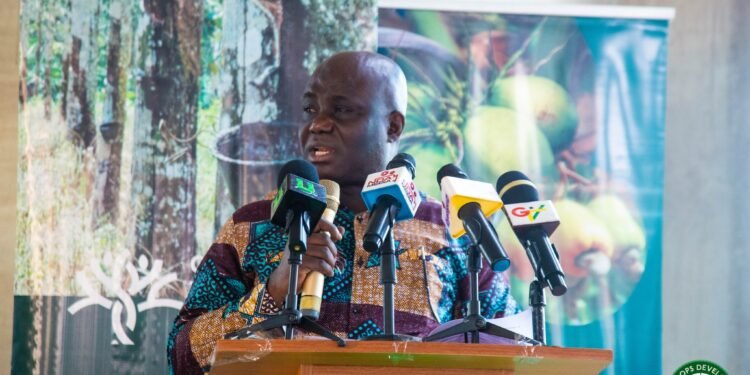

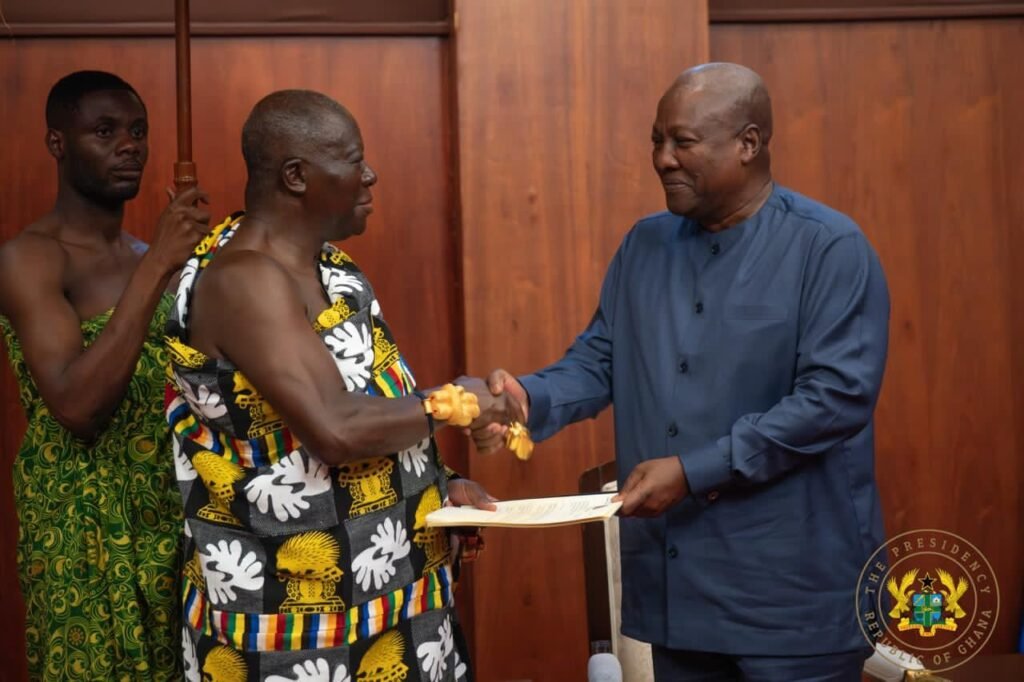
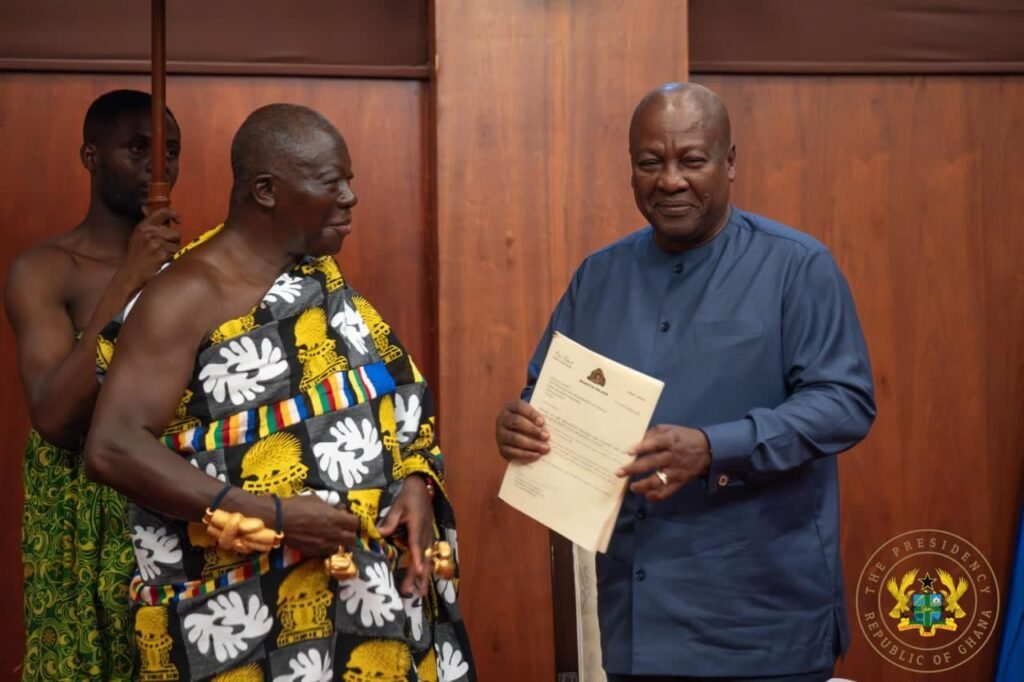
Asantehene Otumfuo Osei Tutu II has formally presented his final mediation report on the protracted Bawku chieftaincy conflict to President John Dramani Mahama, affirming Zugraan Asigri Abugrago Azoka II as the lawful Bawku Naaba and head of the Kusasi Traditional Area.
The report was submitted at the Jubilee House on Tuesday, December 16, 2025, marking a major milestone in efforts to bring lasting peace to one of Ghana’s most volatile conflict zones.
Presenting the report, Otumfuo Osei Tutu II underscored the willingness of the two principal parties—the Kusasi and Mamprusi—to submit themselves to mediation and to work toward an amicable resolution.
He noted that the Bawku Naaba, Zugraan Asigri Abugrago Azoka II, had shown “enormous respect” for the process by personally leading his delegation to the Manhyia Palace whenever invited.
On the other side, the Nayiri, overlord of Mamprugu, consistently delegated elders and sub-chiefs to represent him, expressing confidence in the mediation process and a shared belief that a peaceful outcome was achievable.
Otumfuo recounted that his engagement with the Nayiri began with an appeal for him to magnanimously recognise the position of Ghanaian law that the Kusasi should rule themselves. According to the Asantehene, the Nayiri responded by making concessions, though with conditions rooted in historical claims.


Central among these was the Mamprusi assertion of ancestral ownership over the land constituting the Bawku traditional area, alongside acknowledgment that the Kusasi have long occupied and governed much of that territory.

The Nayiri, Otumfuo explained, described both Kusasis and Mamprusis as his “children” and lamented the bloodshed that had arisen between them, describing it as tragic and unacceptable.
The Asantehene said the Nayiri regarded the conflict, exacerbated by colonial and post-colonial interventions, as having grown into a national and international security concern.
Nayiri’s Concessions
In the interest of peace, coexistence and human dignity, the Nayiri proposed concessions, including ceding aspects of jurisdiction in the Bawku area to the Kusasi, not out of weakness but as a reflection of Mamprugu’s dignity and commitment to peace. Otumfuo described this position as a difficult but principled decision guided by ancestral wisdom and a desire to restore harmony.
Against this backdrop, Otumfuo detailed how he impressed upon the Bawku Naaba the importance of acknowledging that, historically, Mamprugu exercised authority over the area now known as the Bawku traditional area.
He noted that records indicate periods when the Nayiri enskinned the Bawku Naaba, who in turn installed sub-chiefs across the area. This arrangement, he said, was challenged after independence and culminated in legal interventions, including the enactment of PNDC Law 75 in 1983.
The Asantehene emphasised, however, that Ghana’s current constitutional and legal framework leaves no ambiguity regarding the status of the Bawku chieftaincy.
He pointed to PNDC Law 75, the 1992 Constitution, and the Supreme Court ruling in Alhaji Ibrahim Adam Zambego v. Anin Chemah, Aburago and the Attorney-General as decisively affirming Zugraan Asigri Abugrago Azoka II as the lawful Bawku Naaba.
While PNDC Law 75 was later repealed by the Statute Law Revision Act, 1996 (Act 516), Otumfuo stressed that the repeal did not create a legal vacuum, as the law had already served its purpose and the constitutional order had since entrenched the position.
He told the President that, in spite of the clarity of the law, he continued to engage the Nayiri on the proposed concessions, including requests for certain towns in the Kusasi area to be placed under Mamprusi jurisdiction.
After consulting chiefs and communities affected by past withdrawals of recognition, Otumfuo said he found evidence of significant reconciliation between Kusasis and Mamprusis in many towns.
However, he made it clear that Bawku town itself could not be ceded or subjected to any competing claim, as the law firmly recognises Zugraan Asigri Abugrago Azoka II as the sole lawful chief of Bawku.
Dismissal of Rival Bawku Naaba
Otumfuo also addressed the issue of Mr. Seidu Abagre, who has been presented by the Mamprusi side as a rival Bawku Naaba. He stated unequivocally that such an enskinment “cannot stand” under the law. In the interest of peace and respect for the Nayiri, Otumfuo said he had restrained successive governments from effecting Mr. Abagre’s arrest.
However, he concluded that lasting peace would require Mr. Abagre to be recalled to Nalerigu for reassignment to another traditional role or to remain in Bawku strictly as an ordinary citizen, not as a claimant to the Bawku skin.
In his final recommendations, Otumfuo urged the Nayiri to accept the laws as they stand and formally recognise Zugraan Asigri Abugrago Azoka II as Bawku Naaba and paramount chief of the Kusasi Traditional Area.
“We chiefs, no matter how exalted, do not live above the Constitution of Ghana,” he stressed, adding that the government must enforce the law impartially against anyone who challenges the lawful authority of the Bawku Naaba. Such enforcement, he said, is critical to restoring and maintaining peace in Bawku and its environs.
The Asantehene also proposed a broader reconciliation process, involving the National Peace Council and legal representatives from both sides, alongside initiatives to encourage the safe surrender of arms within the community.
He suggested confidence-building measures to support disarmament and healing, stressing that sustainable peace would require not only legal clarity but deliberate reconciliation.
Otumfuo thanked President Mahama and his predecessor for entrusting him with the mediation, and commended the Nayiri, the Bawku Naaba and other traditional leaders for their cooperation.
He concluded that the surest path to lasting peace lies in strict adherence to Ghana’s constitutional order and respect for the Supreme Court’s finality on the matter.
READ ALSO: Global Oil Prices Hit Below $60