President John Dramani Mahama has reaffirmed his government’s commitment to restoring lasting peace in Bawku, describing the completion of the Asantehene-led mediation process as a critical turning point in resolving one of Ghana’s most protracted communal conflicts.
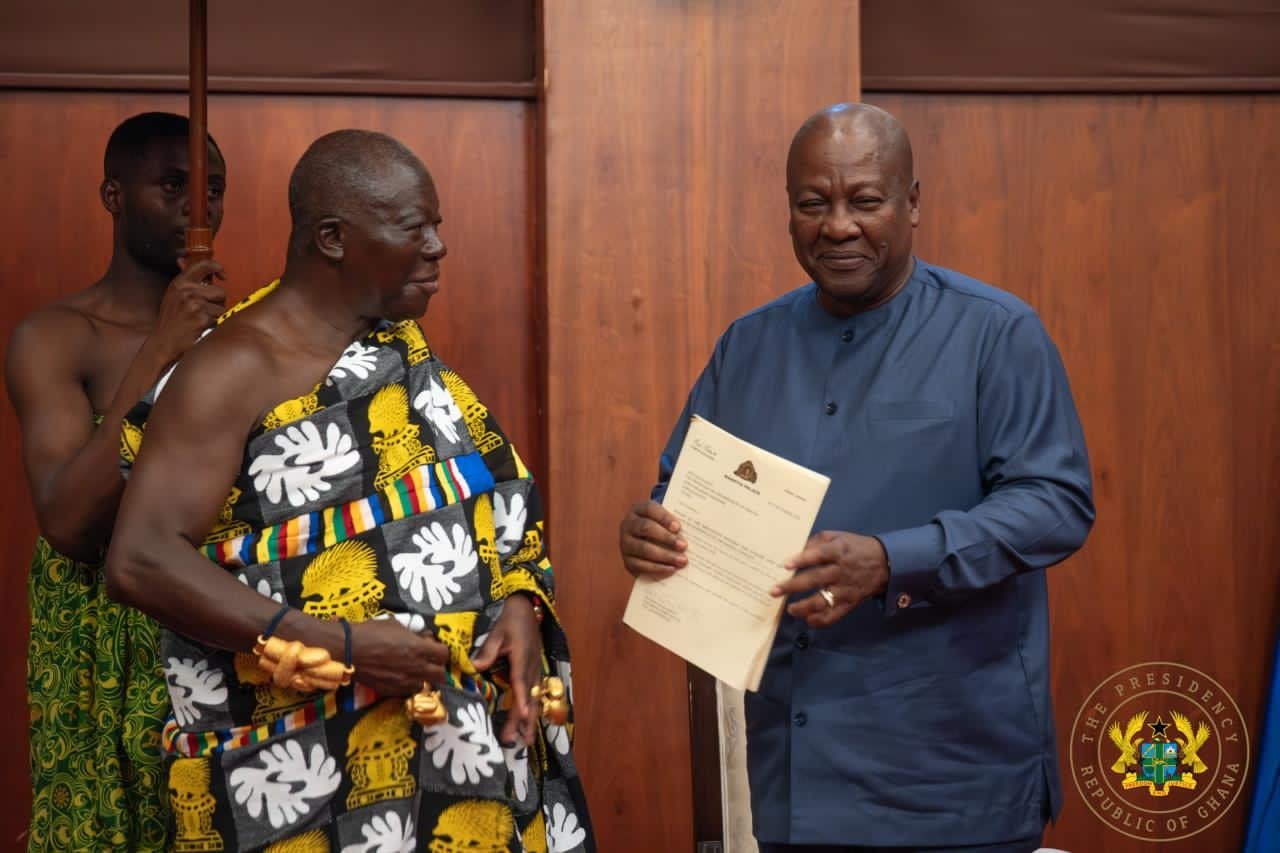
Speaking at the Jubilee House after receiving the final mediation report from Otumfuo Osei Tutu II, the President expressed deep gratitude to the Asantehene for what he described as months of patient, diligent and selfless work.
President Mahama recalled that the mediation process predated his assumption of office, noting that his predecessor, Nana Addo Dankwa Akufo-Addo, had informed him during a security briefing that Otumfuo had been invited to serve as the sole mediator in the Bawku conflict.
Shortly after taking office, President Mahama said he personally visited the Asantehene to confirm both the status of the mediation and Otumfuo’s willingness to continue with the task. According to him, the Asantehene confirmed his acceptance and remained fully committed despite the complexity and sensitivity of the case.
“So even though the mediation has been long, I can understand the complexity of the Bawku case, and so it needed time and patience to be able to thoroughly engage all the parties and be able to flesh out the facts and finally come out with a recommendation.”
President John Dramani Mahama
He described the presentation of the report as the end of one phase and the beginning of another, emphasising that mediation, unlike arbitration, does not seek to declare winners or losers.

“This was not an arbitration: an arbitration normally will make an award on who is right and who is wrong. This was a mediation, and the next leg of the journey is to reconcile our two brothers and sisters from the Kusasi and the Mamprusi side.”
President John Dramani Mahama
He cautioned that the conflict was unwinnable by military means, insisting that no side could vanquish the other through force. The President situated the urgency of peace in Bawku within a broader national and regional security context.


He noted that Bawku’s location at Ghana’s extreme northeastern corner made stability there a matter of national security, especially given the growing threat of terrorist groups operating in neighbouring Burkina Faso. He said intelligence and national security reports consistently highlight the need to resolve the conflict in order to safeguard Ghana’s northern borders.
Severe Socio-Economic Toll
Beyond security concerns, President Mahama lamented the severe socio-economic toll the conflict has taken on Bawku. He described the town as having the potential to be one of Ghana’s most vibrant commercial centres, recalling its long history as a hub of trade where both Kusasis and Mamprusis had prospered.
That potential, he said, has been steadily eroded by years of violence and instability. “Unfortunately, this conflict has blighted the fortunes of Bawku,” the President noted. He disclosed that teachers and doctors have increasingly refused postings to the area, while civil servants already stationed there are leaving due to safety concerns.
He added that national service postings to Bawku have been suspended because the state cannot currently guarantee the safety of young graduates. According to him, these developments have deprived the town of essential services and undermined its development prospects.
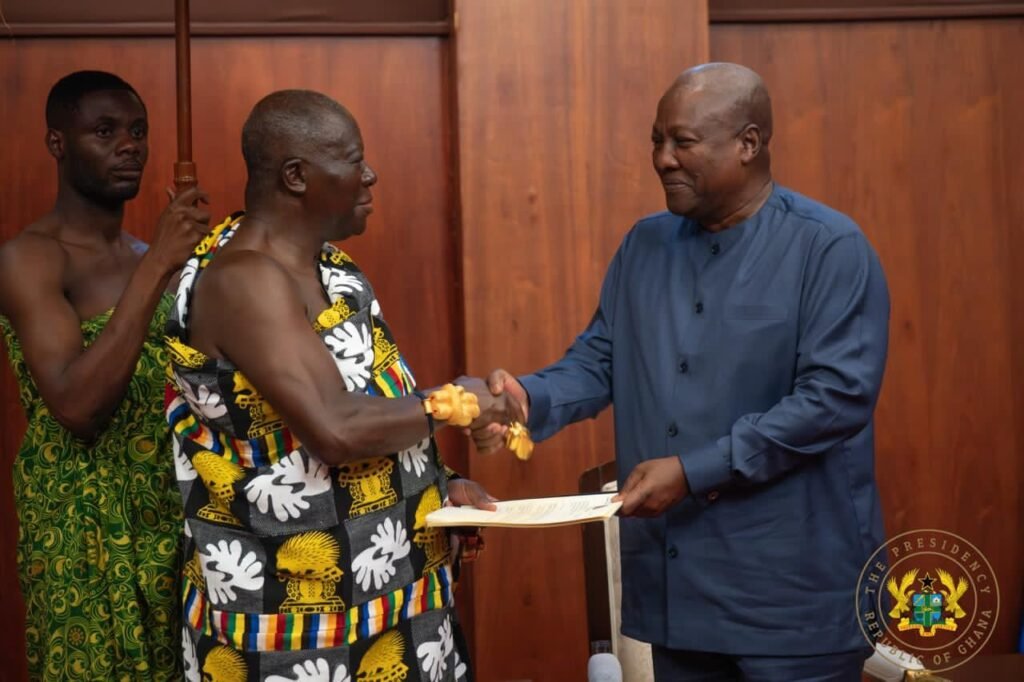
President Mahama welcomed the conclusion of the mediation process as an opportunity to chart a new path toward calm and stability. He assured Otumfuo and the nation that government would study the report promptly and announce its definitive position within 24 hours. While underscoring government’s responsibility to act, he stressed that peace-building must extend beyond official decisions.
He expressed hope that the National Peace Council, the National House of Chiefs, religious bodies and the Asantehene himself would continue to engage the Nayiri and the Bawku Naaba to foster genuine reconciliation between the two sides. According to him, only sustained dialogue and reconciliation can heal wounds and rebuild trust between the Kusasi and Mamprusi communities.
On behalf of Vice President Professor Jane Naana Opoku-Agyemang, government officials and the people of Ghana, President Mahama formally thanked the Asantehene for what he described as an “honourable job” carried out in service to both country and humanity.
He praised Otumfuo’s decision to read the report publicly, describing it as an act of transparency that allowed the entire nation to follow the process and understand its conclusions.
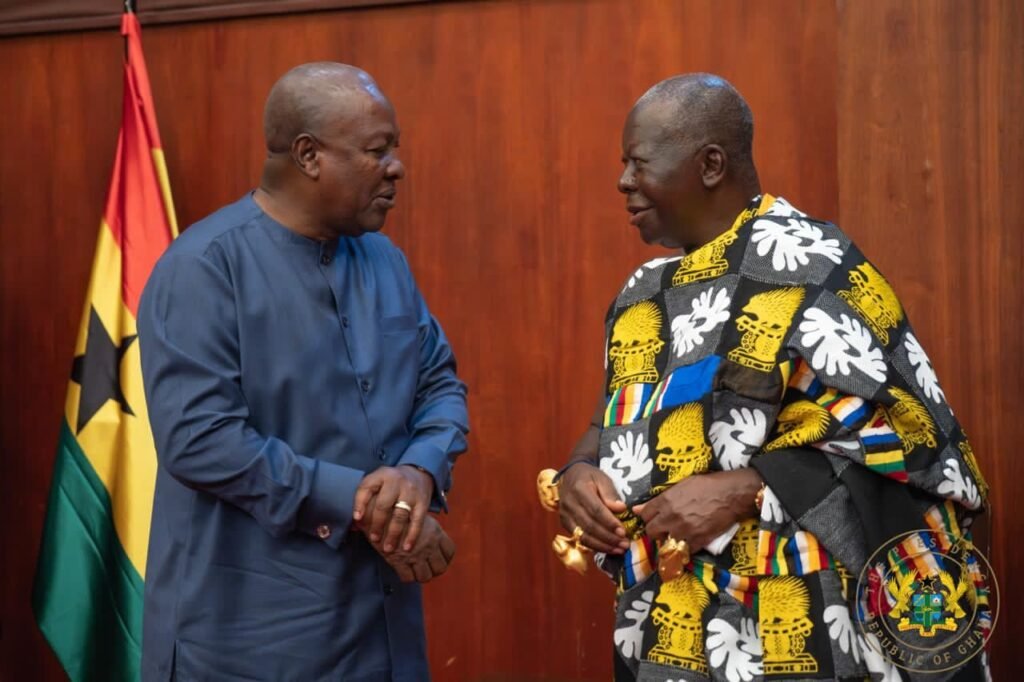
“He has shown that he does not belong to Ashanti alone,” the President said, calling the Asantehene a national asset whose role transcends regional and ethnic boundaries. President Mahama expressed confidence that the clarity and openness surrounding the mediation report would enable the government and other stakeholders to act decisively.
Concluding his remarks, the President voiced optimism that Ghana now stands at a critical juncture where enduring peace in Bawku is achievable. He appealed for collective commitment to the reconciliation process, expressing faith that, with goodwill and firm action, the long-standing conflict can finally give way to stability, development and shared prosperity for the people of Bawku and the nation at large.
READ ALSO: Ghana, Denmark Deepen Energy Cooperation to Advance Green Transition